
Fast SAM 3D Body: Achieving Real-Time 3D Human Mesh Recovery for Humanoid Control
Fast SAM 3D Body: Accelerating SAM 3D Body for Real-Time Full-Body Human Mesh Recovery
Fast SAM 3D Body is a training-free acceleration framework for monocular 3D human mesh recovery that optimizes the SAM 3D Body (3DB) pipeline. It achieves up to a 10.9× end-to-end speedup, enabling real-time performance (~65ms per frame) on an NVIDIA RTX 5090 while maintaining state-of-the-art reconstruction accuracy.
TL;DR
Fast SAM 3D Body is a high-performance acceleration framework that transforms the sluggish SAM 3D Body (3DB) pipeline into a real-time system. By decoupling spatial dependencies and replacing iterative optimization with neural projection, it achieves a 10.9× speedup without retraining the backbone, enabling a humanoid robot to be teleoperated from a single RGB stream at ~15 FPS.
Background & Motivation: The Latency Wall
Monocular 3D Human Mesh Recovery (HMR) has seen a paradigm shift toward high-fidelity, expressive models like SAM 3D Body (3DB). However, 3DB's accuracy comes at a steep price: an inference latency of several seconds. This "compound latency" arises from:
- Serial Dependencies: Hand crops cannot be processed until the body decoder finishes.
- Iterative Refinement: The transformer runs multiple "self-prompting" passes.
- Kinematic Bottlenecks: Converting the output MHR mesh to the standard SMPL format requires hundreds of iterative optimization steps.
Fast SAM 3D Body breaks these barriers by treating the inference pipeline as a holistic system to be optimized, rather than just a collection of neural layers.
Methodology: The Three Pillars of Speed
1. Spatial Dependency Decoupling
In the original 3DB, the system waits for the body decoder to find the wrists before it can crop and process the hands. The authors introduce a lightweight 2D pose prior (YOLO-Pose) to predict coarse keypoints first. This allows the system to analytically derive bounding boxes for the body and both hands simultaneously, unlocking parallelized multi-crop feature extraction in a single batched forward pass.
2. Compute-Aware Decoding & Static Graphs
The authors observed that early transformer layers capture sufficient semantic correlation, making full kinematic projections in intermediate layers redundant. By pruning these layers and disabling the iterative self-prompting refinement, they created a deterministic execution graph. This allowed for hardware-level optimization via TensorRT and CUDA Graphs, eliminating kernel launch overheads.
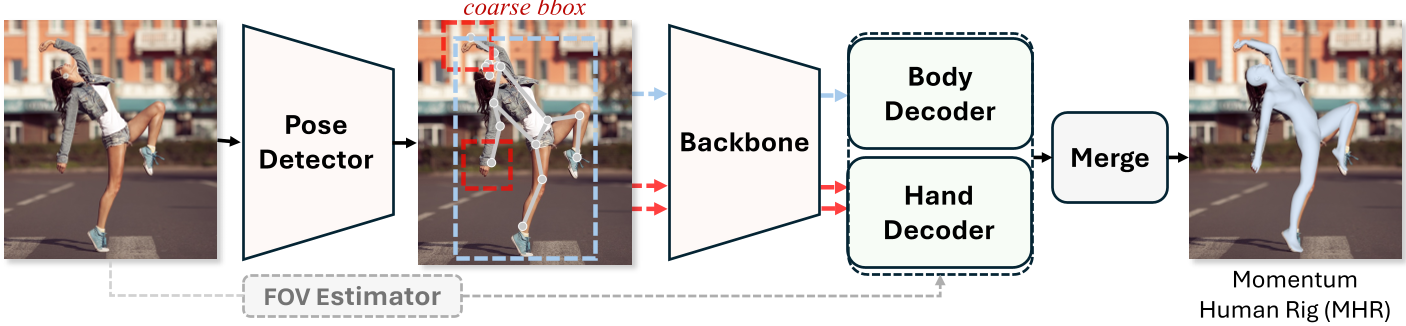 Fig 2: The streamlined Fast SAM 3D Body pipeline vs. the original architectural bottlenecks.
3. Neural Kinematic Projection (10,000× Acceleration)
To make the output compatible with robotic control, MHR meshes must be converted to SMPL joints. Usually, this is an optimization problem: . Fast SAM 3D Body replaces this with a three-layer MLP (). This feedforward mapping achieves near-identical joint accuracy while being four orders of magnitude faster, effectively removing the final bottleneck of the pipeline.
Experimental Results: SOTA Fidelity at Interactive Rates
The framework was evaluated across multiple benchmarks (3DPW, EMDB, RICH).
- Throughput: In automatic settings, the system jumped from ~0.8 FPS to ~8.3 FPS on standard hardware, with peak performance reaching 65ms/frame on an RTX 5090.
- Accuracy: On the LSPET benchmark, the "Fast" variant actually surpassed the original 3DB in 2D alignment (PCK), likely due to the simplified decoder providing a more robust regularizing effect on out-of-distribution data.
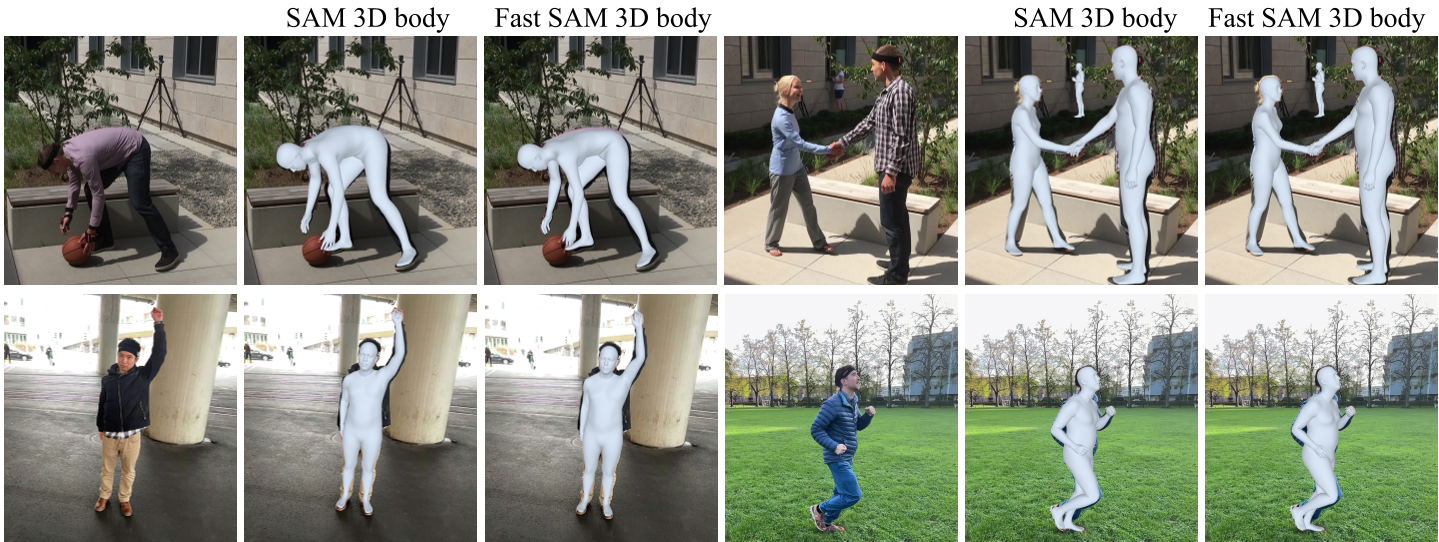 Table 1: Quantitative comparison showing significant speedups with minimal accuracy degradation.
Real-World Impact: Humanoid Teleoperation
The real-world utility of this speed is demonstrated through vision-only teleoperation. By instantly translating human motion into SMPL kinematics, the authors drove a Unitree G1 humanoid to perform complex tasks like bimanual grasping and lateral stepping. The system provided high-quality data for training imitation learning policies, achieving an 80% success rate.
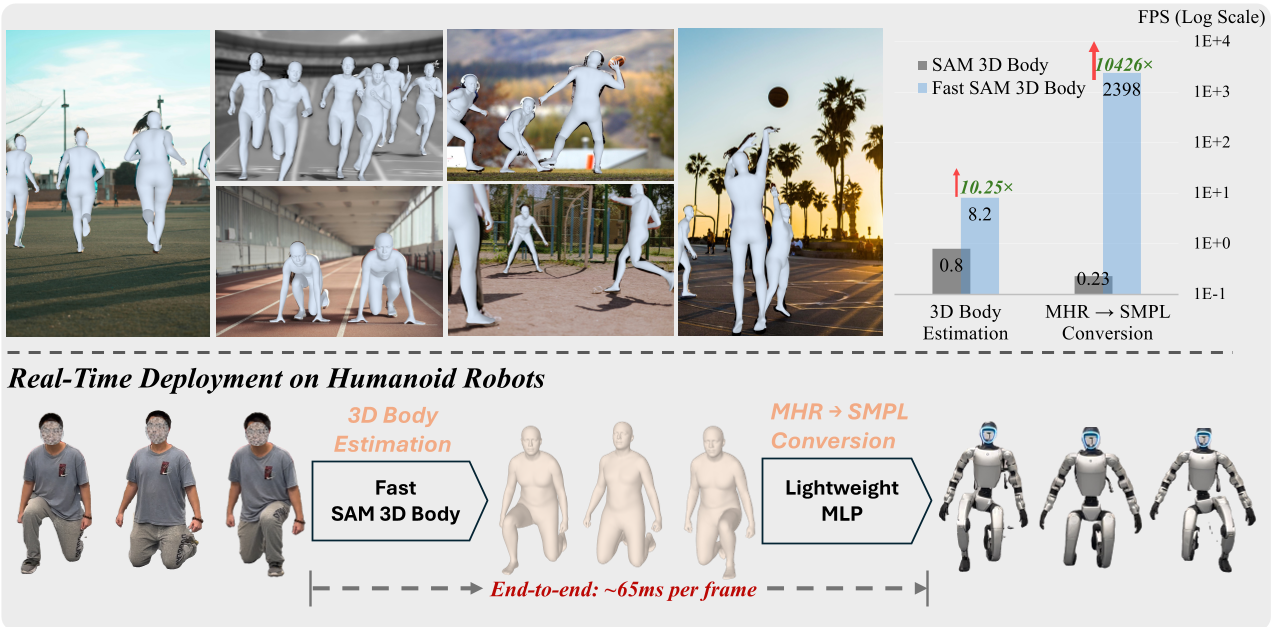 Fig 1: Real-time humanoid control enabled by the 65ms end-to-end latency.
Conclusion & Insights
Fast SAM 3D Body proves that for complex AI pipelines, system-level algorithmic reformulation is as valuable as architectural innovation. By removing serial bottlenecks and replacing iterative math with learned approximations, the authors have bridged the gap between high-fidelity academic models and practical, real-world robotic applications.
Limitations: While the system is robust, self-occlusion in single-view setups can still cause jitter, which the authors partially addressed using an optional multi-view fusion extension.