
The Fate of Nucleated Black Holes: Resolving the de Sitter Nariai Paradox
The Fate of Nucleated Black Holes in de Sitter Quantum Gravity
This paper investigates the stability and fate of Nariai black holes—maximal-mass black holes in de Sitter space—within the framework of quantum gravity. By employing the gravitational path integral and an observer-inclusive model, the authors derive a formal nucleation rate and demonstrate that these black holes undergo standard thermal Hawking evaporation rather than "anti-evaporation."
TL;DR
In a tour de force of semi-classical quantum gravity, Shi, Turiaci, and Wu revisit the Nariai geometry—the largest possible black hole that can exist in a de Sitter (dS) universe. They successfully prove that these black holes aren't just mathematical curiosities; they represent physical processes (nucleation) that eventually "reset" via standard Hawking evaporation. Crucially, they debunk the "anti-evaporation" theory, showing it stems from unphysical, singular quantum states.
Academic Position: This work bridges the gap between Euclidean instanton methods and Lorentzian evolution, reinforcing the thermodynamic view of the de Sitter static patch as a finite-dimensional Hilbert space.
1. The Mystery of the Nariai Instanton
In a de Sitter universe, there is a "speed limit" for black hole mass. If you add too much mass, the black hole horizon expands until it meets the cosmological horizon. This balanced state is the Nariai limit.
For decades, the Euclidean version of this geometry () was thought to describe the "nucleation" or spontaneous birth of these black holes. However, two major problems persisted:
- The Phase Problem: A nucleation rate needs an imaginary component in the path integral. Pure gravity calculations for Nariai were stubbornly real.
- The Evaporation Paradox: Some models suggested Nariai black holes might "anti-evaporate" (grow larger), which would make the empty de Sitter vacuum unstable—a nightmare for dS holography.
2. Methodology: Why the "Observer" Changes Everything
The authors resolve the phase problem by introducing a massive observer. In quantum gravity, the path integral on a sphere isn't a simple state-count unless you define who is counting.
By adding an observer trajectory, the gravitational path integral acquires the necessary negative modes to turn the partition function imaginary. This allows for a concrete calculation of the nucleation rate:
The 2D effective theory
To study the evolution, the authors reduce 4D Einstein gravity to a 2D Jackiw-Teitelboim (JT) gravity model with linear and quadratic dilaton terms.
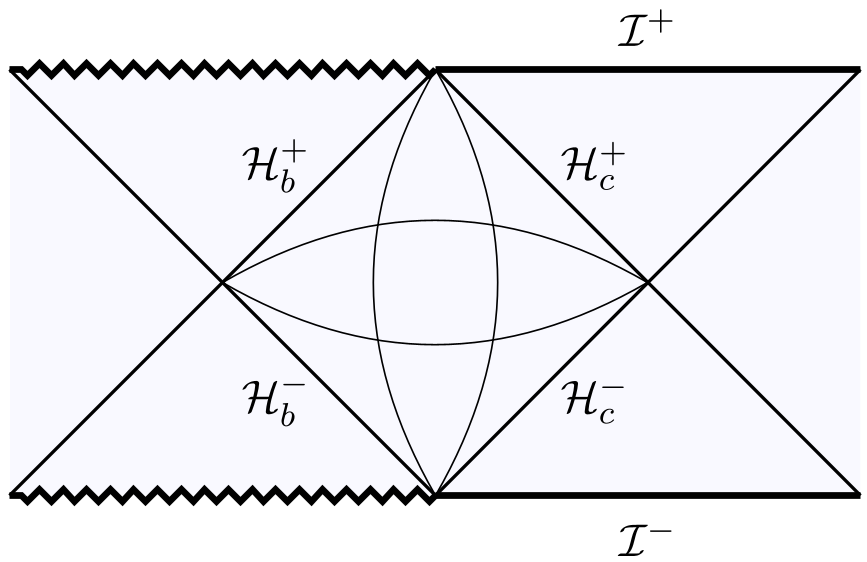 Figure: The Penrose diagram of the Schwarzschild-de Sitter static patch, illustrating the coordinates used to bridge the Euclidean and Lorentzian regimes.
3. Debunking Anti-Evaporation
The most significant contribution of this paper is the rigorous analysis of black hole evolution post-nucleation.
Singular vs. Smooth States
Previous claims of "anti-evaporation" (where the black hole grows and the cosmological horizon shrinks) were based on specific solutions of the stress-energy tensor. This paper demonstrates that those solutions correspond to singular states—quantum states that break at the horizon (non-Hadamard).
The Hawking Winner
By enforcing the Hadamard condition (requiring the quantum state to be smooth across the horizon), the authors find only one physical outcome: Standard Thermal Evaporation.
- The black hole emits more Hawking radiation than it absorbs.
- The area of the black hole horizon decreases.
- The universe relaxes back to empty de Sitter space.
4. Experimental & Quantified Insights
The authors used the no-boundary prescription to prepare the initial state. Under this regime:
- Massive Enhancements: They discovered that scalar fields can actually enhance black hole nucleation, suggesting a "quantum gravity bound" on scalar potentials.
- Timescales: The nucleated black hole evaporates back to vacuum on a timescale of the Page time.
- The "Boltzmann Fluctuation": The entire process—nothingness maximal black hole nothingness—is interpreted as a massive quantum fluctuation of the vacuum.
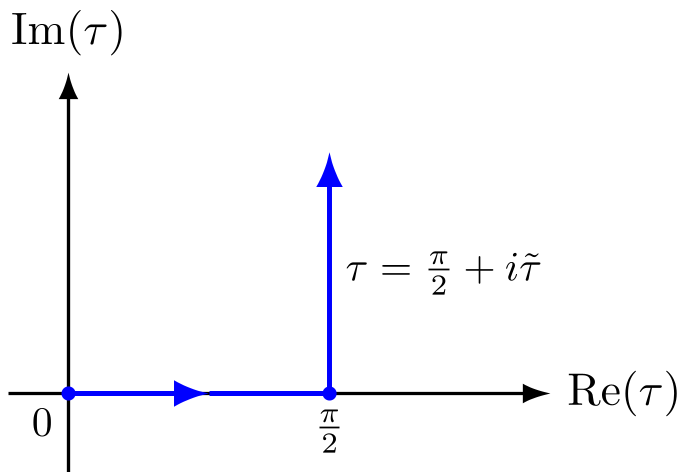 Figure: The Euclidean 'No-Boundary' cap used to define the starting state of the Lorentzian universe.
5. Critical Analysis: Why This Matters
This paper shuts the door on "anti-evaporation" as a physical phenomenon in Einstein gravity. It reaffirms that the de Sitter vacuum is the state of maximum entropy.
Limitations: The study primarily focuses on the s-wave sector (spherical symmetry). While the authors argue that higher-order corrections are suppressed, a full 4D quantum gravity treatment (including graviton loops) remains a challenge for the future.
Final Takeaway: De Sitter space is remarkably robust. Even its most massive "fluctuations" (Nariai black holes) are eventually reclaimed by the vacuum's thermal bath, ensuring the universe remains a consistent thermodynamic system.