
The Walking Cat: A Blueprint for Trapped-Ion Fault-Tolerant Quantum Computing
Fault-Tolerant Quantum Computing with Trapped Ions: The Walking Cat Architecture
The paper introduces the "Walking Cat" architecture, an end-to-end blueprint for a fault-tolerant quantum computer (FTQC) using trapped-ion QCCD technology. It leverages modern low-density parity-check (LDPC) codes and a specialized "cat factory" to achieve high-performance logical operations with significantly reduced physical qubit overhead.
TL;DR
The "Walking Cat" architecture is an end-to-end architectural roadmap for building a near-term fault-tolerant quantum computer (FTQC) using IonQ’s trapped-ion technology. By replacing standard surface codes with high-rate Quantum LDPC (qLDPC) codes and utilizing ion transport for logical operations, the design executes millions of T-gates on hundreds of logical qubits with only a few thousand physical qubits. This represents a paradigm shift from "scaling up" physical qubits to "smartly architecting" logical connectivity.
Motivation: The Overhead Wall
For years, the quantum community has been stuck behind the "Overhead Wall." Standard Surface Codes are reliable but bulky, often requiring a 1000:1 ratio of physical to logical qubits. While recent theoretical breakthroughs in qLDPC codes promised better density, they lacked a concrete hardware map. Trapped ions offer two unique advantages:
- High Fidelity: Standard two-qubit gate fidelities (>99.99%) allow for complex resource state preparation (hence the "Cat States").
- Mobility: The ability to physically move ions (QCCD architecture) allows for the non-local connections required by the best-performing qLDPC codes.
Methodology: The Three Pillars of the Walking Cat
1. The Three-Ring Framework
The architecture organizes qubits into a sequence of "rings" (short, medium, and long). This allows the controller to route ancilla qubits to match the parity-check patterns of high-rate LDPC codes like the [[102, 22, 9]] code (Q102). Unlike fixed-grid superconducting chips, the ions "walk" through the chip along cyclic paths to extract syndromes.
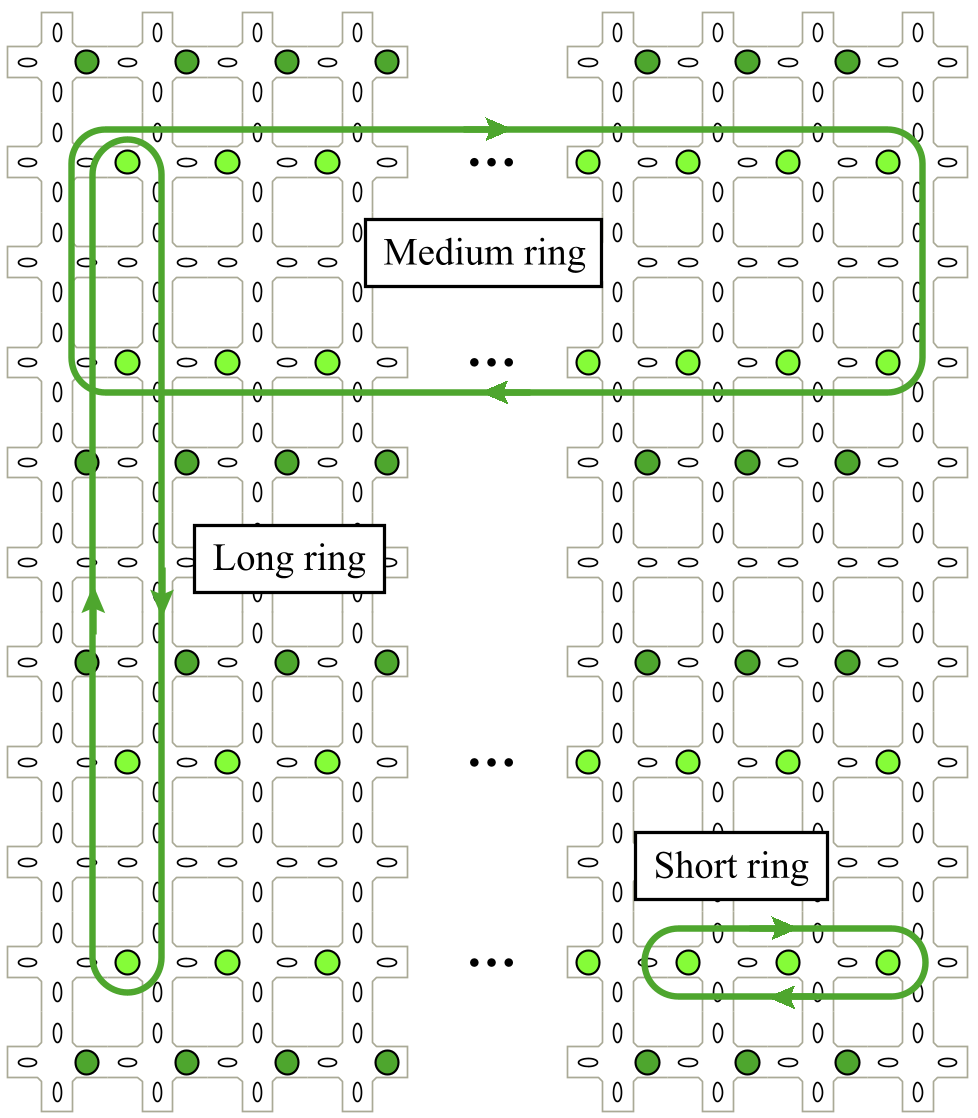 Figure: Mapping the three-ring LDPC framework to a 2D physical ion trap. Gray regions indicate local reservoirs for replacing lost ions.
2. Verified Cat Factories
Instead of complex lattice surgery, logical measurements are performed using "Cat States" (). The architecture features dedicated "factories" that produce and verify these states for purity (precision ). Once a Cat state is ready, it is transported directly to the data block to "read" the logical Pauli operator.
3. Integrated Handling of Loss and Leakage
A major leap in this paper is the move beyond purely Pauli noise models. The authors include:
- Beacon Qubits: Partner qubits that check for ion loss after every operation cycle.
- Leakage Detection Units (LDU): Teleportation-based gadgets to reset qubits that have drifted out of the computational subspace.
Experiments & Benchmarked Applications
The authors simulate several "instances" of the architecture, categorized by speed, simplicity, or density.
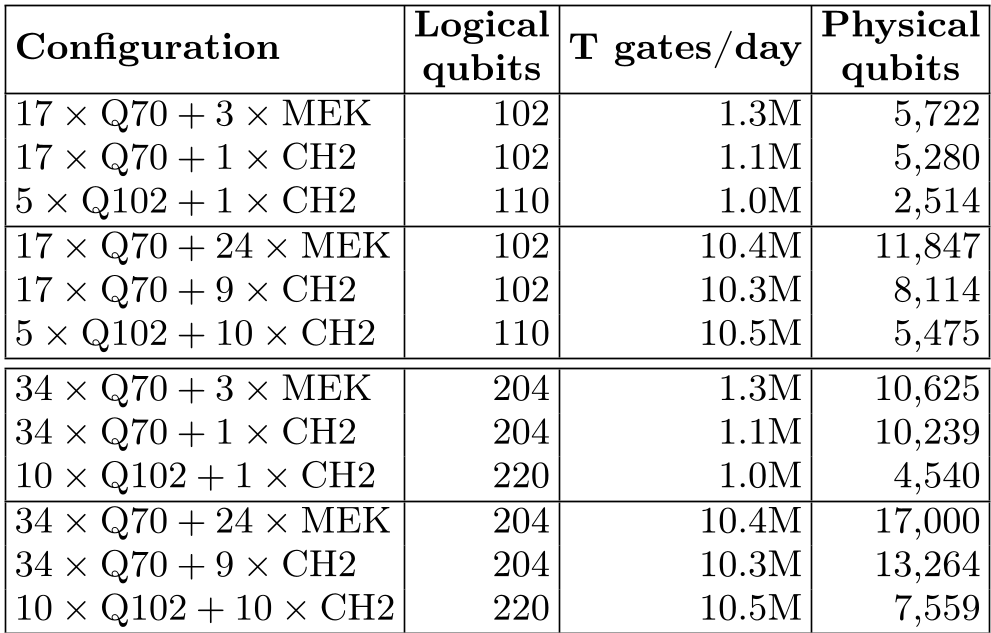 Table: Trade-off between logical qubit count and physical qubit requirements for different configurations.
Key findings include:
- Efficiency: The Q102 memory block provides 2.75x more logical qubits than competing biplanar architectures.
- Shor's Algorithm: Factoring a 30-bit number (32,749 × 32,719) requires ~13,000 physical qubits and takes less than a day.
- Hamiltonian Simulation: Simulating 100 sites of a Heisenberg model—a task intractable for classical supercomputers—could be achieved in one month of runtime.
Critical Analysis: Is the Walking Cat Practical?
The Intuition
The architecture's power comes from modularity. By separating the "production" (Cat/Bell factories) from the "memory" (qLDPC blocks), the compiler can tune the machine's resources on the fly. If an algorithm is T-gate heavy, more blocks act as magic factories; if it requires large memory, they revert to storage.
Limitations
- Transport Congestion: While the "highway" rows facilitate movement, routing 10,000 ions without collisions or excessive heating remains an immense engineering challenge.
- Decoder Latency: The "Streaming Beam Decoder" is fast, but it must stay under the ~1ms threshold to avoid stalling the entire machine.
Conclusion and Future Impact
The "Walking Cat" is a rigorous proof-point that large-scale quantum computation doesn't require a million physical qubits. By combining the mobility of trapped ions with the density of LDPC codes, IonQ has provided a blueprint where "Utility-Scale" quantum computing is a near-term objective rather than a distant dream. The next frontier will be the physical integration of the "Beacon" and "Cat" modules into a single cryogenic QCCD wafer.