
[CVPR 2025/ArXiv] FILT3R: Latent State Adaptive Kalman Filter for Streaming 3D Reconstruction
FILT3R: Latent State Adaptive Kalman Filter for Streaming 3D Reconstruction
FILT3R is a training-free latent filtering layer for streaming 3D reconstruction that reinterprets recurrent state updates as stochastic state estimation. By employing an Adaptive Kalman Filtering (AKF) framework in the token space, it achieves SOTA long-horizon stability, reducing trajectory drift (ATEorig) by over 50% compared to previous gating methods like TTT3R.
Executive Summary
TL;DR: FILT3R transforms the heuristic "update gate" in streaming 3D reconstruction into a principled Adaptive Kalman Filter. By propagating per-token uncertainty, the model learns when to trust its long-term memory and when to adapt to new scene changes, effectively solving the catastrophic drift common in long-horizon inference (1000+ frames).
Background Positioning: This work is a robust "plug-and-play" architectural improvement. It sits atop existing streaming backbones (like CUT3R) and replaces the state update logic with a training-free layer inspired by classical control theory, achieving SOTA stability and length generalization.
Motivation: The Stability Crisis in Streaming
Streaming 3D reconstruction faces a fundamental trade-off: Persistence vs. Plasticity.
- Uniform Overwrites (e.g., CUT3R): Trust the new frame completely. Result: Rapid forgetting of the past and jittery geometry.
- Heuristic Gating (e.g., TTT3R): Scale updates based on attention patterns. Result: Heuristic stability that often fails when the sequence length exceeds the training horizon (typically 64 frames).
The authors' core insight is that the latent tokens in a recurrent model are not just data; they represent a stochastic belief state. If we can quantify the uncertainty of this belief, we can mathematically derive the optimal update gain.
Methodology: Kalman Filtering in Token Space
FILT3R treats the recurrent update as a State-Space Model:
- Process Model: . The scene evolves (or the camera moves). (Process Noise) tracks this.
- Measurement Model: . The decoder's output is a "noisy sensor" reading. (Measurement Noise) represents this.
The Update Mechanism
The core of FILT3R is the Kalman Gain (): Where is the predicted variance. Crucially, as the model stays in a stable scene, the variance shrinks, the gain drops, and the memory becomes "conservative." When the camera moves rapidly, the temporal drift (difference between candidate states) spikes, increasing , which re-opens the gain for fast adaptation.
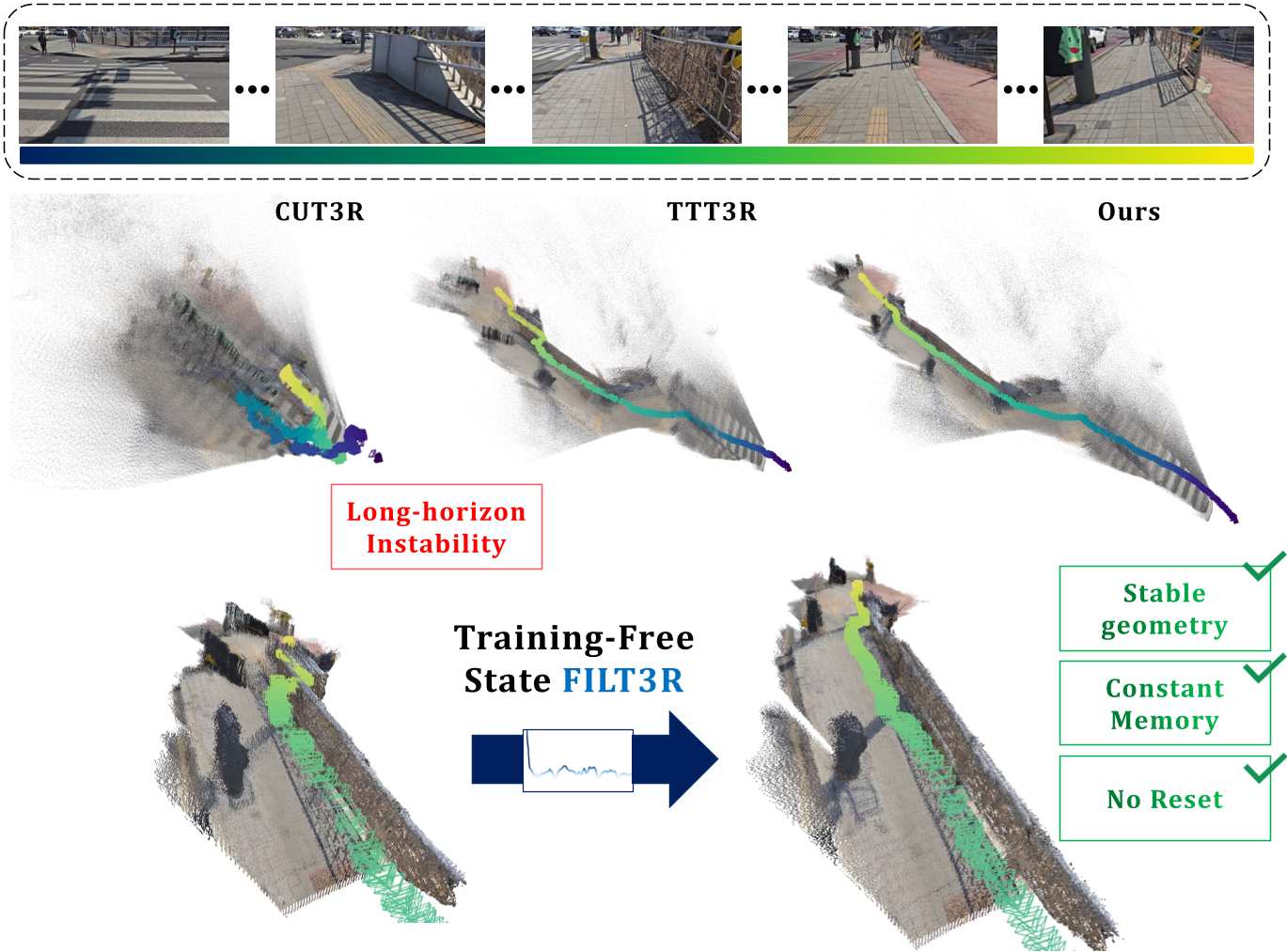 Figure 1: Comparison of update rules. FILT3R (right) propagates uncertainty, enabling time-varying gains that adjust to scene stability.
Experiments & Results
The researchers tested FILT3R across Pose Estimation, Depth, and Full Reconstruction.
1. Long-Horizon 3D Reconstruction
On the 7-Scenes dataset, at length 1000 (vastly beyond the training horizon), FILT3R maintains geometric coherence while other methods fail or run out of memory (OOM).
| Method | Acc (Mean) @ 300f | Acc (Mean) @ 1000f |
|---|---|---|
| CUT3R | 0.134 | 0.233 |
| TTT3R | 0.040 | 0.145 |
| FILT3R | 0.020 | 0.054 |
2. Trajectory Stability
Using Origin-Aligned ATE (ATEorig), which highlights cumulative drift rather than local error, FILT3R shows a dramatic reduction in drift. On TUM-800, it achieved 0.107 compared to TTT3R's 0.214.
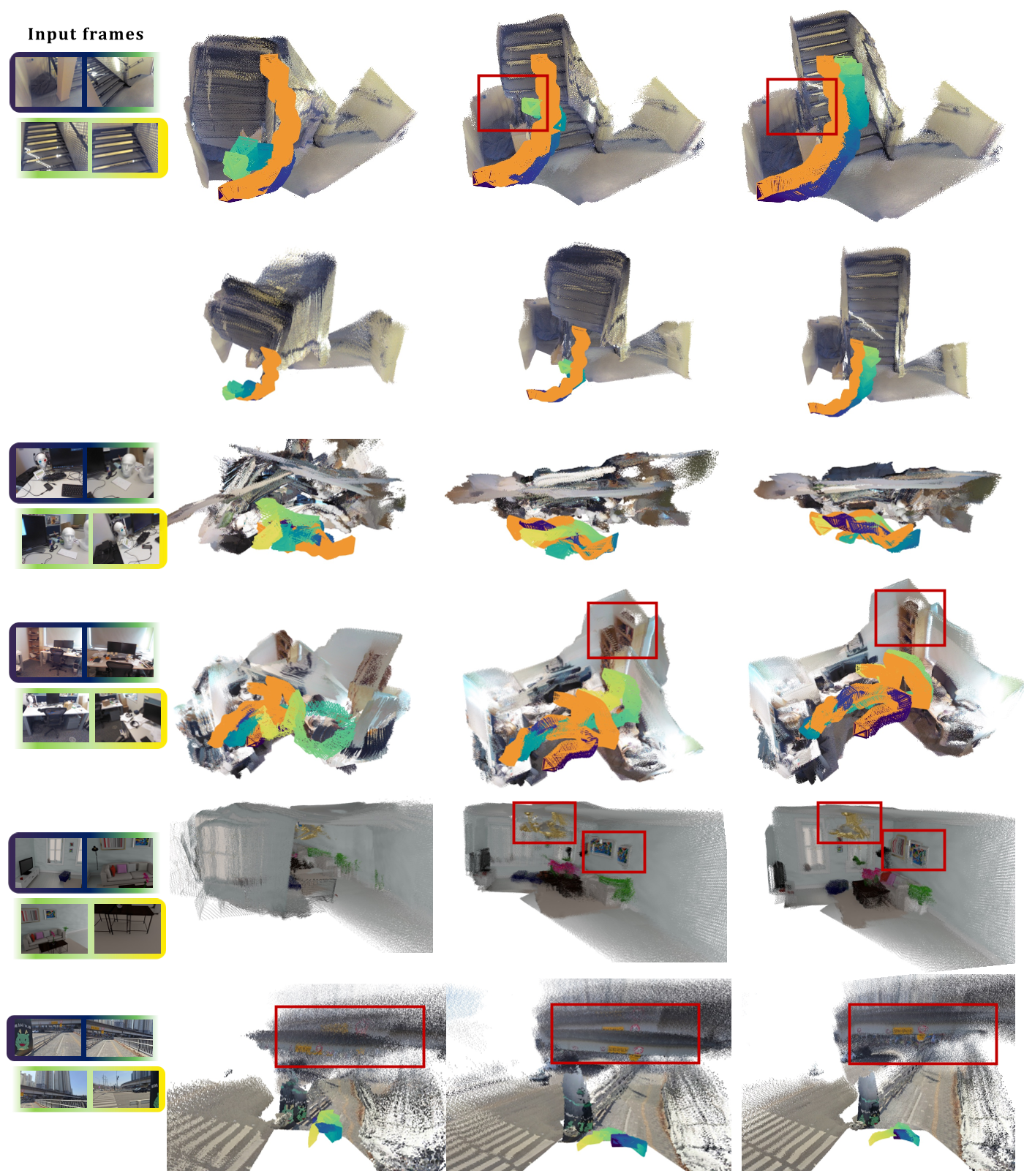 Figure 2: Qualitative long-horizon reconstruction. Note the fragmented surfaces in TTT3R (red boxes) versus the coherent geometry produced by FILT3R.
Critical Analysis & Insight
Why does it work? The ablation study reveals that Variance Propagation is the "secret sauce." Without the recursive update of the variance (), the gain cannot "settle" into a confident state.
Interestingly, the authors found that making the Measurement Noise () adaptive (e.g., based on attention) actually hurt performance. This is because "scene change" and "attention novelty" are highly correlated, causing the gain to overshoot and become unstable—proving that a stable, fixed serves as a necessary "anchor" for the Kalman filter.
Limitations: While FILT3R is training-free, its performance is still bounded by the pre-trained backbone. If the backbone's candidate predictions are biased, the filter will eventually track that bias, though much more slowly than previous methods.
Conclusion: A Return to Fundamentals
FILT3R proves that deep learning researchers don't always need "more data" or "larger models" to solve stability problems. Often, the solution lies in the elegant fusion of modern architectures with the robust mathematical frameworks of the past—in this case, reaching back to 1960 to bring Kalman's insights into the world of 3D latent tokens.