
FineCog-Nav: Scaling UAV Intelligence Through Human-Centric Cognitive Modules
FineCog-Nav: Integrating Fine-grained Cognitive Modules for Zero-shot Multimodal UAV Navigation
FineCog-Nav is a zero-shot Vision-Language Navigation (VLN) framework for UAVs that organizes navigation into fine-grained cognitive modules including perception, attention, memory, and imagination. Achieving SOTA performance, it significantly outperforms existing zero-shot baselines across diverse model scales and environments.
TL;DR
FineCog-Nav is a breakthrough zero-shot framework for Unmanned Aerial Vehicle (UAV) Vision-Language Navigation. By moving away from "black-box" monolithic models and instead simulating human cognitive functions—such as imagination, hierarchical memory, and targeted attention—it achieves superior instruction-following and planning efficiency. Accompanied by the AerialVLN-Fine dataset, it sets a new standard for interpretable and robust aerial agents.
Background & Motivation: Why Drones Fail at Zero-Shot VLN
Standard Vision-Language Navigation for ground robots is hard, but for UAVs, it's a nightmare. Drones operate in continuous 3D space with six degrees of freedom, facing complex occlusions and high-speed motion. Current zero-shot approaches typically throw a Large Foundation Model (LFM) at the problem with a generic prompt.
The authors identify a "Coherence Gap": when a model like LLaVA-7B replaces GPT-4V, success rates often plummet from nearly 30% to essentially 0%. Why? Because these models lack a structured way to handle cognitive interdependence—the way our memory informs our perception, and our imagination helps us verify if we've reached a goal.
Methodology: The Seven Pillars of FineCog-Nav
FineCog-Nav decomposes the navigation task into seven fine-grained modules, each powered by a moderate-sized model (like Qwen-72B or InternLM-20B) with role-specific protocols.
1. Hierarchical Memory: The Brain's Filing System
Unlike previous methods that use a "flat" history (a simple list of all past actions), FineCog-Nav uses a three-tier hierarchy:
- Step Memory: "I see X, I did Y."
- Subgoal Memory: Consolidates steps into a summary once a milestone is reached.
- Instruction Memory: Aggregates subgoal summaries for the entire task. Ablation studies show this is the most critical module; removing it causes the largest performance drop.
2. Imagination-Driven Reasoning
The Imagination Module simulates a reference visual state. Before moving, the agent "hallucinates" what the target (e.g., a yellow truck) should look like upon arrival. The Subgoal Judger then compares real-time perception against this imagined state to decide when to transition to the next instruction.
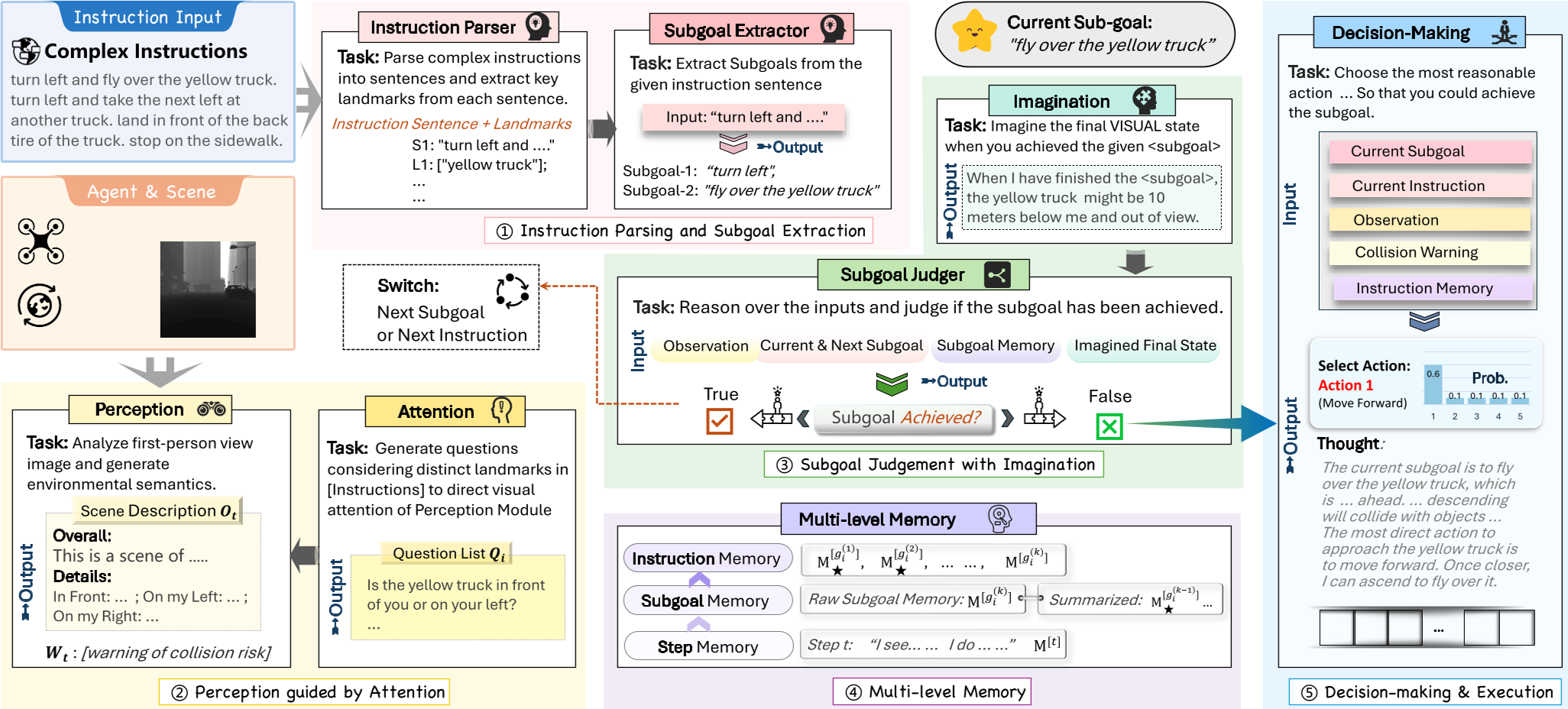 Figure: The overall workflow of FineCog-Nav, highlighting the closed-loop interaction between cognitive modules.
Experiments & Results: Efficiency Meets Accuracy
The researchers introduced AerialVLN-Fine, a curated version of the existing AerialVLN dataset, fixing issues like instruction-trajectory misalignment and invisible landmarks.
Performance vs. Baselines
In head-to-head comparisons, FineCog-Nav didn't just win; it dominated the efficiency metrics:
- Success Rate (SR): Doubled or tripled relative to single-module baselines.
- Token Efficiency: Consumed only ~3.9K tokens per step, compared to DiscussNav's 18.7K.
- Latency: Per-step reasoning was ~4x faster than DiscussNav (23.5s vs 80.5s).
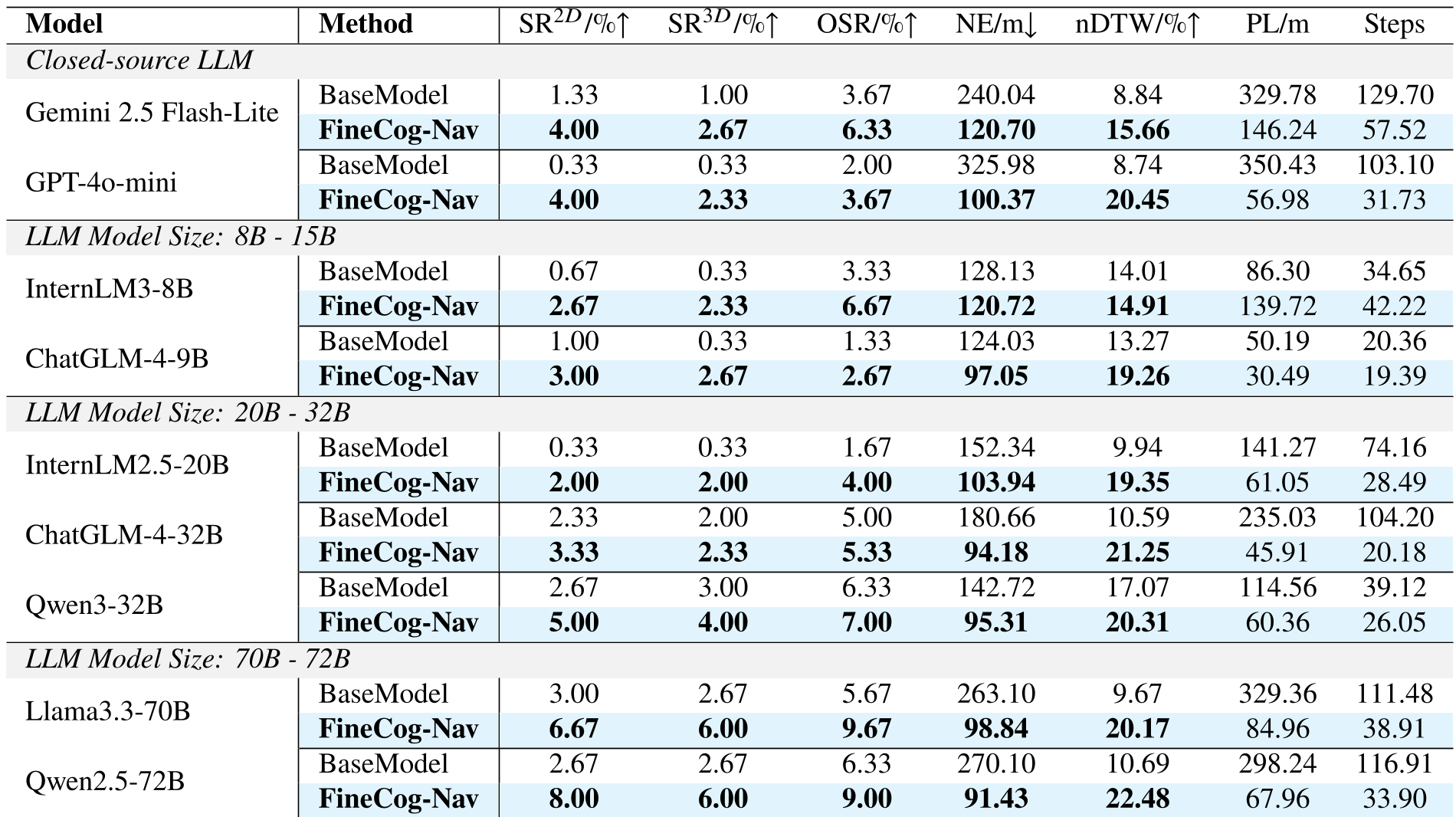 Table: FineCog-Nav consistently outperforms BaseModel across diverse LLM backbones.
Qualitative Insight: Interpretation in Action
In a complex "T-junction to tunnel" scenario, FineCog-Nav was the only agent to correctly ground the instruction to "face the tunnel." While others flew past or crashed, the combination of Attention-guided Perception and Subgoal Extraction allowed FineCog-Nav to maintain alignment with the human instruction through a long-horizon path.
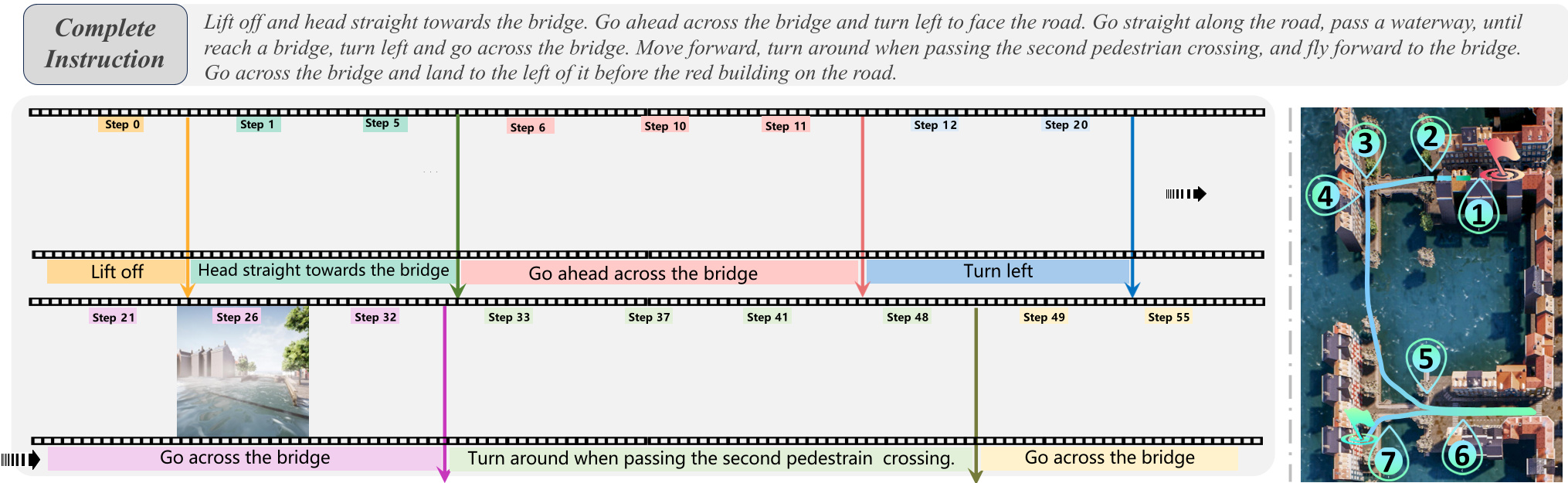 Figure: A trace of FineCog-Nav correctly identifying sequential subgoals in a 3D environment.
Summary & Future Outlook
FineCog-Nav proves that modularity is a feature, not a bug. By specializing prompts and structuring information flow, we can achieve high-level reasoning on moderate hardware.
Limitations: The success rates in zero-shot UAV VLN are still objectively low (under 10% in many complex cases), reflecting the "sim-to-real" difficulty and the ambiguity of natural language. Future Work: The team has already begun real-world deployment on RoboMaster TT UAVs, proving that this cognitive architecture can survive outside of a simulator.