
It’s All in Your Head: Why Naturalness in Physics is Pure Bayesian Logic
It's all in your head -- fine-tuning arguments do not require aleatoric uncertainty
This paper reviews the statistical foundations of naturalness arguments in theoretical physics through the lens of Bayesian inference. It demonstrates how an "automatic Occam's razor" emerges from the Bayes factor to penalize fine-tuned models, specifically achieving a preference of for natural models over those with quadratic corrections (Hierarchy Problem).
TL;DR
Is the "fine-tuning" of the universe a real scientific problem or just a physicist's aesthetic whim? This paper argues it is a matter of rigorous logic. By reframing naturalness as Bayesian model comparison, the author proves that "unnatural" theories are mathematically disfavored not because they are "ugly," but because they are poor predictors. Crucially, this holds true even if the universe isn't "random"—probability here is about our knowledge, not dice-rolling.
The Misconception: Wotan’s Dice
In recent years, prominent critics like Sabine Hossenfelder and James Wells have challenged the "Hierarchy Problem"—the mystery of why the Higgs mass is so much smaller than the Planck scale. Their core argument: Naturalness assumes parameters are chosen randomly (aleatoric uncertainty). If the universe is "just so" and not a result of a random draw, they claim, talking about "improbable" parameter values is a logical fallacy.
The author, Andrew Fowlie, counters this by invoking the spirit of Bruno de Finetti: "Probability does not exist" in an objective sense. Instead, all probabilities in these arguments are epistemic—they live in our heads as measures of our uncertainty.
The Automatic Occam’s Razor
The most profound insight of the paper is that Bayesianism doesn't need an extra "simplicity axiom." Simplicity is baked into the math of the Bayes Factor.
How it Works: The Dilution of Belief
Consider two models:
- Simple Model (): Predicts a narrow range of possible outcomes.
- Complex/Fine-tuned Model (): Has vast parameter space and can predict almost anything.
When we observe a specific data point, the Simple Model wins because it "bet" heavily on that outcome. The Complex Model, having spread its "predictive mass" across thousands of possibilities that didn't happen, is penalized. This is the Automatic Occam's Razor.
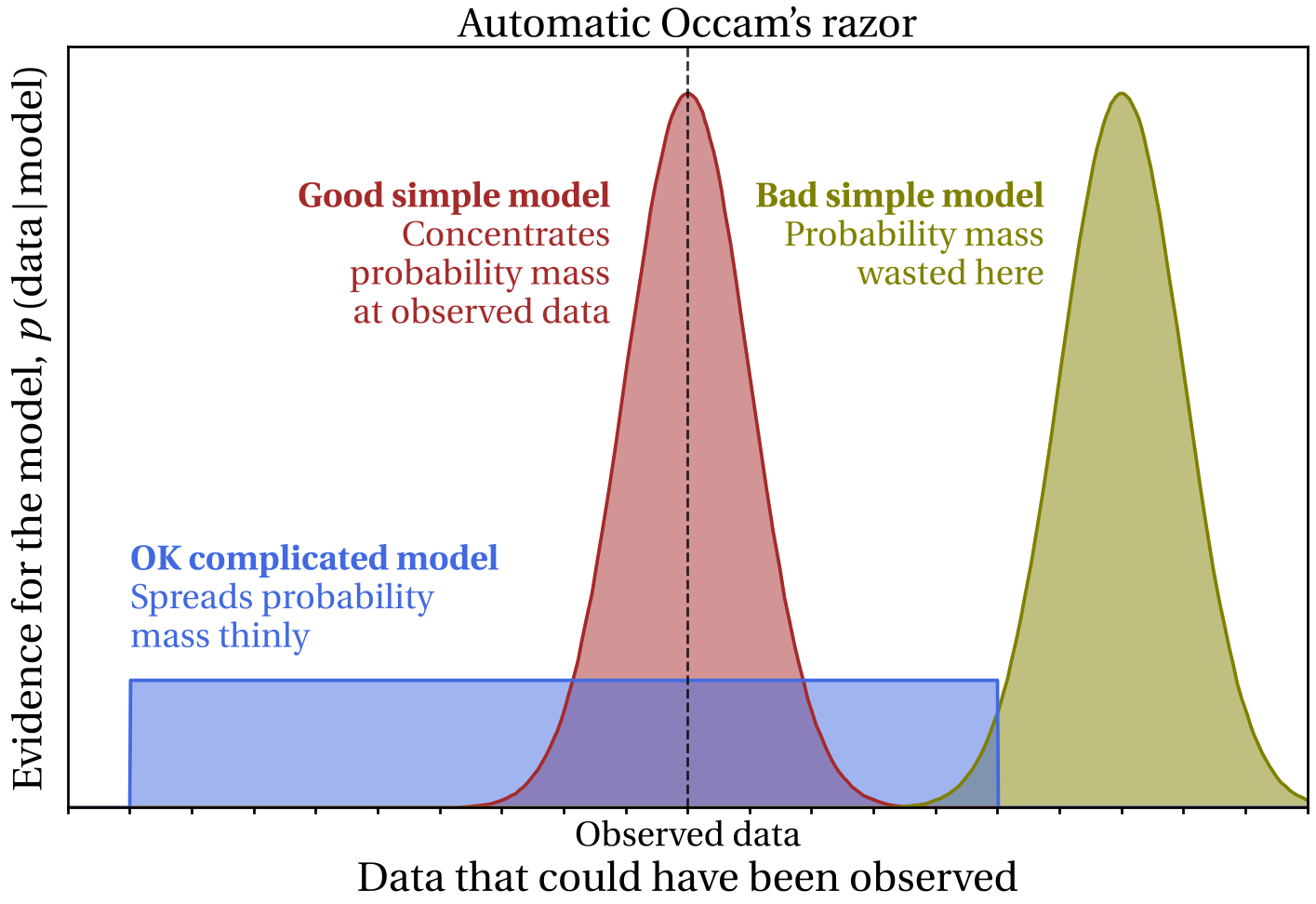 Figure 1: Complicated models spread their predictions thinly, making them less likely to match specific observations compared to simple models.
Case Study: The Hierarchy Problem
Fowlie applies this to the Z boson mass ().
- Model (Natural): (The mass is just what it is).
- Model (Unnatural/Fine-tuned): (Two huge numbers, and , must cancel out to leave a tiny ).
Using scale-invariant (logarithmic) priors, the math is staggering. The Bayes factor —the ratio of how much more we should believe one model over the other—favors the natural model by a factor of .
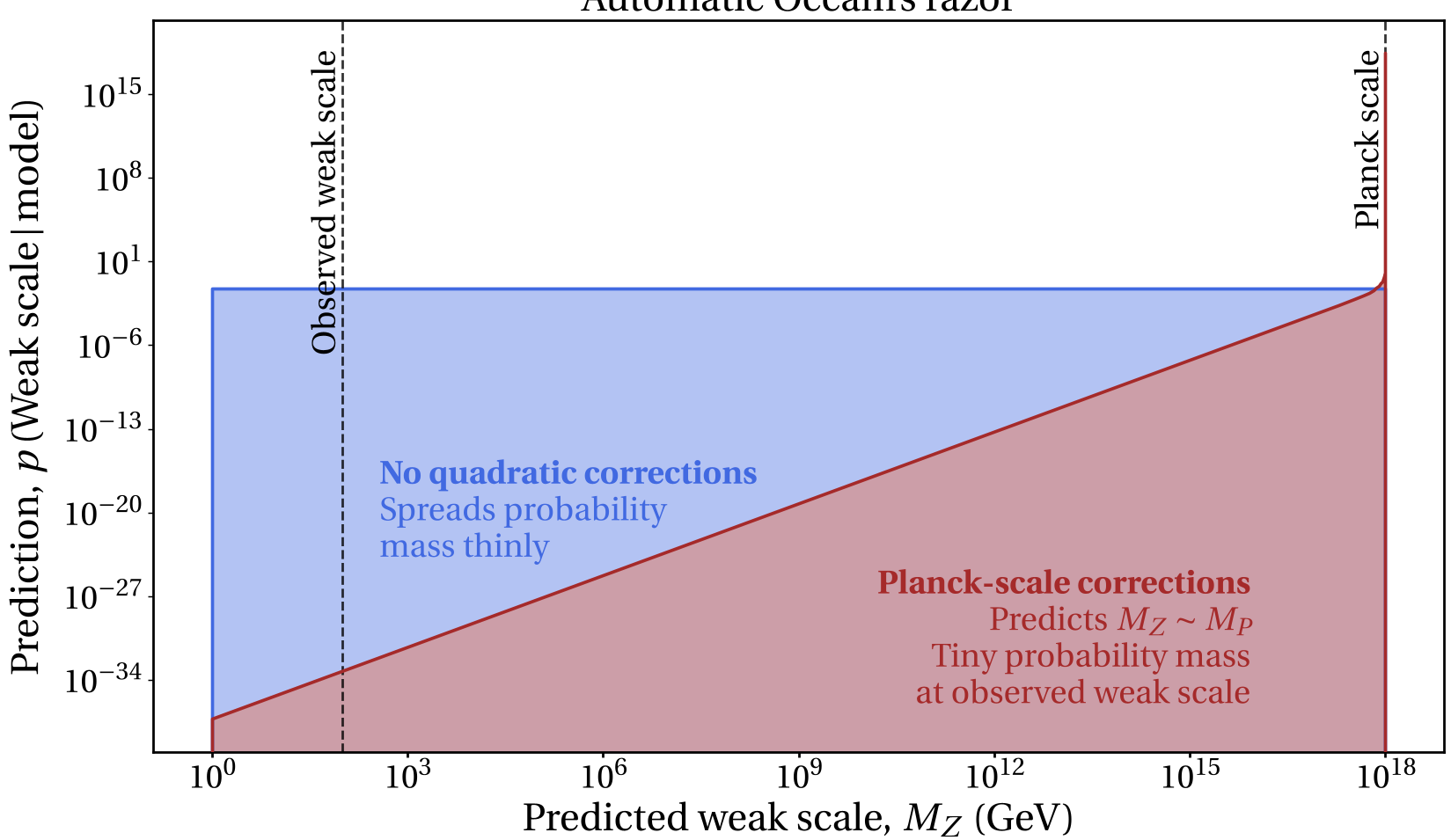 Figure 2: The predictive density at the observed weak scale (blue) is vastly higher than the fine-tuned model (red).
To make the "unnatural" model look good, you would have to assume a prior for the parameter that is focused with surgical precision—exactly the kind of "special pleading" that Occam’s Razor is designed to cut away.
Methodology: From Falling Balls to Particle Physics
The paper bridges the gap between simple physics (Jeffreys’ example of a ball in free-fall) and high-energy theory.
In the ball-drop example, a 9th-order polynomial can fit 10 data points perfectly, yet we prefer a simple quadratic equation. Why? Because the 9th-order polynomial could have fit any 10 points. Its success is "cheap." Similarly, a theory that requires fine-tuning to explain the weak scale is "cheap" because it requires specific, unexplained alignment of fundamental constants.
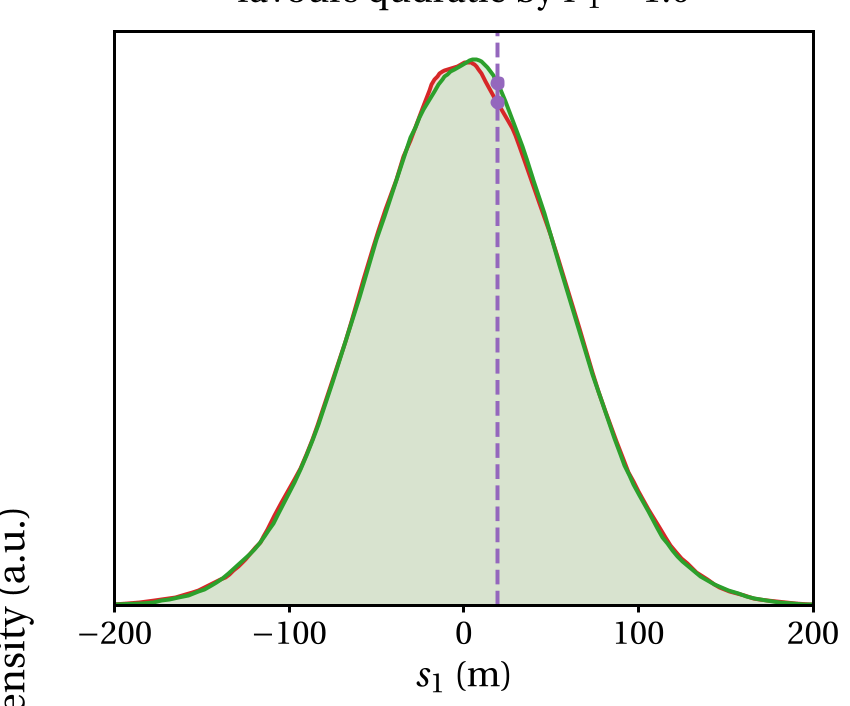 Figure 3: Breaking down the Bayes factor measurement by measurement shows how simpler models gain an advantage as data accumulates.
Conclusion: It’s Not Aesthetic, It’s Evidence
Fowlie concludes that naturalness isn't a "matter of taste" or an "aesthetic preference" as some physicists (like Shifman or Hossenfelder) suggest. It is the output of a consistent statistical framework.
Key Insights for the Reader:
- No Randomness Required: You don't need a multiverse or "Wotan throwing dice" for fine-tuning to be a problem. You only need to be uncertain about the parameters.
- Priors Matter: While results depend on priors, "unnaturalness" can only be avoided by choosing priors that are themselves incredibly "unnatural" (highly tuned).
- The "Illness" is Predictive: Fine-tuned models are treated as "less likely" because they are logically weaker at predicting the specific values we observe in our universe.
The debate over naturalness is essentially a debate over how we handle epistemic uncertainty. If you accept Bayes' Theorem as a tool for science, you have already accepted the validity of naturalness arguments.