
The Finetuner’s Fallacy: Why Your Domain Data Belongs in Pretraining
The Finetuner's Fallacy: When to Pretrain with Your Finetuning Data
This paper introduces Specialized Pretraining (SPT), a strategy where a small fraction (1-5%) of domain-specific data—typically reserved for finetuning—is interleaved throughout the entire pretraining phase. Using the OLMo architecture across ChemPile, MusicPile, and ProofPile, the authors demonstrate that SPT consistently achieves SOTA domain performance and superior general knowledge retention compared to standard "pretrain-then-finetune" pipelines.
In the current LLM landscape, the standard operating procedure for building a "Legal-LLM" or "Bio-LLM" is simple: take a powerful base model (like Llama-3 or Mistral) and finetune it on your private data.
The DatologyAI team argues that this intuition is a strategic error they call the "Finetuner's Fallacy." In their latest work, they reveal that by the time you reach the finetuning stage, it might already be too late to get the most out of your data.
TL;DR: Shift Left with SPT
Instead of treating pretraining and finetuning as disjoint phases, the authors propose Specialized Pretraining (SPT). By mixing just 1-5% of your finetuning data into the massive pretraining corpus, you can:
- Reduce required pretraining tokens by up to 1.75x.
- Allow a 1B model to outperform a 3B model on domain-specific tasks.
- Drastically reduce catastrophic forgetting of general knowledge.
The Problem: The High Cost of the "Finetuners Tax"
Practitioners often choose finetuning because it seems cheaper—avoiding the massive compute bill of pretraining. However, the authors argue this ignores the Inference Tax. A 3B model that was only finetuned might perform similarly to a 1B model that underwent SPT, but the 3B model is 3x more expensive to serve.
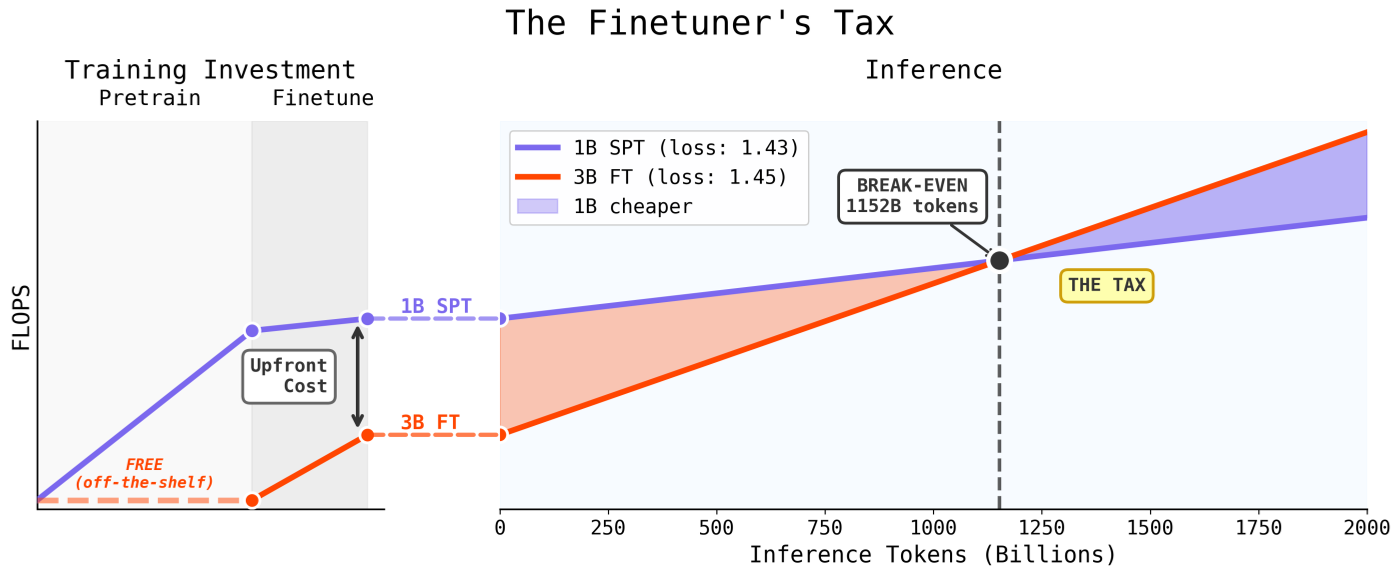 Figure 1: The "break-even" point where a smaller SPT model becomes cheaper than a larger finetuned model occurs around 1 trillion inference tokens.
Methodology: The Power of Diffused Exposure
The core insight of SPT is regularization through diffusion. When you finetune, the model sees only domain data, leading to a massive "train-test gap" as it memorizes the small dataset.
In SPT, the domain data is interleaved with general web data (like the Dolma corpus). Even if the domain data is repeated 50 times, the surrounding general data prevents the model from "overfitting" in the traditional sense. It learns the structure of the specialized domain slowly and durably.
 Figure 2: SPT (solid line) achieves lower domain loss and less general knowledge forgetting compared to Naive Pretraining (dashed line).
Key Results: Scaling and Efficiency
The researchers tested SPT across three distinct, data-scarce domains: MusicPile (Symbolic Music), ChemPile (Chemistry), and ProofPile (Math).
- Parameter Efficiency: In Music and Math, a 1B SPT model outclassed a 3B NPT model. This suggests that "knowing the right data early" is more valuable than having 3x more parameters.
- Task Performance: For symbolic music (MusicTheoryBench), SPT improved accuracy by ~4%. For MATH, it saw a ~6% jump.
- The "Forget Me Not" Effect: Because SPT models start finetuning from a much better initialization (lower domain loss), they require fewer "aggressive" weight updates during finetuning, which preserves the model's ability to answer general questions.
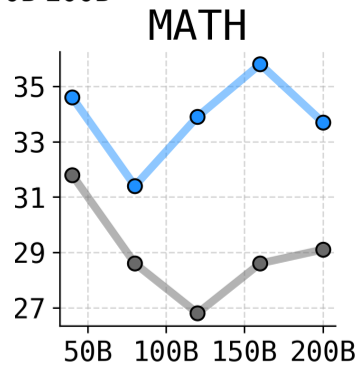 Figure 3: SPT is a Pareto improvement, closing the gap between 1B and 3B models while using less compute.
A New Scaling Law for Overfitting
Standard power laws don't account for the "U-shape" of test loss when data is repeated. The authors propose a new decomposition:
- follows a standard power law (negative exponent).
- (the overfitting component) follows a power law with a positive exponent.
By modeling these separately as a function of the mixture percentage (), developers can predict exactly when a model will start to overfit, allowing them to choose the optimal for their compute budget without expensive trial-and-error.
Critical Insight: When is SPT Most Effective?
- Distributional Shift: SPT is most powerful when your data is "far" from web text (e.g., Music or Code).
- Data Volume: If you have very little data (<30M tokens), it’s better to introduce it later in pretraining (Specialized Continued Pretraining) to avoid early overfitting.
- Compute Budget: Higher mixture fractions (e.g., 10%) are better for short training runs, while lower fractions (1-2%) are superior for long-horizon pretraining.
Conclusion
The boundary between pretraining and post-training is blurring. The "Finetuner's Fallacy" reminds us that data is most potent when it's integrated natively into the model's world-view from day one. If you have specialized data, don't wait for the final stage—front-load your expertise.