
FingerEye: Bridging the Gap Between Seeing and Feeling in Robotic Manipulation
FingerEye: Continuous and Unified Vision-Tactile Sensing for Dexterous Manipulation
The paper introduces FingerEye, a compact and unified vision-tactile sensor for dexterous manipulation. By integrating binocular RGB cameras and a compliant soft ring with a custom AprilTag layout, it achieves seamless perception across pre-contact, contact initiation, and post-contact phases, enabling SOTA performance in delicate tasks like coin standing and chip picking.
TL;DR
Dexterous manipulation is often a game of three phases: look, touch, and regulate. Historically, robots "saw" with external cameras and "felt" with tactile sensors, but failed during the critical transition of contact initiation. FingerEye solves this by combining both into one compact fingertip sensor. Using binocular cameras and a deformable AprilTag skin, it provides continuous 6D feedback from approach to grasp, enabling tasks as delicate as standing a coin or picking a potato chip without breaking it.
Problem & Motivation: The "Blind Spot" of Contact
In robotic manipulation, the moment of contact is a sensing "no-man's land." External cameras (wrist-mounted) get occluded by the hand itself, and traditional tactile sensors like GelSight are completely uninformative until the object is already pressed against the sensor.
The authors identify three phases of interaction:
- Pre-contact: Millimeter-level visual alignment.
- Contact Initiation: Detecting the exact instant of touch to prevent pushing objects away.
- Post-contact: Regulating 6D forces to maintain stability.
Existing See-Through-Skin (STS) sensors often require illumination switching or semi-transparent gels that limit depth perception. FingerEye was born from the insight that a binocular system focusing on marker-based deformation can unify these phases into a single, high-frequency RGB stream.
Methodology: The FingerEye Architecture
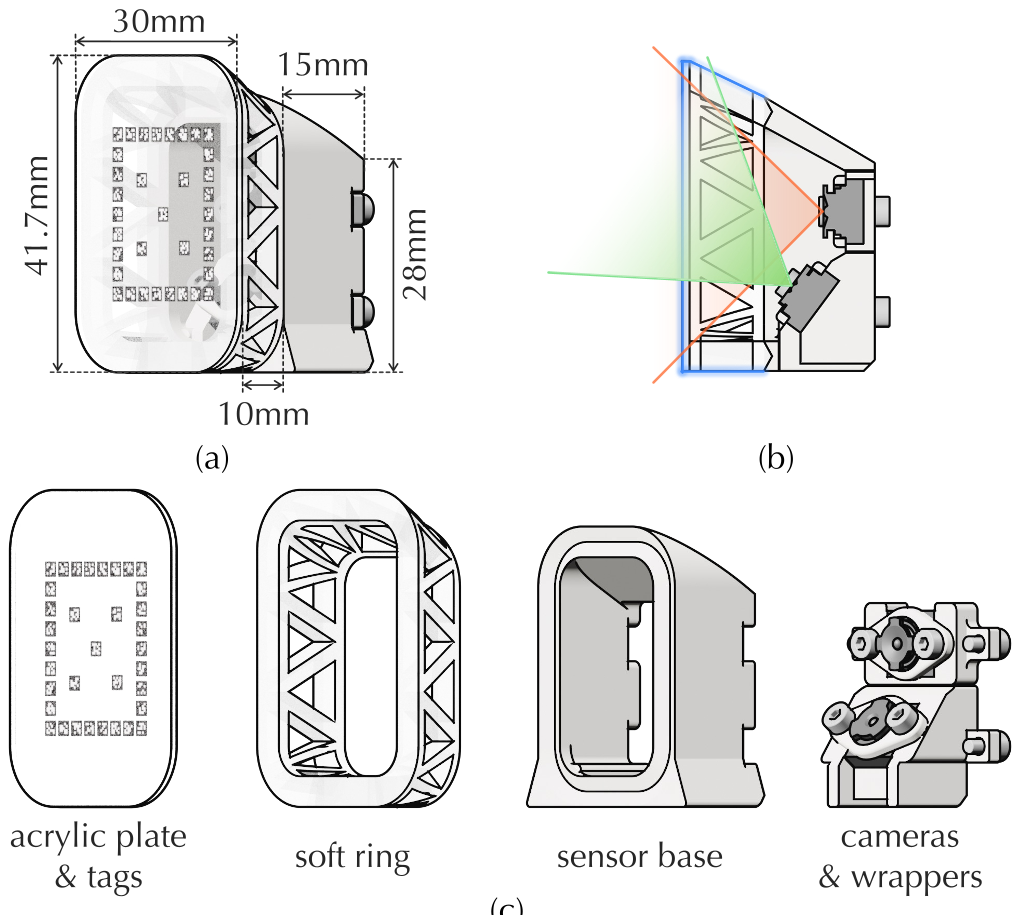
FingerEye is a masterpiece of cost-effective engineering (~$60), utilizing:
- Binocular Vision: Two cameras with different focal points. An "Eye" for the scene and a "Finger" for the internal markers.
- Compliant Soft Ring: A silicone structure that allows peripheral deformation, meaning the robot can "feel" even if it hits an object with its side.
- AprilTag Layout: 35 markers allow for robust 6D pose estimation. By tracking how these tags move, the system infers forces and torques (the wrench) acting on the fingertip.
The Control Policy
To handle this rich data, the team developed the FingerEye Policy, a transformer-based imitation learning model. It fuses visual tokens from the wrist and fingertips with proprioceptive data and tag-pose history to predict "action chunks"—sequences of future movements that ensure temporal consistency.
Experiments: Precision in Action
The sensor was tested across four grueling tasks: Coin Standing, Chip Picking, Letter Retrieving, and Syringe Manipulation.
Key Findings:
- Sensitivity: It detects forces as small as 4.3 mN—enough to grasp an eggshell or a singe wafer without damage.
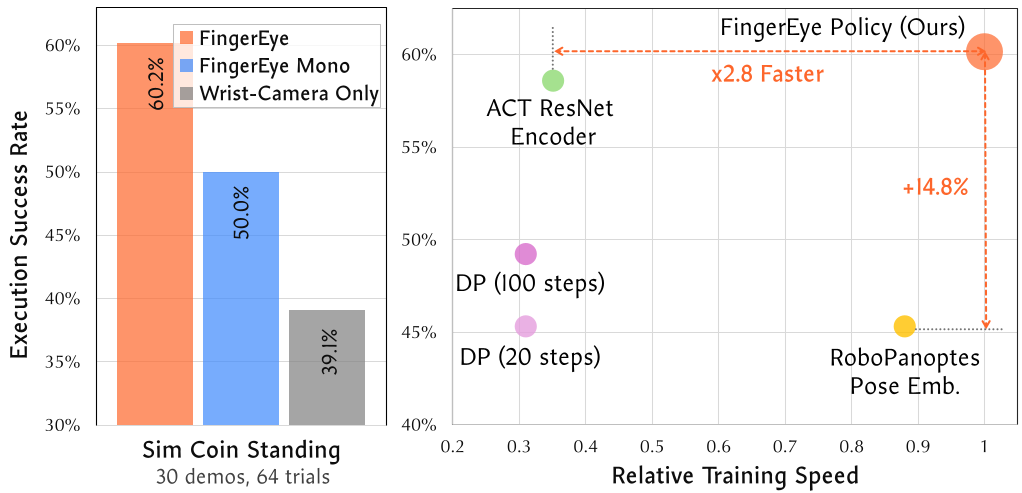
- Binocular Advantage: The dual-camera setup significantly outperformed monocular versions by providing implicit depth, which is crucial for determining exactly how far the finger is from an edge.
- Efficiency: Their policy architecture, using RADIO foundation model summaries, trained 2.8x faster than traditional ResNet-based ACT encoders.
Solving Generalization with Digital Twins
A standout feature is the Sim-Augmented Representation Learning. By training in a "Digital Twin" environment, the model learns to ignore object color variations (e.g., a yellow coin vs. a purple coin) by focusing on the underlying geometry and contact physics.
Critical Analysis & Conclusion
FingerEye proves that we don't need expensive, high-end "electronic skins" to achieve high dexterity. Simplicity in hardware (3D printing and off-the-shelf cameras) combined with sophisticated transformer policies is a winning formula.
Takeaway: The "Secret Sauce" is continuity. By treating vision and touch as a single continuous signal rather than two separate modes, robots can navigate the messy reality of contact-rich tasks with human-like grace.
Limitations: Currently, the sensor doesn't reconstruct the exact shape of the contact, only the 6D wrench. Future work could integrate tactile shape reconstruction to allow for even more complex manipulation of unknown geometries.
Future Outlook
The release of the hardware design and code opens the door for researchers to scale FingerEye to bimanual or humanoid platforms, potentially leading to a "Foundation Model" for tactile interaction.