
Finite-Time Memory Detectors: Bridging Quantum Scattering and Classical Gravity
Finite-time memory detectors and fully constraining Faddeev-Kulish dressings in QED and gravity
The paper develops a finite-time formalism for memory detectors and Faddeev-Kulish (FK) dressings in massive QED and perturbative quantum gravity. It demonstrates that by retaining explicit time dependence and imposing rotational symmetry, FK dressings are uniquely constrained and successfully reproduce the non-linear Christodoulou memory effect.
TL;DR
This paper bridges the gap between Quantum Field Theory (QFT) scattering technology and classical general relativity by introducing Finite-Time Memory Detectors. By refining Faddeev-Kulish (FK) dressings to include previously neglected time-dependent terms and enforcing rotational symmetry, the author demonstrates that the quantum "dressed" Fock space uniquely and correctly reproduces the classical memory effect, including the non-linear Christodoulou effect.
The Missing Link: Why Standard Scattering Isn't Enough
In the specialized world of QFT, we often treat the "in" and "out" states as existing at . To avoid the infrared (IR) divergences caused by massless photons or gravitons, physicists use Faddeev-Kulish dressings—essentially a cloud of soft radiation that "dresses" charged or massive particles.
However, standard treatments usually discard the time-dependence of these dressings because they don't change the final S-matrix. The author argues this is a mistake. If you want to measure the memory effect—the permanent displacement of spacetime or a change in the electromagnetic field after a wave passes—those sub-leading terms are precisely where the information lives.
Methodology: The Geometry of a Measurement
The core innovation is the definition of a finite-time detector. Unlike a detector sitting at an abstract "null infinity," a real-world detector (like a calorimeter or a gravitational wave interferometer) exists at a finite distance and measures fields over a finite time interval.
1. Unique Dressings through Symmetry
The author proves that specifying the dressing isn't just a matter of choice. By demanding:
- Energy Conservation: The dressing shouldn't change the total energy of the state.
- Rotational Invariance: The gauge-fixing function must respect the symmetry of the celestial sphere.
The author arrives at a unique choice for the gauge vector , which must be the antipodal map.
2. The Finite-Time Limit
By carefully balancing the limits of the soft-mode frequency () and the time (), the author uses the Riemann-Lebesgue lemma to show how the phase oscillations eventually "wash out" the contributions to the energy while leaving the memory effect intact.
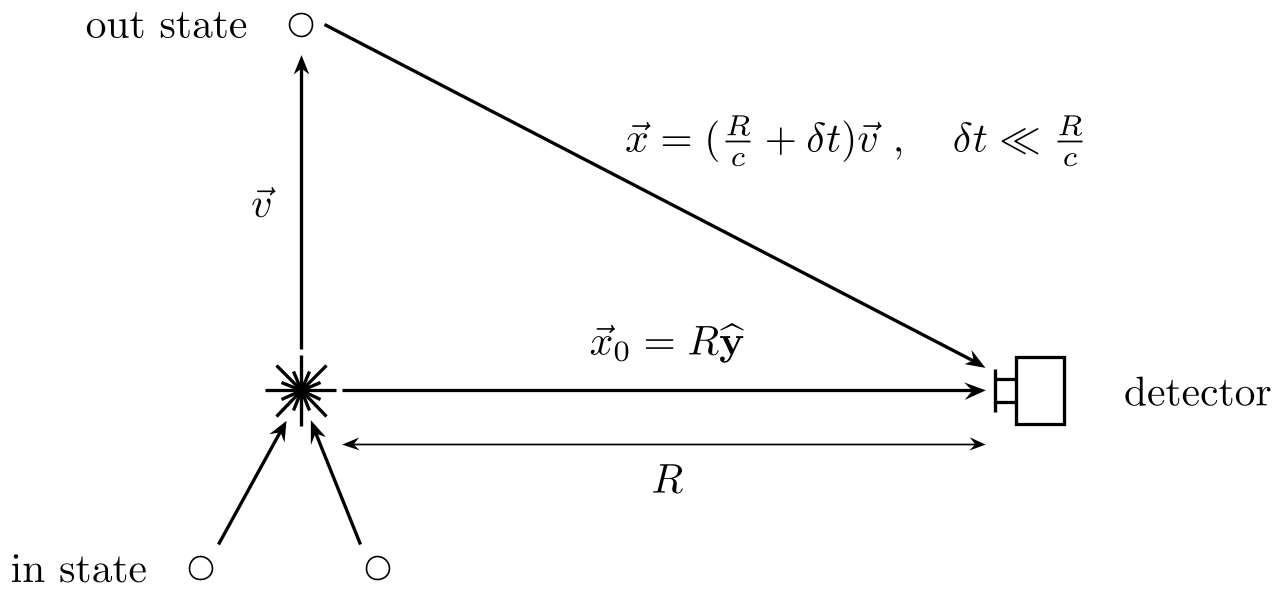 Fig 1: A diagram of a real experiment measuring radiation at a distance R. The study emphasizes that the order of limits (r approach infinity then u approach infinity) is vital for physical consistency.
Results: Capturing the Christodoulou Effect
The most striking result is in the realm of gravity. Classical general relativity predicts several "layers" of memory:
- Linear Memory: Displacement due to the change in velocity of massive particles.
- Non-linear (Christodoulou) Memory: Displacement caused by the energy of the gravitational waves themselves.
While previous QFT methods often missed the non-linear part, this paper shows that because the new FK dressings make the S-matrix IR-finite, the inclusive "in-in" calculations automatically capture these higher-order effects through higher-loop Feynman diagrams.
 The final proof showing that the detector's eigenvalue perfectly matches the classical gravitational memory formula.
Critical Analysis & Conclusion
The success of this formalism suggests that our understanding of "asymptotic states" in QFT is often too idealized. By treating the time-dependence and the measurement process (detectors) more rigorously, we recover deep classical truths.
Limitations: The study focuses on massive scalar fields. Extending this to fermions or more complex spinning particles might introduce new collinear divergence issues, though the author expects the logic to hold.
Future Outlook: This framework is a significant step toward describing Fock spaces at finite distances. It opens the door to verifying "sub-leading" conserved charges in gravity, which are currently at the forefront of the Celestial Holography program.
Summary Takeaway
If you drop the time-dependence in your quantum dressings, you lose the physics of the memory effect. Keep the time, enforce the symmetry, and the quantum-to-classical transition becomes crystal clear.