
FLAS: Beyond the Steering Vector – Why LLM Control Needs "Flow"
Beyond Steering Vector: Flow-based Activation Steering for Inference-Time Intervention
The paper introduces FLAS (Flow-based Activation Steering), a novel inference-time control method for LLMs that learns a concept-conditioned velocity field. Unlike static steering vectors, FLAS uses iterative Euler integration to achieve state-adaptive and position-sensitive interventions, consistently outperforming in-context prompting on the AxBench benchmark.
TL;DR
Researchers from Georgia Tech have introduced FLAS (Flow-based Activation Steering), a method that moves beyond the traditional "steering vector" paradigm. By treating activation modification as a continuous flow rather than a single additive step, FLAS becomes the first learned method to consistently beat in-context prompting on the massive AxBench benchmark, proving that the geometry of LLM activations is far more curved and complex than previously thought.
Problem: The Limits of Linear Steering
For the past year, "Activation Steering" has been the darling of AI safety and interpretability. The idea is simple: find a direction in the model's hidden layers that represents "honesty" or "happiness" and add it during inference.
However, the AxBench evaluation recently delivered a reality check: most of these methods generalize poorly and are often worse than just asking the model to "be honest" in the prompt. Why? The authors of FLAS hypothesize that we’ve been relying on flawed assumptions:
- Single-step: Assuming one addition is enough.
- Position-invariant: Applying the same shift to every token in a sentence.
- Linearity: Assuming the "concept" exists on a straight line.
Methodology: Steering as a Transport Problem
Instead of a static vector, FLAS learns a velocity field. Imagine the activation as a particle in high-dimensional space. FLAS doesn't just teleport the particle; it prescribes a path.
The FlowBlock Architecture
The core of FLAS is the FlowBlock, a transformer-style module that takes the current activation, a time step , and the target concept .
- Concept Conditioning: It uses cross-attention to "read" the natural language description of the steering target.
- Euler Integration: It updates the activation over steps (usually ).
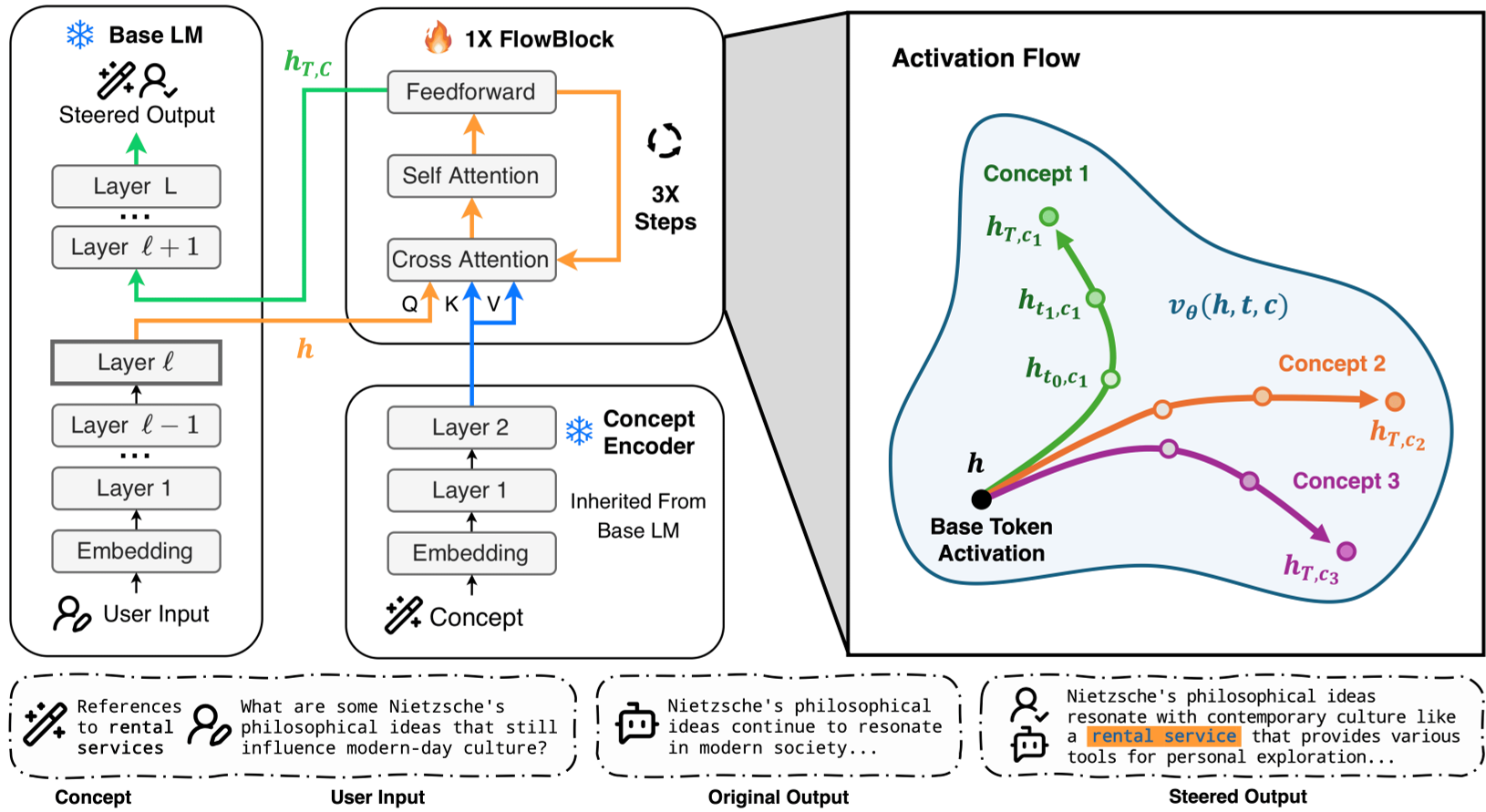
The beauty of this approach is that it is zero-shot. You can type a brand-new concept like "talk like a 19th-century pirate who loves calculus," and the FlowBlock generates a custom velocity field for that specific request without further training.
Results: A New SOTA on AxBench
FLAS doesn't just improve on previous steering methods; it bridges the gap where steering previously failed to beat prompting.
| Method | Gemma-2-2B (Held-out HMean) | Gemma-2-9B (Held-out HMean) |
|---|---|---|
| Prompting | 0.762 | 1.091 |
| HyperSteer | 0.608 | 0.934 |
| FLAS (Ours) | 1.015 | 1.113 |
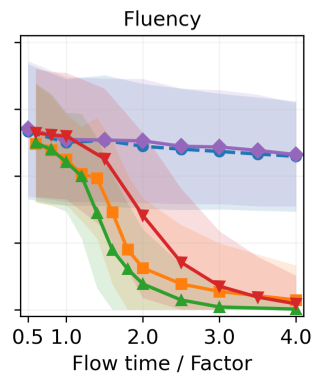
Crucially, FLAS maintains Instruction Following and Fluency even as the steering strength increases. Previous methods usually caused the model's logic to collapse ("brain rot") when turned up too high, but FLAS remains robust.
Deep Insight: The Geometry is Curved
The most striking part of the paper is the visualization of the trajectories. By performing PCA on the displacements, the authors found that the paths taken by the activations are not straight lines.
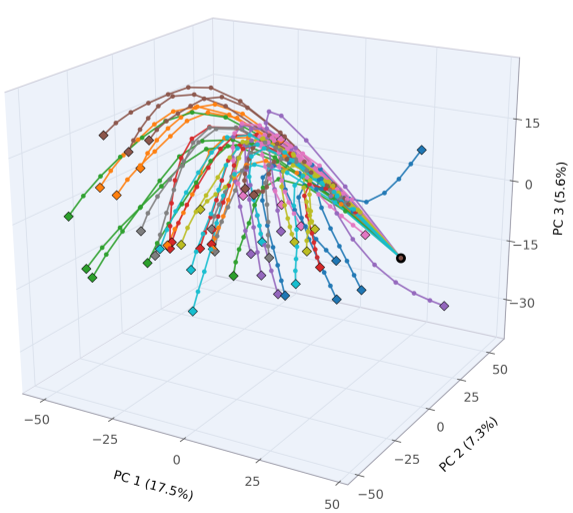
As seen in the figure above, all concept trajectories start by leaving the origin in a similar direction (a "general steering" phase) before executing a sharp bend into concept-specific regions. This explains why single-step linear methods struggle—they can't capture the "bend."
Critical Analysis & Conclusion
FLAS represents a shift from Representation Engineering as a static search for vectors to a dynamic process of Representation Transport.
Takeaways:
- Complexity Matters: The latent space of LLMs is a manifold, not a flat Euclidean space. Multi-step methods are necessary to navigate it.
- Position Sensitivity: Different tokens need different amounts of steering. FLAS handles this naturally, whereas global vectors fail.
Limitations: The main drawback is inference cost. Because FLAS runs multiple Euler steps, it adds a per-token latency (~30-50% slowdown). While this is optimized-out in some production environments, it remains the "tax" for superior control.
In conclusion, FLAS proves that if we want to steer the most powerful models in the world, we need to stop thinking in terms of "points" and start thinking in terms of "flows."