
AuxPath-FM: Revolutionizing Flow Matching with Arbitrary Trajectories and 2x Faster Guidance
Flow Matching with Arbitrary Auxiliary Paths
The paper introduces AuxPath-FM (Flow Matching with Arbitrary Auxiliary Paths), a novel generative framework that generalizes probability paths by incorporating auxiliary variables from arbitrary distributions (Gaussian, Uniform, Laplace, etc.). It achieves state-of-the-art efficiency by enabling Trajectory-Level Classifier-Free Guidance (CFG), which halves inference costs compared to standard methods.
TL;DR
Researchers have unveiled AuxPath-FM, a framework that breaks the "Gaussian noise" monopoly in generative modeling. By allowing probability paths to follow arbitrary auxiliary distributions, they've managed to embed class labels directly into the flow's geometry. The result? Classifier-Free Guidance (CFG) that is 2x faster because it only requires one neural network pass instead of two.
Background: The Limitations of "Network-Only" Conditioning
In the world of Flow Matching (FM) and Diffusion, we usually treat the "path" from noise to data as a relatively fixed highway. When we want to generate a specific image (like a "cat"), we typically tell the neural network via an embedding, and the network struggles to steer the sample toward the "cat" region.
This leads to an expensive trick called Classifier-Free Guidance (CFG). To get high-quality results, CFG evaluates the model twice at every step—once with the label and once without—to calculate a "direction" toward the label. This doubling of compute is a massive headache for scaling large models.
The Core Insight: Geometry is Guidance
The authors of AuxPath-FM asked a radical question: What if the path itself knew about the label?
By redefining the interpolation path to include an auxiliary variable : Where:
- is the data.
- is the starting noise.
- is an arbitrary variable (not just Gaussian noise!).
If we set to be a semantic prototype (the "average" of all cats), the trajectory is naturally biased toward the correct class from the very first step.
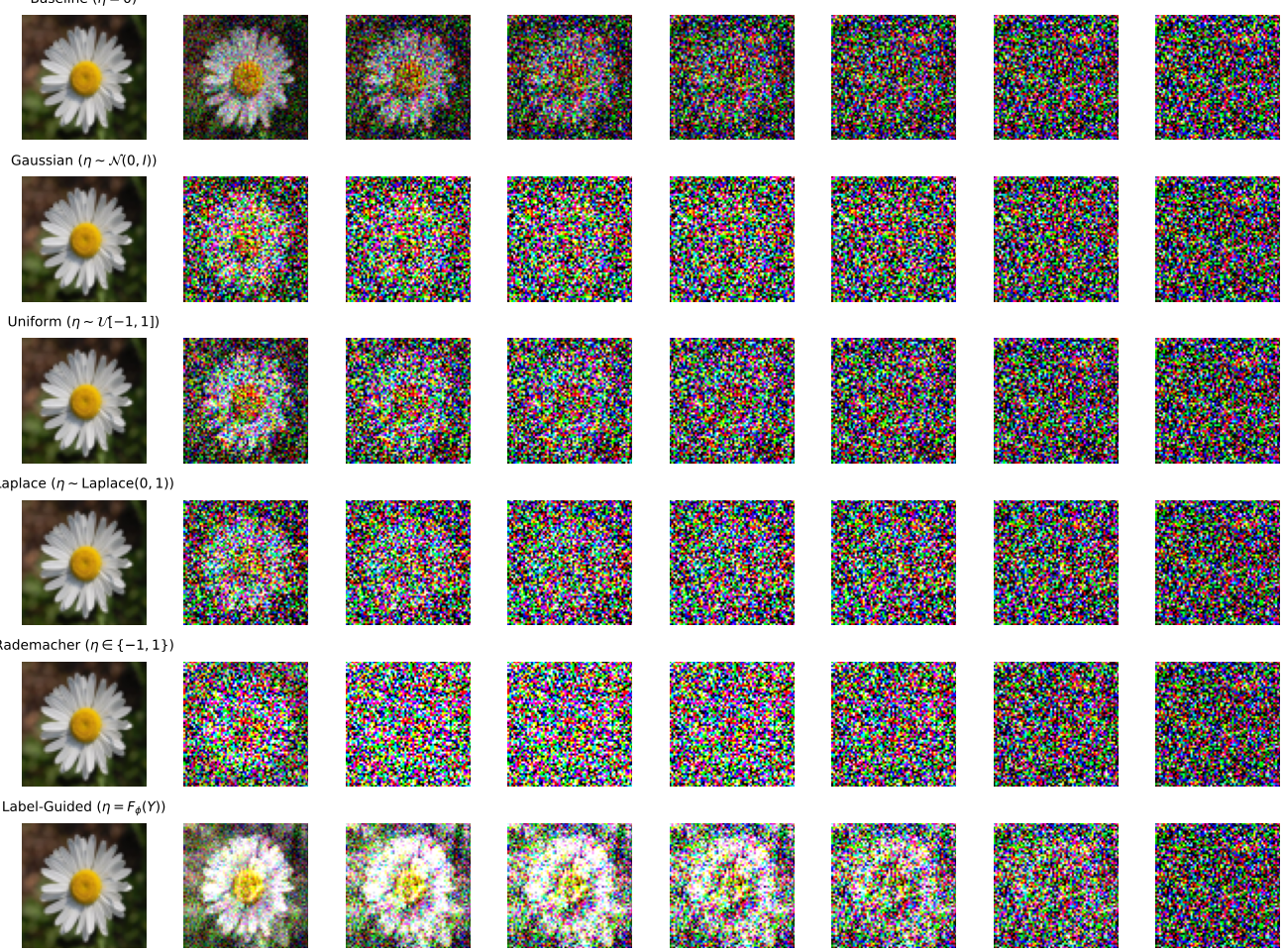 Figure 1: Diverse geometric properties induced by different auxiliary distributions (Gaussian, Uniform, Laplace, etc.).
Methodology: Trajectory-Level CFG
The mathematical beauty of this paper lies in demonstrating that even with an arbitrary , the Continuity Equation still holds. This allows the velocity field to be decomposed:
In this setup:
- is the "heavy" backbone model (the expensive DiT or U-Net).
- is a "lightweight" module that predicts the class center.
Because the guidance is additive at the trajectory level, we no longer need to run the heavy backbone twice! We run it once, and then simply add the nudge from the tiny module.
The Two-Stage Training Process:
- Stage 1: Train a tiny network to find the "center" of each class.
- Stage 2: Train the Flow Matching model using the path modified by these centers.
Experimental Battlefront: Speed vs. Quality
The authors tested AuxPath-FM across MNIST, CIFAR-10, and ImageNet-1k.
1. High-Resolution Performance (ImageNet-1k)
Using a Diffusion Transformer (DiT-B/2), AuxPath-FM achieved competitive FID scores while significantly slashing the GFLOPs required for generation.
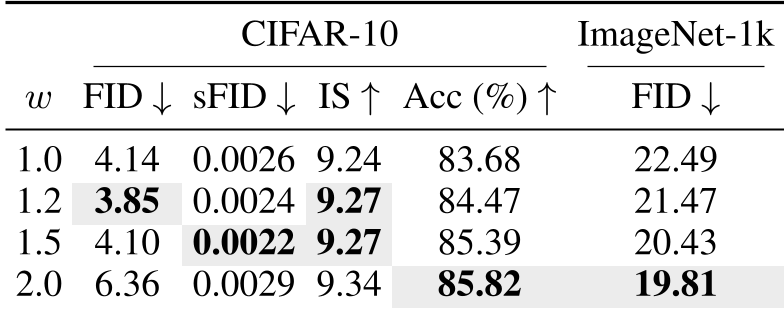 Table 1: As guidance scale increases, FID improves, but notice the "Pass" count stays at 1 for trajectory-level guidance.
2. Multi-modal Accuracy
On the challenging "Ring-64" dataset (64 clusters in a circle), the label-guided outperformed all other noise types, proving that "structured" noise is superior to "random" noise for complex distributions.
Critical Insight & Future Outlook
The most profound takeaway is that AuxPath-FM can upgrade pre-trained unconditional models. You don't have to retrain your giant foundation model from scratch to get faster, guided generation. By fine-tuning with a semantic auxiliary path, you "teach" the existing trajectories to respond to labels.
Limitations: While the inference speed is halved, the method relies on accurately capturing class prototypes. For extremely complex or "long-tail" datasets where a "class center" is ill-defined, this approach might need more sophisticated auxiliary distributions.
Conclusion
AuxPath-FM bridges the gap between the rigid math of probability paths and the practical need for controllable, efficient AI. By treating the generation path as a flexible, steerable entity, it paves the way for the next generation of real-time, high-fidelity generative models.