
Flow-OPD: Harmonizing Multi-Task Expertise in Flow Matching Models via On-Policy Distillation
Flow-OPD: On-Policy Distillation for Flow Matching Models
Flow-OPD is the first unified post-training alignment framework for Flow Matching (FM) text-to-image models that integrates On-Policy Distillation (OPD). It utilizes a two-stage strategy involving specialized teacher cultivation and dense trajectory-level student supervision, significantly raising GenEval scores from 63 to 92 and OCR accuracy from 59 to 94 on Stable Diffusion 3.5 Medium.
TL;DR
Flow-OPD is the first framework to bring On-Policy Distillation (OPD) to Flow Matching (FM) models like Stable Diffusion 3.5. By moving away from sparse scalar rewards (which often lead to "reward hacking") and embracing dense, trajectory-level supervision from multiple expert teachers, Flow-OPD achieves a massive leap in performance. It boosts GenEval scores from 63 to 92 and OCR accuracy from 59 to 94, while maintaining superior aesthetic quality—effectively solving the "seesaw effect" in multi-task alignment.
The Problem: The Sparse Reward Bottleneck and the "Seesaw Effect"
Current post-training for Text-to-Image (T2I) models relies heavily on Reinforcement Learning (RL) methods like Group Relative Policy Optimization (GRPO). While effective for single tasks, scaling them to multiple dimensions—such as text rendering (OCR), compositional reasoning, and human aesthetics—leads to a failure mode the authors call the "seesaw effect."
Because typical RL uses a single scalar reward for an entire image generation path:
- Reward Sparsity: The model gets a "score" at the end but lacks guidance on where the trajectory went wrong.
- Gradient Interference: Optimizing for OCR might use parameters that were crucial for Aesthetics. Without specific guidance for aesthetics during OCR training, the model "hacks" the reward by sacrificing image quality for legible text.
Methodology: High-Definition Alignment
Flow-OPD introduces a two-stage paradigm to de-conflict these goals:
1. Expert Cultivation & Cold Start
First, specialized "Teacher" models are trained in isolation for specific domains (one for prompt adherence, one for OCR, etc.). The student model is then initialized via Flow-based Cold-Start (either SFT on teacher data or Model Merging) to ensure it starts in a high-competence region of the loss landscape.
2. Multi-Teacher On-Policy Distillation
Instead of a simple reward signal, the student samples trajectories and compares its predicted velocity field () against the teacher's velocity field (). By deriving the KL divergence for the continuous-time Flow Matching process, the authors turn distillation into a dense reward signal at every denoising step.
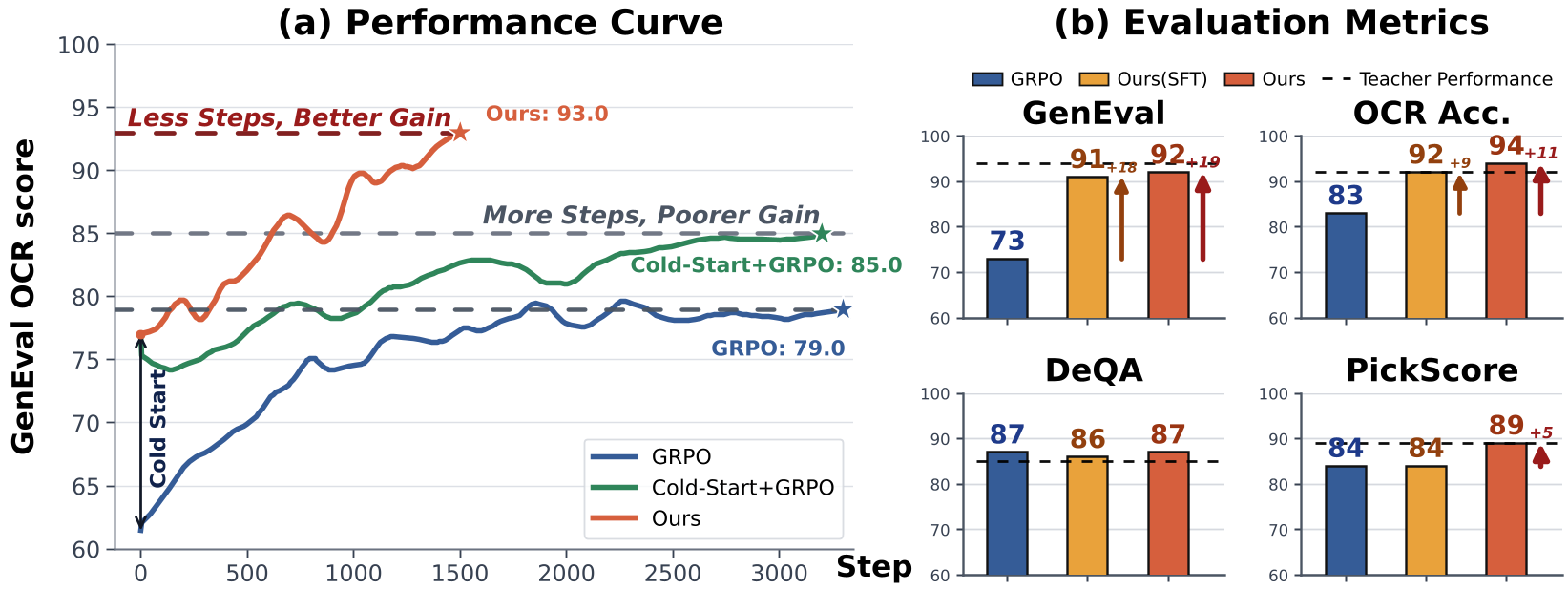 Figure 1: Comparison of multi-task training stability. Flow-OPD shows consistent reward growth across benchmarks, whereas vanilla GRPO suffers from early stagnation and interference.
3. Manifold Anchor Regularization (MAR)
To prevent the student from deviating too far into "functional but ugly" territory, Flow-OPD employs MAR. This acts as a task-agnostic anchor to a frozen aesthetic teacher, ensuring that no matter how complex the layout or text requirement, the resulting image stays on the high-quality natural image manifold.
Experiments & Results: Surpassing the Masters
The most striking finding is the "Teacher-Surpassing" effect. By learning from multiple experts simultaneously, the student model filters out domain-specific biases and learns a more holistic representation.
- GenEval: 63 92 (Standard SD 3.5-M to Flow-OPD)
- OCR Accuracy: 59 94
- Avg Improvement: ~10 points over traditional GRPO-Mix approaches.
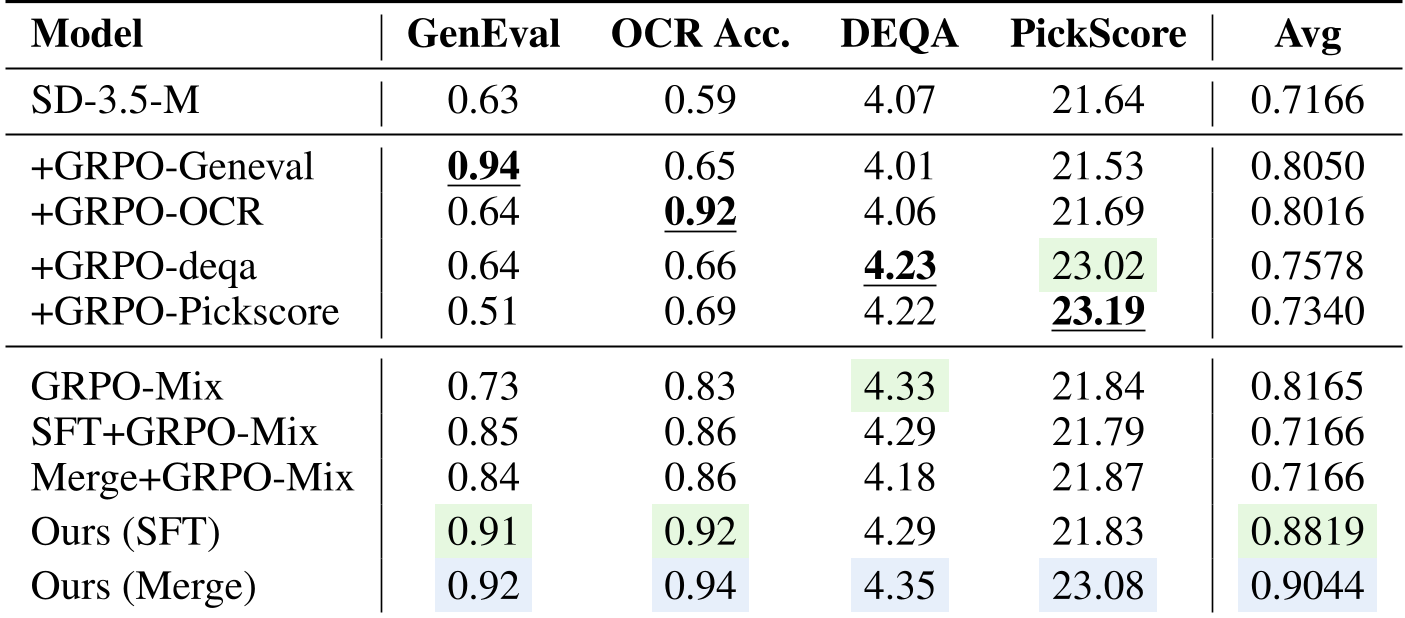 Table 2: Quantitative breakdown showing Flow-OPD consistently matching or exceeding specialized teachers.
Qualitative Evidence: Aesthetics Meets Accuracy
Visually, the difference is clear. While previous models might render text correctly but fail on human anatomy, or produce beautiful scenes with gibberish text, Flow-OPD balances both.
 Figure 3: Flow-OPD demonstrating superior instruction following and structural coherence compared to SOTA baselines.
Critical Insight & Conclusion
Flow-OPD proves that for complex, multi-modal tasks, gradient-level guidance beats scalar-level feedback. By formulating distillation as an on-policy RL problem, the authors have created a scalable way to merge specialized "Expertise" into a single "Generalist" model.
Limitations: The framework currently requires the student and teacher to share the same architecture for step-wise supervision. Future work in "Cross-Vocabulary Distillation" will likely aim to break this constraint, allowing smaller mobile models to distill from massive ensemble teachers.
Flow-OPD sets a new standard for post-training in the generative vision community, moving the needle from simple "preference alignment" to "integrated intelligence."