
Flow Sampling: Accelerating Scientific Discovery with Denoising Diffusion Samplers
Flow Sampling: Learning to Sample from Unnormalized Densities via Denoising Conditional Processes
Flow Sampling is a novel framework for learning amortized diffusion-based samplers from unnormalized densities using a denoising conditional process. By matching conditional denoising drifts instead of noising drifts, it achieves state-of-the-art performance in molecular conformer generation and synthetic energy benchmarks.
TL;DR
Flow Sampling is a major leap in generating samples from unnormalized probability densities (defined by energy functions). Unlike standard diffusion models that learn to add noise, Flow Sampling learns to remove it by conditioning on the source distribution. This allows for a massive 4x–8x training speedup and, for the first time, provides a closed-form solution for sampling on curved Riemannian manifolds like spheres and hyperbolic spaces.
Problem & Motivation: The "Data-Free" Bottleneck
In fields like computational chemistry or drug discovery, we often know the energy function of a molecule but lack actual samples of its stable states. Existing solutions typically fall into two camps:
- MCMC/Langevin Dynamics: Mathematically correct but painfully slow because they generate samples one by one.
- Standard Diffusion Samplers: They try to bridge "noise" and "data" by estimating gradients many times, which becomes prohibitively expensive when each energy evaluation (NFE) takes significant compute.
The authors identified that existing diffusion methods are "noising" processes. They require constant Monte Carlo corrections to align with the target. Flow Sampling flips the script: what if we condition on the noise and learn a denoising drift toward the energy minima from the start?
Methodology: The Power of Denoising Conditioning
The core innovation is the Denoising Conditional Process. In a standard Flow Matching setup, you condition on a data point and push the source . Flow Sampling conditions on the noise and pushes the target .
The Mathematical Intuition
The authors derive a supervising drift that injects target information (the reward/energy gradient ) directly into the learning signal:
abla r(X_1)$$ This formula is a game-changer because for every target sample $X_1$, the expensive energy gradient $ abla r(X_1)$ only needs to be computed **once**. By using a replay buffer, the model can reuse these gradients throughout training. ### Going Beyond Euclidean Space Perhaps the most elegant part of the paper is the extension to **Riemannian Manifolds**. By utilizing the properties of constant curvature manifolds (like the Hypersphere $\mathbb{S}^d$), the authors used **Jacobi Fields** to derive a closed-form Jacobian of the geodesic interpolant. This allows the model to perform diffusion directly on the surface of a sphere – essential for robotics and structural biology – without needing messy reparameterizations. 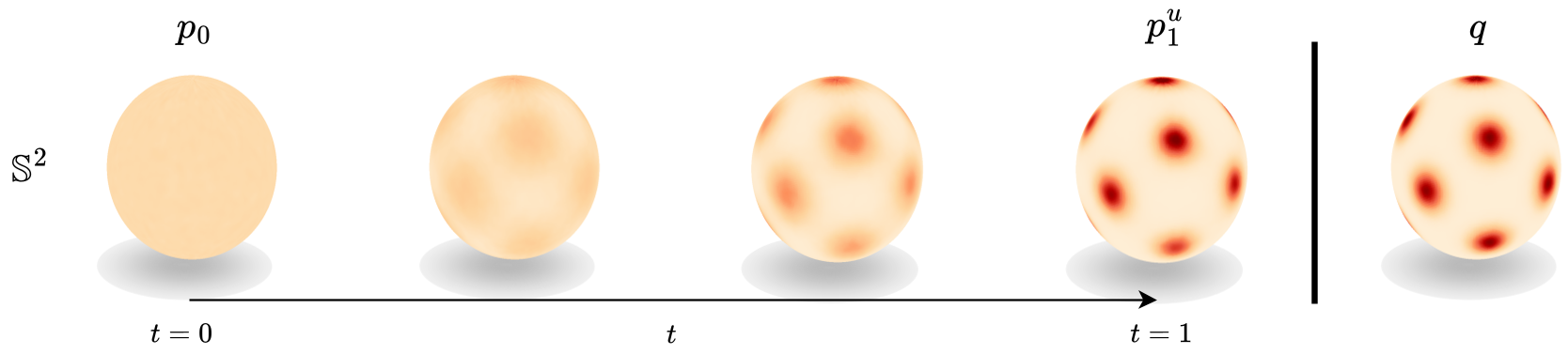 *Figure 1: Flow Sampling accurately recovers multimodal densities on a sphere using iterative learning.* ## Experiments: Efficiency Meets Accuracy The authors tested Flow Sampling on synthetic energy benchmarks (Double-Well, Lennard-Jones) and large-scale molecular tasks (SPICE, GEOM-DRUGS). ### Key Findings: - **Conformer Generation**: On the SPICE dataset, Flow Sampling remained robust even when training with only 64 NFEs, whereas competitors like Adjoint Sampling (AS) collapsed. - **Peptide Accuracy**: For Alanine Dipeptide (Ala2), Flow Sampling achieved a Joint JSD of 0.018, significantly better than ASBS's 0.242 at identical NFE levels. 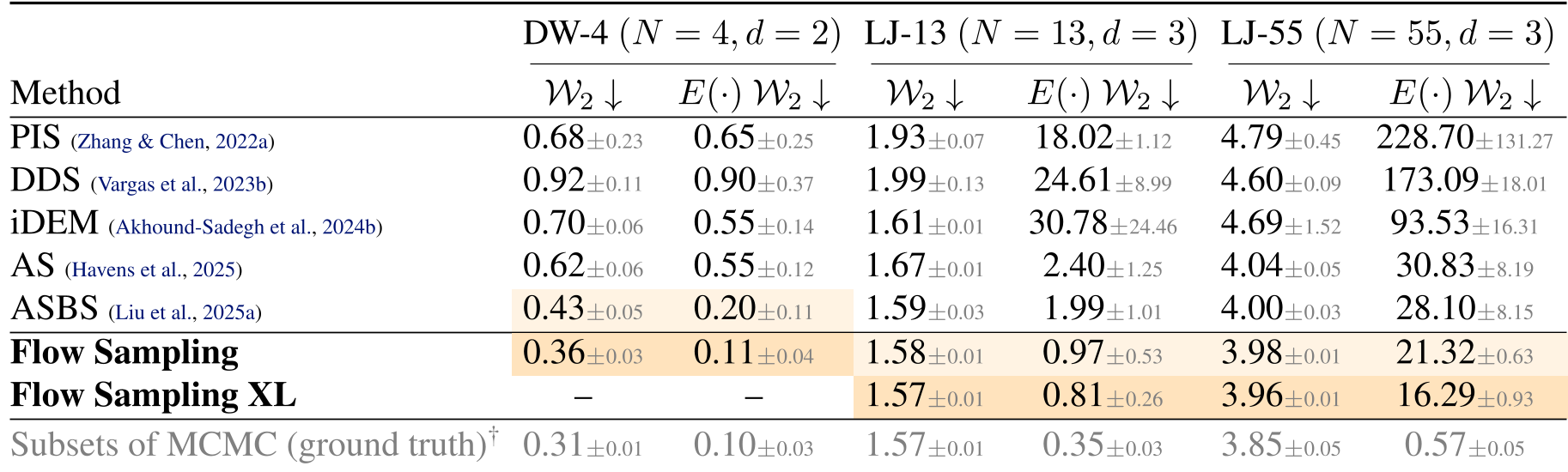 *Table 1: Superior performance across particle systems, showing improved energy concentration compared to SOTA.* ### Qualitative Excellence In the Ala4 peptide test (Figure 3 in the paper), Flow Sampling demonstrated the ability to cover all 8 metastable modes of the molecule, maintaining a tighter concentration around physically plausible regions than previous methods. ## Critical Analysis & Future Outlook ### Takeaway Flow Sampling's efficiency comes from its "fixed-point" strategy: iterating between exploring with the current sampler and optimizing with the stored gradients. This simplicity makes it highly scalable for real-world chemical engineering. ### Limitations - **Convergence**: As a fixed-point procedure, it lacks a global convergence guarantee (though it works excellently in practice). - **Geometry**: Currently limited to constant curvature manifolds. Extending this to general constrained manifolds (e.g., protein backbones with rigid bonds) is the next frontier. Effective, scalable, and geometrically aware—Flow Sampling is set to be a cornerstone for the next generation of AI-driven scientific simulation.