
[2026] FLUIDWORLD: Is Self-Attention Necessary for World Models?
FluidWorld: Reaction-Diffusion Dynamics as a Predictive Substrate for World Models
FLUIDWORLD is a novel world model architecture that replaces self-attention and convolutional recurrence with reaction-diffusion partial differential equations (PDEs) as its predictive engine. On the UCF-101 and Moving MNIST benchmarks, it achieves 2x lower reconstruction error and superior multi-step rollout stability compared to parameter-matched Transformer and ConvLSTM baselines.
Executive Summary
TL;DR: FLUIDWORLD challenges the dominance of Transformers in world modeling by replacing self-attention with Reaction-Diffusion PDEs. In a parameter-matched battle (800K params), this physics-grounded substrate outperformed Transformers and ConvLSTMs in rollout stability and spatial structure preservation, achieving 2x lower reconstruction error.
Background: While the industry defaults to Transformers, this work positions itself as an architectural "back-to-basics" movement. It asks whether the laws of physics—specifically diffusion—can provide a more robust inductive bias for predicting the future than generic combinatorics.
Problem: The Fragility of Latent Imagination
Current world models (like DreamerV3 or ISO-JEPA) typically use Transformers to predict the next latent state. This approach has three fatal flaws:
- Computational Waste: Quadratic scaling limits resolution.
- Lack of Physics: The model must spend capacity learning that "pixels near each other usually move together."
- Error Accumulation: In autoregressive rollouts (mental simulation), small errors compound exponentially because the architecture has no inherent mechanism to "smooth out" noise.
Methodology: The BeliefField and Reaction-Diffusion
Instead of a discrete forward pass, FLUIDWORLD defines a BeliefField () that evolves via a continuous-time PDE.
The Core Equation
The state evolves according to:
abla^2 u + R(u) + ext{Memory}$$ * **Diffusion ($D \cdot abla^2 u$)**: A multi-scale Laplacian (dilations 1, 4, 16) that propagates information spatially at $O(N)$ cost. * **Reaction ($R(u)$)**: A position-wise MLP that handles nonlinear transformations. * **Bio-Mechanisms**: It incorporates *Synaptic Fatigue* and *Lateral Inhibition* to prevent channel collapse, ensuring the model uses its full representational capacity. 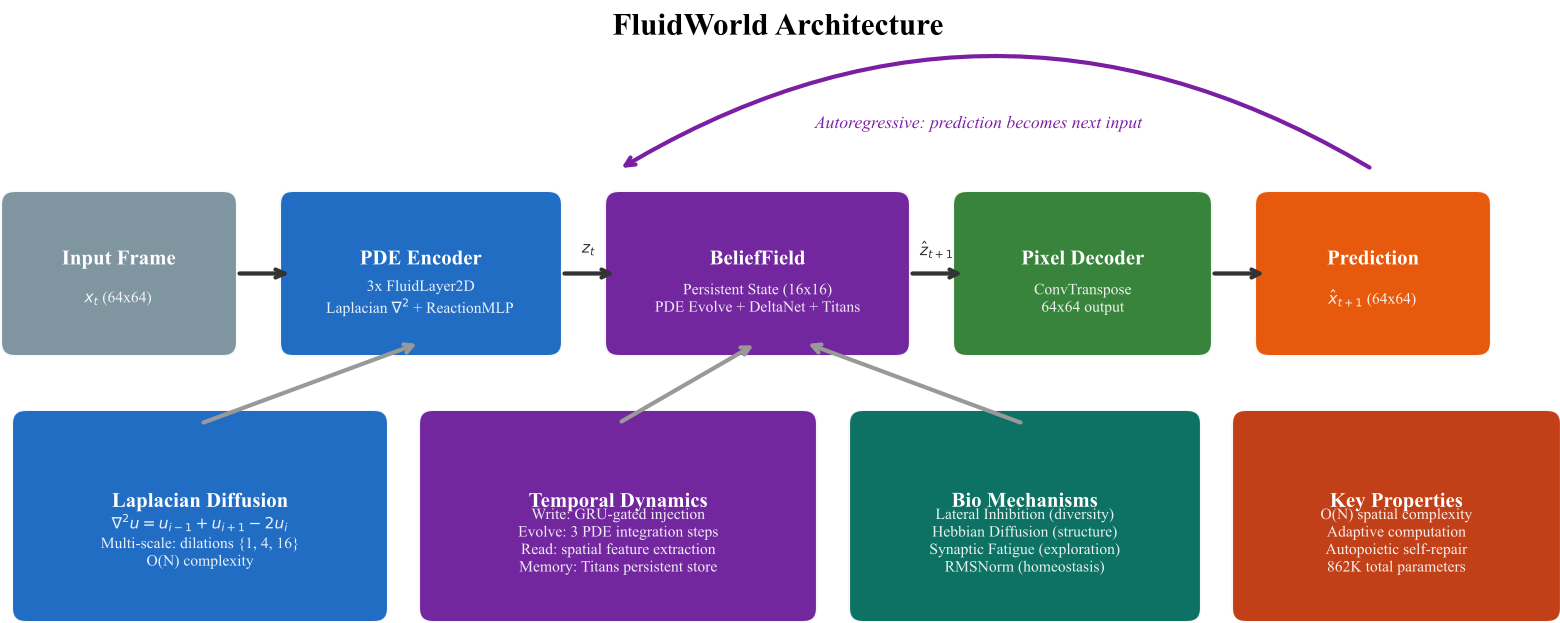 *Figure 1: The FLUIDWORLD pipeline. Note how the BeliefField evolution replaces the standard Transformer block.* ## Experiments: PDE vs. The World To prove this wasn't just "parameter hunting," the author compared three models with exactly **~801K parameters** on UCF-101. ### Results at a Glance | Metric | FLUIDWORLD (PDE) | Transformer | ConvLSTM | | :--- | :--- | :--- | :--- | | **Reconstruction MSE** | **0.001** | 0.002 | 0.001 | | **Effective Rank** | **~20,000** | ~16,500 | ~19,000 | | **Rollout Stability** | **Stable to $h=3$** | Fails at $h=2$ | Fails at $h=2$ | The most striking discovery was the **"Autopoietic Self-Repair."** When the latent state was 50% corrupted with noise, the PDE substrate naturally "healed" itself through diffusion. 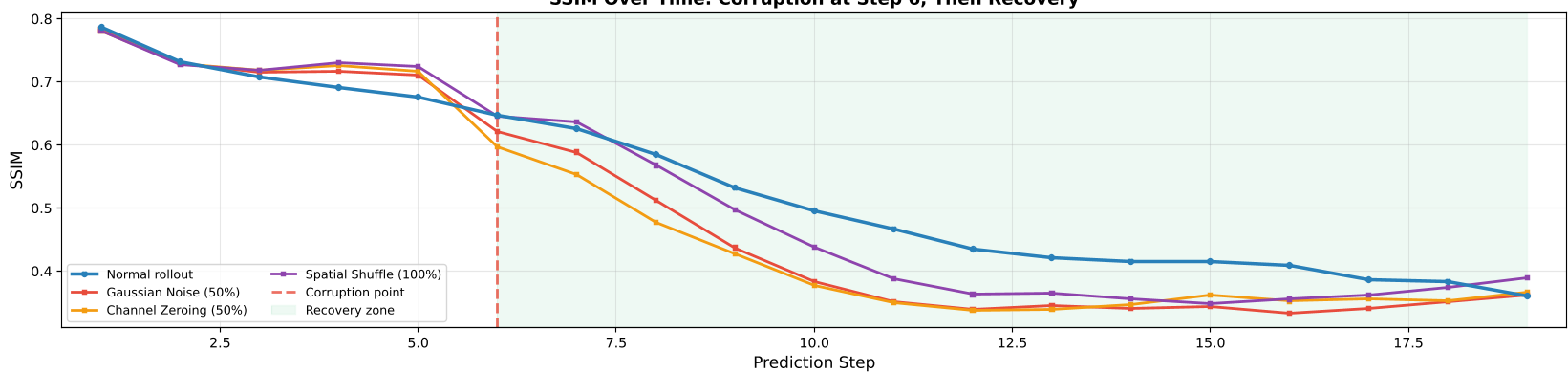 *Figure 2: Deliberate state corruption at step 5. The PDE smooths the corruption (Step 9-11), whereas traditional models would enter a permanent "hallucination" state.* ## Critical Insight: The Oscillatory Recovery On Moving MNIST, FLUIDWORLD displayed a non-monotonic SSIM curve. Usually, model accuracy drops steadily over time. FLUIDWORLD's accuracy **dropped and then rose again**. **Why?** The Laplacian operator acts as a spatial "immune system." It identifies high-frequency prediction errors as "noise" and dissipates them via diffusion, allowing the underlying low-frequency structure (the "object") to re-emerge. ## Conclusion & Future Work FLUIDWORLD proves that **Reaction-Diffusion is a viable, parameter-efficient alternative to Attention.** * **Value**: It offers $O(N)$ scaling, making it a prime candidate for high-resolution robotics. * **Limitations**: It is currently $5-8 imes$ slower to train due to the iterative nature of PDE integration. * **Future**: The next frontier is action-conditioned planning—directing the "flow" of the BeliefField via agent intentions. This work suggests that the future of World Models may look less like a database (Attention) and more like a fluid (PDE).