
[CVPR 2024] FORGE: Can AI Actually Run a Factory? Deep-Diving into Fine-Grained Manufacturing Evaluation
FORGE: Fine-grained Multimodal Evaluation for Manufacturing Scenarios
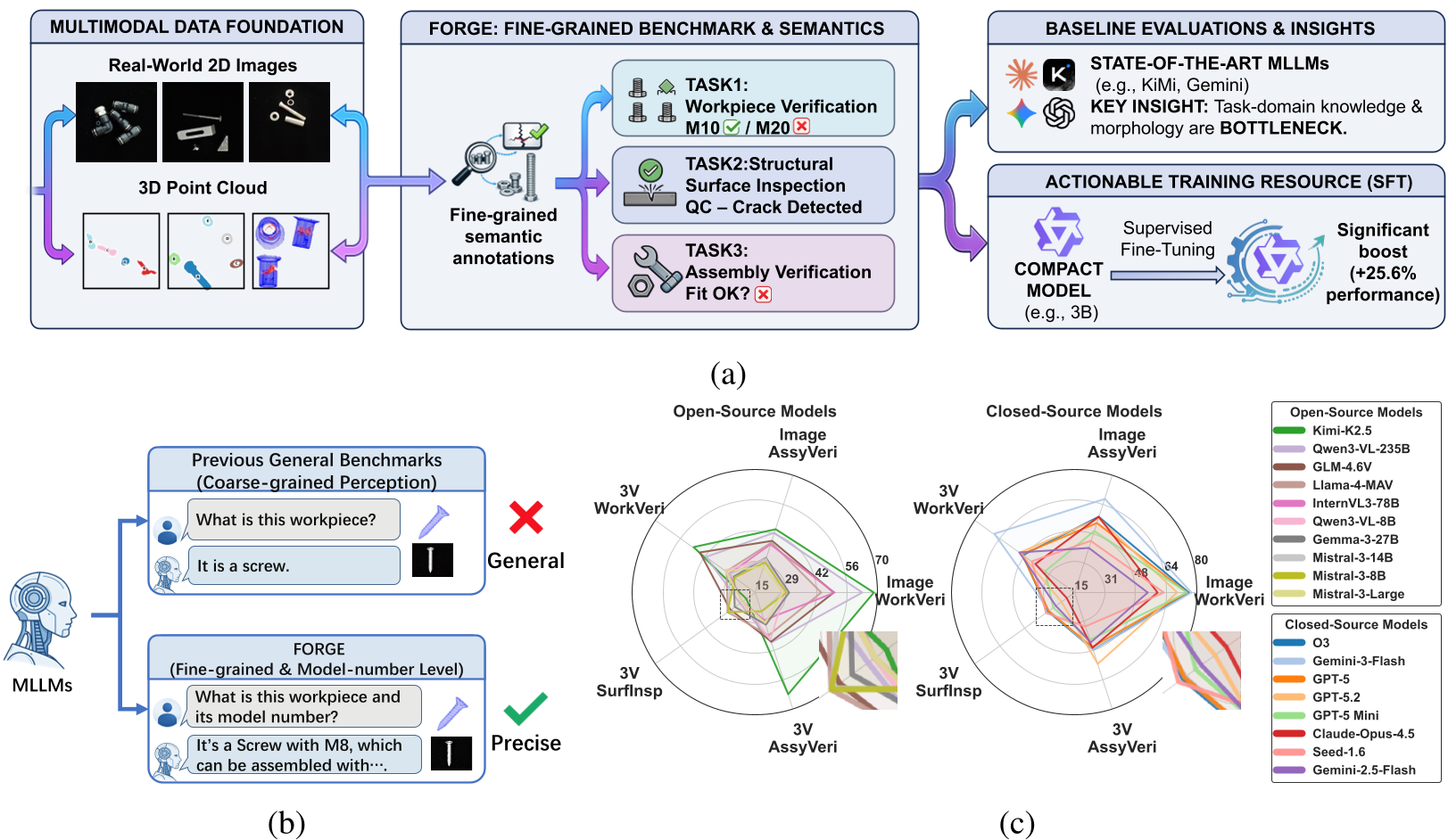
The paper introduces FORGE, a first-of-its-kind comprehensive multimodal benchmark for evaluating Multimodal Large Language Models (MLLMs) in manufacturing scenarios. It utilizes a large-scale dataset of aligned 2D images and 3D point clouds (rendered as three-view images) to assess 18 SOTA models on tasks like workpiece verification and assembly compatibility, revealing significant performance gaps.
TL;DR
Current Multimodal Large Language Models (MLLMs) are great at identifying a "bolt," but they fail miserably at distinguishing an M10 bolt from an M12 bolt. The FORGE benchmark introduces a rigorous framework using 2D images and 3D point clouds to test 18 SOTA models. The verdict? Models have the eyesight (grounding) but lack the brain (domain knowledge). However, the authors prove that fine-tuning a tiny 3B model on their data can outperform models 80x its size.
1. The Perception-to-Cognition Gap in Industry
In the world of smart manufacturing, we are moving away from simple "eyes" (vision models for defect detection) to "brains" (autonomous agents that decide if an assembly is safe).
Traditional vision models are modular and narrow. They can spot a crack, but they can't reason about whether that crack violates a specific ISO standard or if a part is the wrong model number for a complex CNC fixture. This is where MLLMs should shine, but existing benchmarks are too "coarse." Identifying a "screw" isn't enough when the production line requires a specific thread pitch.
2. Methodology: FORGE-ing a New Standard
The researchers behind FORGE addressed two pillars: Modality and Task Logic.
3D as 2D: The Multi-View Strategy
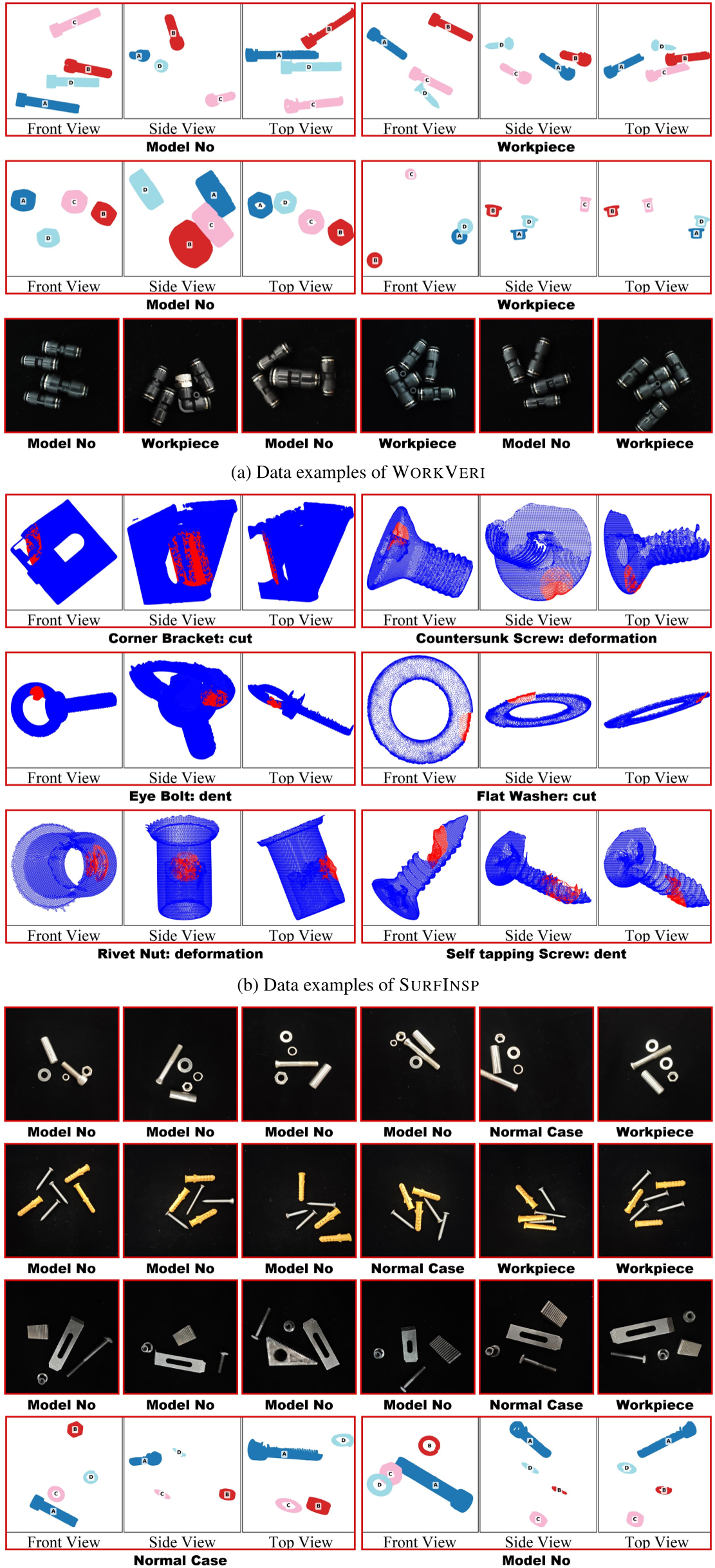
Since most frontier MLLMs (GPT-4o, Gemini) don't have native 3D point cloud encoders, the authors used a Three-View (3V) projection. By rendering front, side, and top orthogonal views, they allowed the models to perceive 3D geometry through their existing 2D visual "machinery."
Three Pillars of Manufacturing Intelligence
- WORKVERI (Workpiece Verification): Can the model find the "imposter" in a batch of parts?
- SURFINSP (Surface Inspection): Can it identify micro-defects like cracks or dents?
- ASSYVERI (Assembly Verification): This is the high-level reasoning task. Given a set of rules (e.g., "An expansion bolt needs a sleeve, a nut, and two washers"), can the model spot an error in a complex 3D assembly?
3. The "Gotcha" Moment: Grounding vs. Knowledge
The most fascinating part of the paper is the Bottleneck Analysis. One might assume MLLMs fail because they can't "see" the small parts.
The results say otherwise. By using "Set-of-Mark" (SoM) prompting—labeling parts with letters—the researchers tested if models could simply point to parts. Gemini-3-Flash hit 98.9% accuracy in single-image grounding.
So why do they fail industrial tasks? The failure happens in Domain Reasoning. The models can see the washer, but they don't know that a "Spring Washer" is required to prevent vibration loosening in that specific context. It's a failure of knowledge, not vision.
4. Results: Small Models, Big Gains
The benchmark evaluated 18 models. Open-source models (like Qwen, Llama) generally hovered near the random baseline on complex tasks, while Gemini and GPT-4o led the pack.
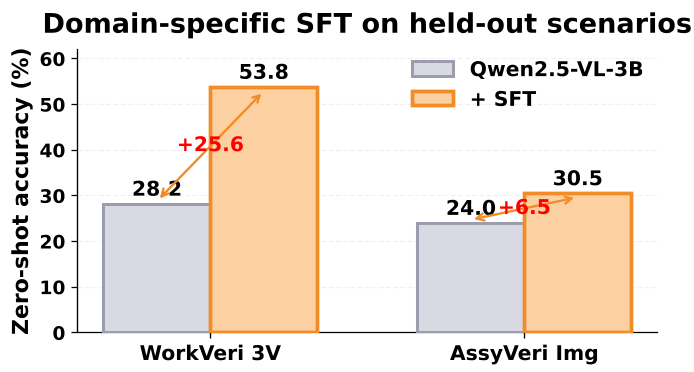
However, the authors demonstrated a "Practical Pathway": By taking a relatively small 3B parameter model (Qwen2.5-VL) and performing Supervised Fine-Tuning (SFT) on the FORGE dataset, the performance on held-out (unseen) manufacturing scenarios jumped by 90.8%. This suggests that we don't need 100B+ parameter giants for the factory floor; we need well-instructed specialized models.
5. Critical Analysis & Future Outlook
Limitations
- Microscopic Analysis: Even the best models are bad at surface defects (SURFINSP). 2D projections might lose the texture detail needed for subtle crack detection.
- Temporal Dynamics: Real factories involve video streams and moving parts; FORGE is currently static.
Future Perspectives
FORGE proves that the goal of "Autonomous Manufacturing" is within reach if we stop treating MLLMs like general-purpose chat-bots and start treating them like expert apprentices. The next frontier is Retrieval-Augmented Generation (RAG) for industrial standards, where a model can look up a blueprint in real-time to verify an assembly it has never seen before.
Key Takeaway: Stop trying to build a harder "eye." Build a smarter "industrial brain" by feeding it high-quality, fine-grained domain data.