
[PRL 2026] Precision QCD at the Frontier: Fully Analytic Four-Loop Non-Singlet Splitting Functions
The four-loop non-singlet splitting functions in QCD
The paper presents the first complete analytic calculation of the four-loop non-singlet splitting functions in perturbative Quantum Chromodynamics (QCD). These functions, , govern the -evolution of quark non-singlet parton distribution functions (PDFs) and include the determination of the four-loop virtual and rapidity anomalous dimensions.
TL;DR
Researchers have achieved a breakthrough in perturbative Quantum Chromodynamics (QCD) by deriving the first fully analytic expressions for four-loop non-singlet splitting functions. This result accurately describes how quarks evolve within a proton at N3LO precision, eliminating long-standing numerical uncertainties and providing the exact "virtual" and "rapidity" anomalous dimensions critical for high-energy collider predictions.
Background: The Pulse of the Proton
In the Standard Model, the internal structure of the proton is not static; it depends on the energy scale at which it is probed. This evolution is governed by the DGLAP equations, where the "splitting functions" act as the kernel, describing the probability of a parton radiating and changing its momentum fraction .
For decades, the community has pushed these kernels from one-loop (LO) to three-loop (NNLO) accuracy. However, as the LHC enters a high-precision era, the remaining numerical approximations in the four-loop (N3LO) sector became a bottleneck for interpreting experimental data.
Methodology: Solving 16,000 Diagrams
Calculating four-loop quantities is a monumental task in algebraic complexity. The authors utilized a sophisticated pipeline:
- Operator Matrix Elements (OMEs): Instead of calculating scattering cross-sections directly, they computed the anomalous dimensions of twist-two operators for a symbolic Mellin moment .
- IBP Reductions: Using tools like
Reduze 2andFinred, the authors reduced millions of integrals into a set of 6,000 Master Integrals. - Differential Equations: By introducing an auxiliary parameter , they converted symbolic powers into linear propagators and solved the resulting differential equations. Interestingly, while elliptic geometries appeared in the intermediate steps, they "dropped out" of the final poles, allowing for a result expressed in Harmonic Sums.
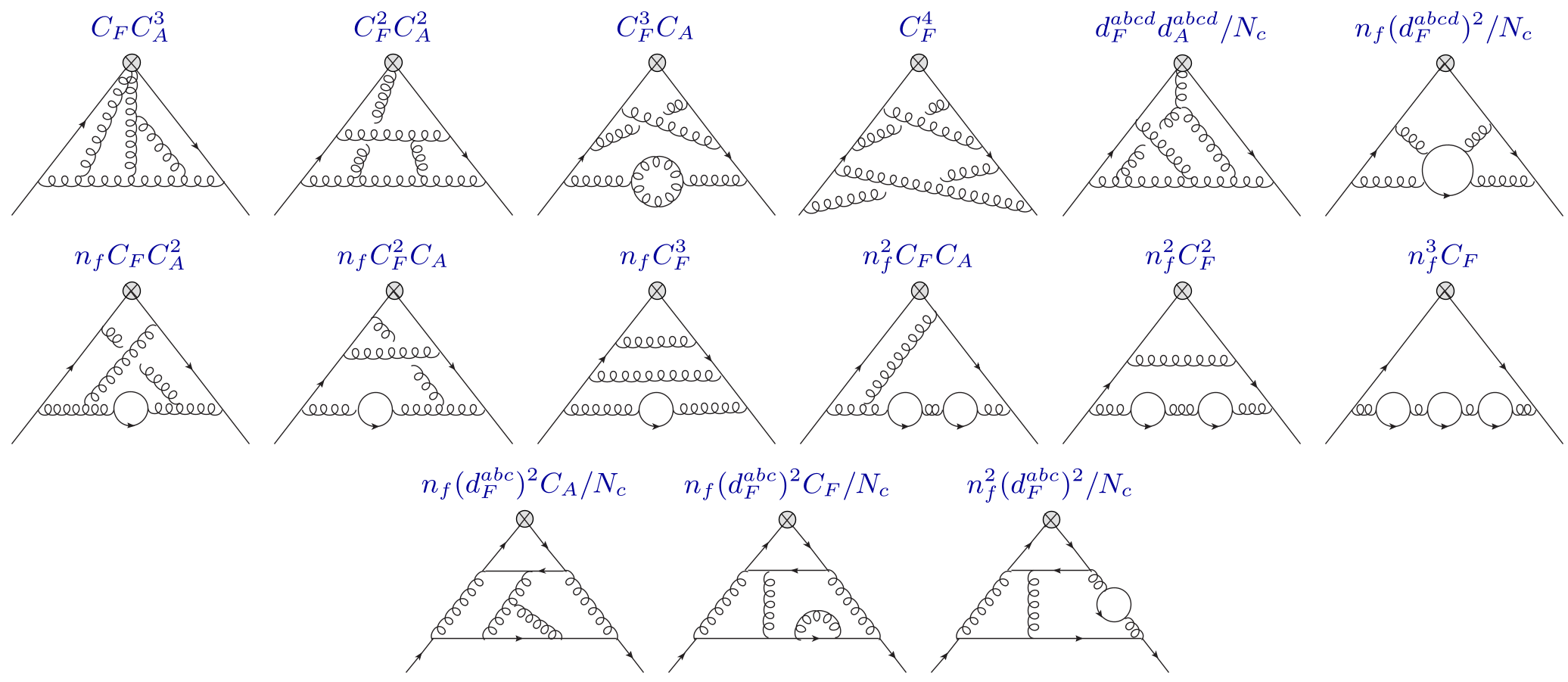 Fig 1: Selection of four-loop Feynman diagrams contributing to the non-singlet quark operator matrix elements.
The Core Achievement: Exact Asymptotics
The transition from numerical approximations to an analytic formula is not just a mathematical flex; it allows for the study of the proton at extreme limits ( and ):
- Large- Limit: The results confirm the four-loop Cusp Anomalous Dimension and provide the first analytic form of the Virtual Anomalous Dimension ().
- Small- Limit: The study verifies previous predictions for logarithmically enhanced terms () and provides power-suppressed corrections.
- Rapidity Anomalous Dimension: By combining these results with soft-collinear effective theory (SCET) correspondences, the authors determined the four-loop rapidity anomalous dimension analytically—a value previously known only through numerical estimation.
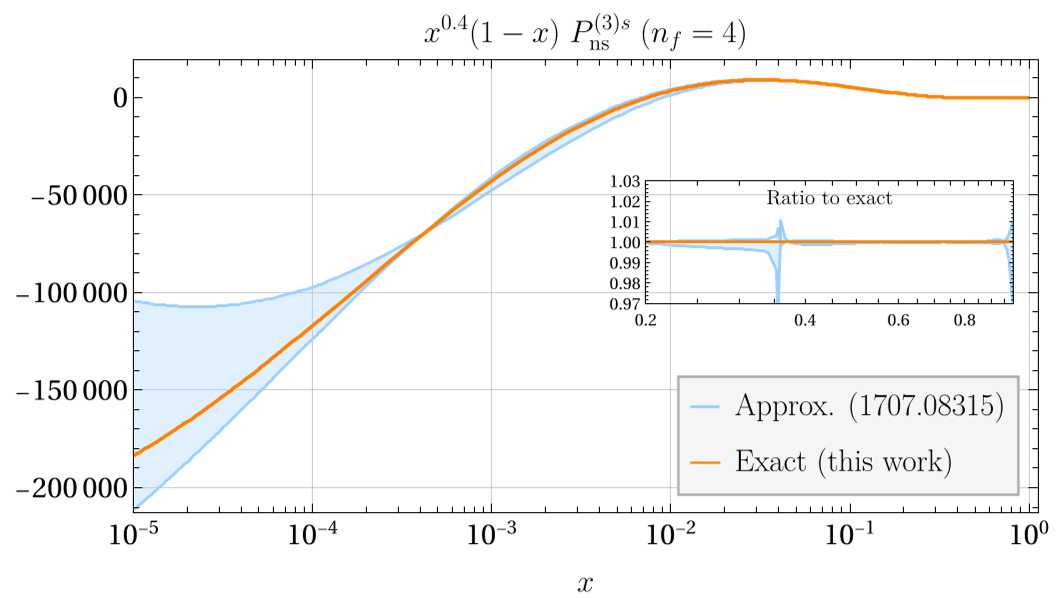 Fig 2: Comparison of the newly derived analytic four-loop non-singlet splitting functions (solid lines) against previous numerical approximations (shaded bands).
Experiments & Results
The authors compared their analytical results with the most advanced approximations available (e.g., Moch et al., 2017).
- Accuracy: The previous approximations were found to be remarkably robust, mostly staying within their quoted uncertainty bands.
- Deviation: Minor discrepancies were noted in at very low , where the analytic result provides a more precise upward correction.
- Numerical Implementation: For practical use in PDF fits, the authors provided ultra-fast power-logarithmic approximations with a relative error of less than .
Critical Analysis & Future Outlook
This paper marks the "beginning of the end" for the four-loop splitting function problem. While the non-singlet sector (differences between quark flavors) is now solved, the singlet sector (where quarks mix with gluons) remains the final boss of N3LO evolution.
Takeaway: This work provides the exact "theirs" and "ours" for quark flavor evolution, paving the way for N3LO PDF sets that will be the standard for the next decade of hadron collider physics. It also demonstrates that even when elliptic integrals appear in 4-loop QCD, the physical splitting functions might still reside in the simpler space of harmonic polylogarithms.
Senior Editor's Note: The precision of and is essential for transverse-momentum (qT) resummation at N3LL' and N4LL, making this paper a foundational reference for the theory community.