
FD-loss: Transforming Fréchet Distance from a Passive Metric into a Powerful Training Objective
Representation Fréchet Loss for Visual Generation
The paper introduces FD-loss, a novel post-training objective that enables direct optimization of the Fréchet Distance (FD) in various representation spaces. By decoupling population size from batch size, the authors achieve SOTA one-step generation, reaching 0.72 FID on ImageNet 256x256.
TL;DR
For nearly a decade, the generative AI community has treated Fréchet Inception Distance (FID) as the ultimate scoreboard—a metric to be monitored but never directly optimized. This paper breaks that wall by introducing FD-loss, a method that makes Fréchet Distance a practical training objective. By efficiently estimating distributional statistics, the authors transform "slow" multi-step diffusion and flow models into lightning-fast, high-quality one-step generators, achieving a record-breaking 0.72 FID on ImageNet.
The "Evaluation vs. Training" Paradox
In visual generation, we usually optimize sample-level losses (like MSE in Diffusion or Log-likelihood in Autoregressive models). However, we evaluate models using distribution-level metrics (like FID).
Why haven't we just optimized FID directly?
- Statistical Scale: To get a reliable FID, you need ~50,000 images. Back-propagating through 50,000 images in one training step is computationally impossible.
- Noise: Small-batch estimates of FD are incredibly noisy and often lead to "reward hacking" where the model generates artifacts to fool the metric.
Methodology: The Art of Decoupling
The core insight of this paper is simple yet brilliant: Decouple the population size for FD estimation from the batch size for gradient computation.
The authors propose two ways to do this:
- Queue-based: Maintain a rolling buffer (queue) of features from previous batches. Compute the Mean and Covariance over the whole queue, but only backprop through the current batch.
- EMA-based (The Winner): Track the first and second moments of features using an Exponential Moving Average. This is memory-efficient and keeps statistics "on-policy."
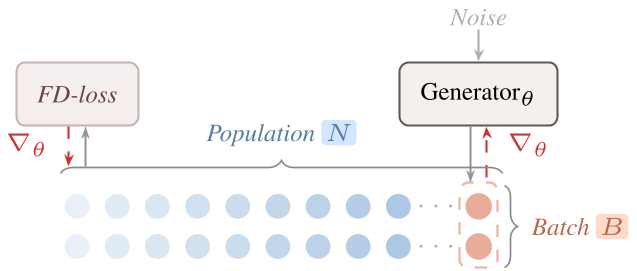 Figure 1: The FD-loss mechanism decoupling population size (N) from optimization batch size (B).
Surprising Findings: Repurposing Multi-Step Models
One of the most "magic" moments in the paper is Repurposing. The authors took a pre-trained multi-step generator (like SD3.5 or JiT) and, without any teacher distillation or GAN loss, forced it to produce a sample in a single step .
Initially, the output is pure noise (FID ~300). But after a few epochs of FD-loss post-training in modern representation spaces (like SigLIP or DINOv2), the model learns to "jump" to the final image in one go, achieving quality comparable to the multi-step original.
Is ImageNet Generation "Solved"?
The authors raise a provocative point: many SOTA models now have an FID lower than real validation images. Yet, we can still tell they are fake. This is Goodhart's Law in action: when a metric becomes a target, it ceases to be a good metric.
To solve this, they introduce FDr6, a metric that averages FD across six different deep-learning backbones (Inception, ConvNeXt, DINOv2, MAE, SigLIP2, and CLIP).
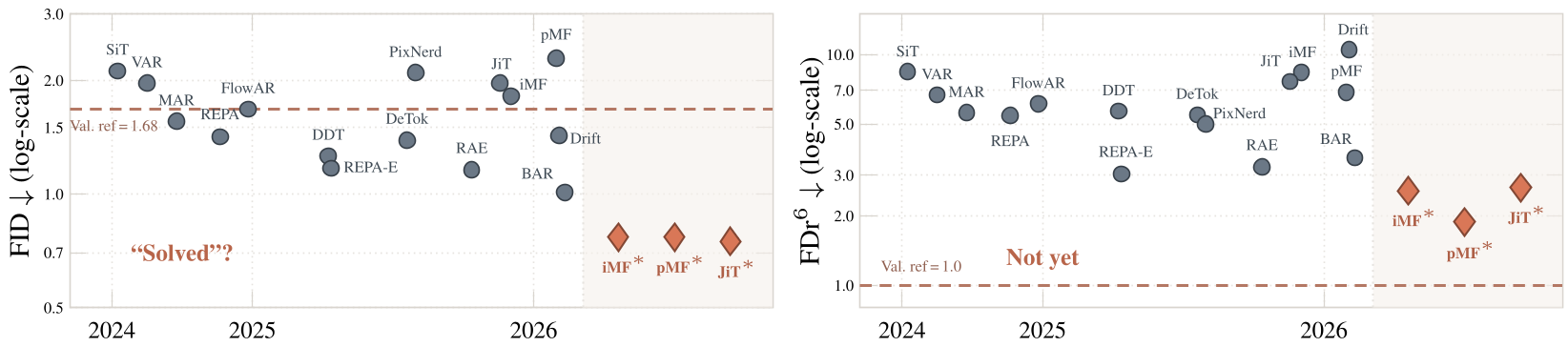 Figure 2: Comparing traditional FID with the new FDr6. While FID suggests the problem is solved, FDr6 reveals a significant remaining gap between generated and real images.
Depth Insight: The Representation Problem
The paper proves that the choice of Feature Space () is everything.
- Optimizing for Inception boosts FID but ignores structural artifacts.
- Optimizing for MAE (Masked Autoencoders) forces the model to learn better spatial structures.
- The best results come from FD-SIM (a combination of SigLIP, Inception, and MAE), which balances semantic alignment with textural detail.
Critical Analysis & Conclusion
The Takeaway: FD-loss is a "plug-and-play" post-training recipe. Whether you are using Pixel-space or Latent-space models, adding FD-loss for a few epochs consistently improves visual fidelity and inference speed.
Limitations: While FD-loss is powerful, it still assumes the feature distribution is Gaussian (as per the Fréchet Distance formula). If the underlying distribution is highly non-Gaussian (multi-modal), this metric might still have blind spots.
Future Outlook: This work signals a shift toward Distribution-level fine-tuning. We expect to see this approach applied beyond images—perhaps to video and audio—where global consistency is even harder to capture with simple pixel-wise losses.