
FreeTimeGS++: Unveiling the "Secrets" of 4D Gaussian Splatting and Restoring Physical Sanity
FreeTimeGS++: Secrets of Dynamic Gaussian Splatting and Their Principles
FreeTimeGS++ is a principled 4D Gaussian Splatting (4DGS) framework designed for high-fidelity dynamic scene reconstruction. By formalizing hidden implementation heuristics, it introduces Gated Marginalization and Neural Velocity Fields to achieve superior temporal stability and physical motion consistency, outperforming prior SOTA methods like FreeTimeGS with a +0.89 dB PSNR gain on DyNeRF.
The rapid rise of 3D Gaussian Splatting (3DGS) has revolutionized real-time rendering, and its temporal extension—4DGS—has quickly dominated dynamic scene reconstruction. However, as performance metrics like PSNR continue to climb, a troubling gap has emerged: high-quality images often hide "trash" underlying motion.
In their latest work, researchers from SNU and POSTECH introduce FreeTimeGS++, a framework that systematically dissects the "secrets" of why 4DGS works and proposes a principled way to fix its physical inconsistencies.
TL;DR
The paper uncovers that 4DGS often achieves high scores by "cheating"—using short-lived Gaussians to flicker on and off instead of modeling true motion. FreeTimeGS++ solves this by enforcing a Neural Velocity Field and Gated Marginalization, resulting in cleaner backgrounds, physically plausible motion, and a significant +0.89 dB PSNR boost.
The Hidden Secrets: Why 4DGS is Internally Messy
The authors first built a transparent baseline, FreeTimeGSours, to investigate why current models behave the way they do. They uncovered five "secrets":
- Emergent Temporal Partitioning: Gaussians naturally split into two groups—those that stay for the whole video (static background) and those with tiny lifespans (moving subjects).
- Photometric-Motion Decoupling: You can have a perfect RGB render while the actual velocity vectors of the Gaussians are pointing in random, noisy directions.
- Initialization Sensitivity: Tiny changes in how you seed the initial point cloud (the "keyframe stride") drastically change the final quality.
- Density Control Pitfalls: How a new Gaussian inherits properties (scale/opacity) during cloning determines whether your background stays clean or fills with "wobbling haze."
- Instability: These models have so many degrees of freedom that running the same training twice leads to wildly different results.
Methodology: Engineering Principles over Heuristics
To address these secrets, FreeTimeGS++ introduces three architectural shifts:
1. Neural Velocity Field (NVF)
Instead of letting every Gaussian decide its own speed (which leads to noise), the authors use a shared coordinate-based network (HyperMLP with Hash-grid encoding) to predict velocity. This forces spatial and temporal consistency across the scene.
2. Gated Marginalization
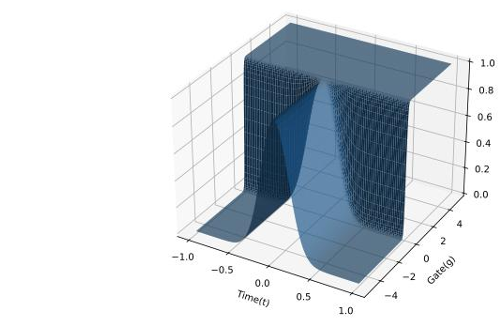
To formalize the discovery that Gaussians take on different roles, they added a learnable persistence gate ().
- If , the Gaussian is a static "forever" primitive.
- If , it is a transient primitive that only appears for a specific duration.
3. UFM-Guided Initialization
Rather than starting with random velocities, they use a pre-trained Unified Flow & Matching (UFM) model to extract real-world optical flow cues, seeding the Gaussians with a "warm start" that resembles actual physical movement.
Experimental Results: Visual Stability
The improvements are most visible in X-t slices (looking at a single line of pixels over time).
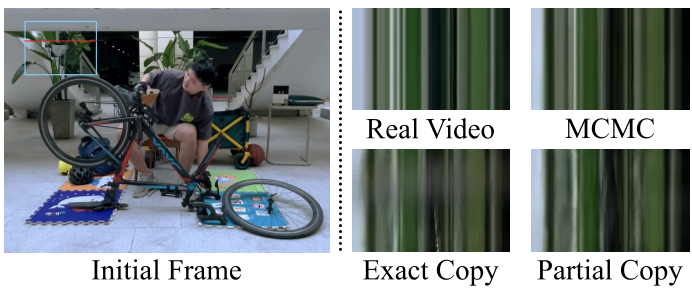
As shown in the comparison, standard 4DGS models often suffer from "haze-like wobbling" (middle column). FreeTimeGS++ (right) produces much sharper, straighter boundaries in the temporal domain, indicating a stable and physically consistent reconstruction.
| Method | DyNeRF (PSNR) | SelfCap (PSNR) |
|---|---|---|
| FreeTimeGS (SOTA Baseline) | 32.97 | 27.27 |
| FreeTimeGS++ (Ours) | 33.51 | 27.10* |
| *Note: FreeTimeGS++ prioritizes repeatability and physical stability, yielding significantly lower variance across runs. |
Critical Insight: Reliability Matters
One of the most profound takeaways from this paper is the introduction of Affine Color Correction. By delegating camera exposure and lighting shifts to a dedicated module, the Gaussians are "freed" to focus solely on geometry and motion. This simple addition reduced the instability and made the training process much more repeatable.
Limitations
While FreeTimeGS++ solves the consistency problem, it adds a precomputation step for optical flow (UFM). However, the authors demonstrate that using a "flow cache" makes the overhead negligible during the actual training phase.
Conclusion
FreeTimeGS++ is more than just a performance booster; it is a diagnostic tool that exposed the "cheating" mechanisms of previous 4DGS methods. By moving from per-primitive heuristics to continuous neural fields and gated logic, it sets a new standard for reliable and physically grounded 4D scene generation.
Senior Editor's Note: This work provides a much-needed "reality check" for the Gaussian Splatting community, shifting the focus from leaderboard-chasing to structural integrity.