
[Nature/Optica] MMG-OPA-FROG: Mapping the Hidden Modes of Ultrafast Squeezed Light
Frequency resolved optical gating using parametric amplification for characterizing ultrafast temporally multimode squeezed states
The paper introduces MMG-OPA-FROG, a novel characterization technique for ultrafast temporally multimode squeezed states. By utilizing an Optical Parametric Amplifier (OPA) as a nonlinear gate within a Frequency-Resolved Optical Gating (FROG) setup, the method simultaneously reconstructs complex temporal mode shapes and quadrature variances with high resolution.
TL;DR
Researchers have developed MMG-OPA-FROG, a robust technique to simultaneously extract the complex temporal "fingerprints" (mode shapes) and the quantum statistics (squeezing levels) of ultrashort light pulses. By using an Optical Parametric Amplifier as a measurement gate, this method bypasses the need for complex mode-matched local oscillators, achieving over 99% fidelity in numerical benchmarks.
Background: The Multimode Challenge
In the quest for high-capacity quantum information processing, encoding data into the temporal modes of ultrashort pulses is a winning strategy. Unlike spatial multiplexing, which requires multiple fibers or paths, temporal modes allow a single pulse to carry multiple independent quantum channels.
However, there is a catch: the "shape" of these modes (their phase and amplitude in time) is rarely known precisely. They depend on the nuances of the pump laser and the nonlinear crystal used. Without knowing the mode shapes, you cannot "read" the quantum information efficiently.
The Insight: OPA as a Quantum Microscope
Current techniques like homodyne detection are the gold standard but require a "Local Oscillator" that perfectly matches the unknown mode—a classic "chicken and egg" problem.
The authors solve this by repurposing FROG (Frequency-Resolved Optical Gating), a staple of classical ultrafast optics. They replace the standard nonlinear crystal with a high-gain Optical Parametric Amplifier (OPA).
- Why OPA? It provides phase-sensitive amplification. It doesn't just make the signal louder; it amplifies specific quadratures ( and ), preserving the "squeezing" information that characterizes the quantum state.
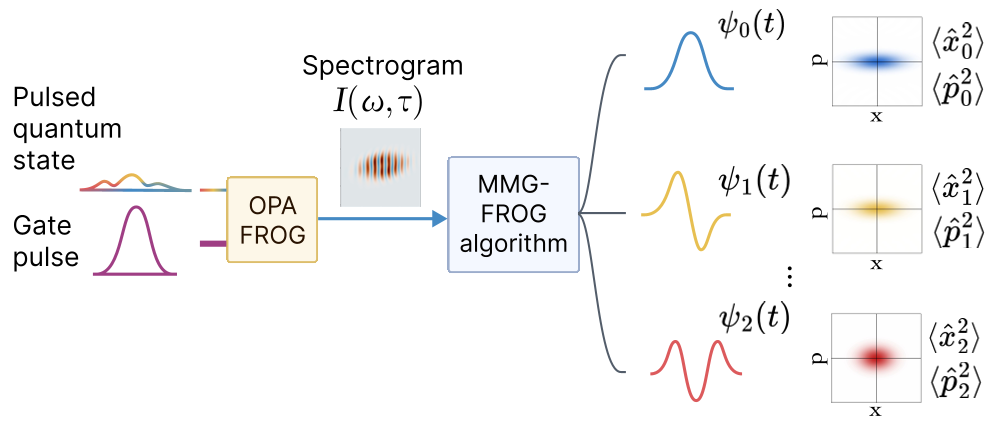 Figure 1: The OPA-FROG workflow. A pulsed quantum state and a gate pulse interact in an OPA. The resulting spectrogram is processed by a specialized algorithm to decouple the orthogonal modes () and their variances ().
Methodology: Decoding the Spectrogram
The core innovation lies in the MMG-OPA-FROG Algorithm. Traditional FROG looks for a single pulse shape. In the quantum regime, the spectrogram is the sum of contributions from multiple independent modes.
The authors derived a new spectrogram equation:
By subtracting the "vacuum" (noise generated by the OPA itself), they can isolate the squeezing signatures. The algorithm uses gradient descent to navigate the complex landscape of these modes, ensuring the recovered modes are orthonormal (mathematically independent).
Experimental Validation & Robustness
The team tested the method against "chirped" pulses—pulses where the frequency changes over time—simulating 30-femtosecond Hermite-Gaussian modes.
- Near-Perfect Recovery: In noiseless conditions, the mode shapes were recovered with >99.5% fidelity.
- Noise Resiliency: Even at 15 dB SNR, the system effectively distinguished the mode shapes, proving it can handle real-world laboratory noise.
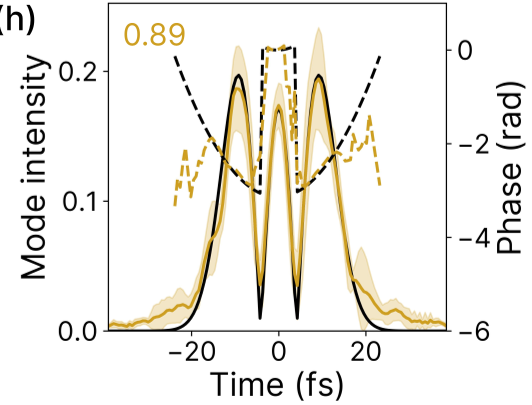 Figure 2: Statistical performance across different Noise levels. Even with significant noise (SNR 15dB), the recovered mode intensities (solid lines) and phases (dashed lines) closely track the ground truth.
Deep Insight: Why This Matters
The true power of MMG-OPA-FROG is its flexibility. It doesn't care about the wavelength or the specific shape of the pump pulse. This makes it a "plugin" solution for integrated photonics—specifically Lithium Niobate on Insulator (LNOI) platforms—where both generation and characterization can potentially reside on the same chip.
Limitations & Future Work
While powerful for Gaussian states (like squeezed vacuum), the current algorithm needs adaptation for non-Gaussian states (like Schrodinger's Cat states). Future versions using single-shot spectrometers might unlock full density-matrix tomography, providing a complete picture of the quantum world at the femtosecond scale.
Conclusion
MMG-OPA-FROG bridges the gap between classical pulse characterization and quantum state tomography. By treating the OPA as both an amplifier and a gate, it provides the "glasses" needed to see the high-dimensional temporal structure of light.