
Is the Future Compatible? Diagnosing Dynamic Consistency in World Action Models
Is the Future Compatible? Diagnosing Dynamic Consistency in World Action Models
This paper introduces "Action-State Consistency" as a novel reliability metric for World Action Models (WAMs). It evaluates the dynamic alignment between predicted future observations and actual outcomes across joint-prediction and inverse-dynamics architectures, utilizing this signal to improve robot manipulation success rates on RoboCasa and RoboTwin 2.0.
TL;DR
Researchers have identified a critical "blind spot" in World Action Models (WAMs): visual realism does not equal physical truth. This paper introduces Action-State Consistency—a metric that measures if a model's predicted future actually aligns with the actions it takes. By using this consistency as a "value-free" guide at test-time, they boosted robot success rates across complex manipulation tasks without any additional training or reward labels.
Problem & Motivation: The Illusion of Realism
Modern Vision-Language-Action (VLA) models are getting better at playing "mental movies" of what might happen next. World Action Models (WAMs) use these "imagined rollouts" to decide on the best move. However, there is a catch: just because a generated video looks real doesn't mean it is dynamically compatible with the robot's commands.
Existing models often fail because their imagined futures are disconnected from the actual physics of the task. If a robot "thinks" it closed a drawer but the drawer is still open, the rest of its plan is useless. The authors argue that we are missing a "reliability axis"—one that checks if the action and the state transition are truly in sync.
Methodology: Measuring the "Aha!" Moment
The core of the paper is the Action-State Consistency score ().
1. Defining Consistency
The authors compare the predicted future () with the actual observation () after an action is taken. Instead of comparing pixels (which is noisy), they measure the distance in the latent space of a VAE. If the predicted and real states are close, the model is "consistent."
2. Consistency-Consensus Strategy
How do you choose the best action without knowing the reward? The authors propose a "Consensus" approach:
- Sample different future paths.
- Average these paths to create a "Consensus Future."
- Choose the action whose individual prediction is closest to that consensus.
This is inspired by the "wisdom of the crowd"—if multiple model samples agree on a specific state transition, that transition is likely the most physically grounded.
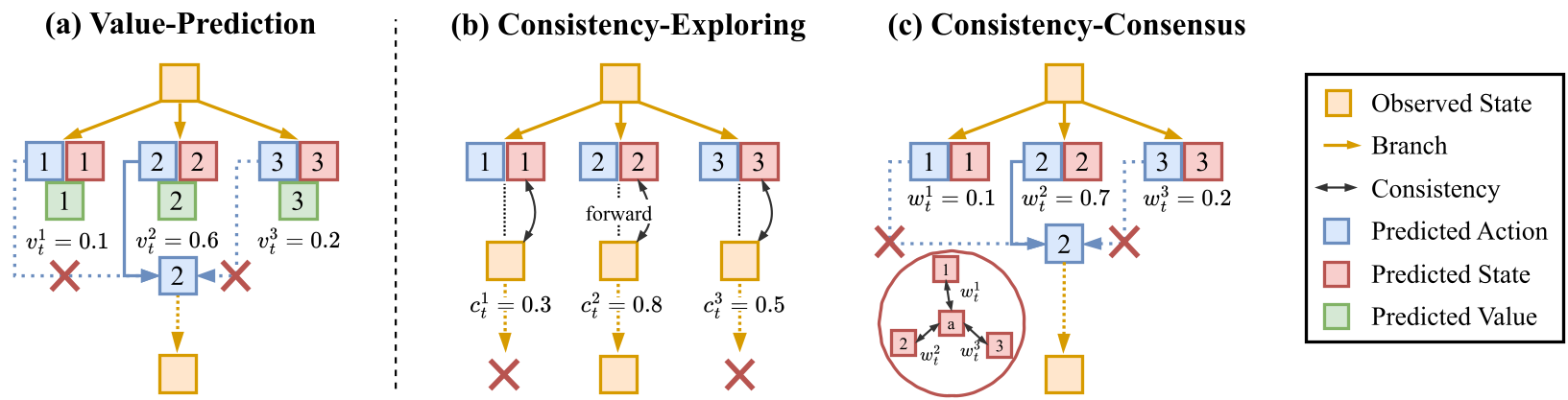 Figure 1: Different selection strategies. (c) shows the Consensus method which picks the most "agreeable" future.
The "Background Collapse" Trap
One of the most fascinating findings is a failure mode called Background Collapse. In some failed tasks, the model predicts a completely static scene. Because nothing moves, the prediction is "technically" easy to get right, leading to a high consistency score even though the task failed.
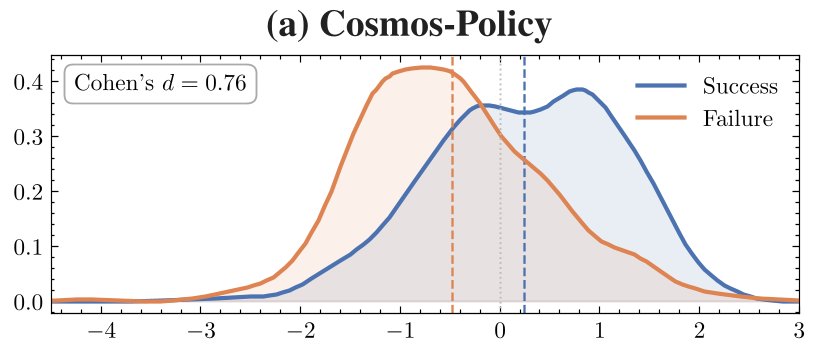 Figure 2: Notice how in (b), the predicted future just becomes a static image of the background, hiding the model's inability to model the actual interaction.
The paper proves that by looking at the Latent Change Magnitude (), we can detect this. If the robot stops moving in its own head, we know the consistency score is lying.
Experiments & Results: Value-Free Planning
The team tested their theories on RoboCasa (kitchen tasks) and RoboTwin 2.0 (bimanual/dual-arm tasks).
- Predictive Power: Consistency scores separated successful vs. failed runs with an AUC of up to 0.88.
- Performance Boost: On RoboTwin 2.0, the success rate jumped from 90.2% to 93.0% using the Consistency-Consensus strategy.
- Scalability: More samples () led to better results, suggesting that WAMs benefit from "thinking longer" (inference-time compute scaling).
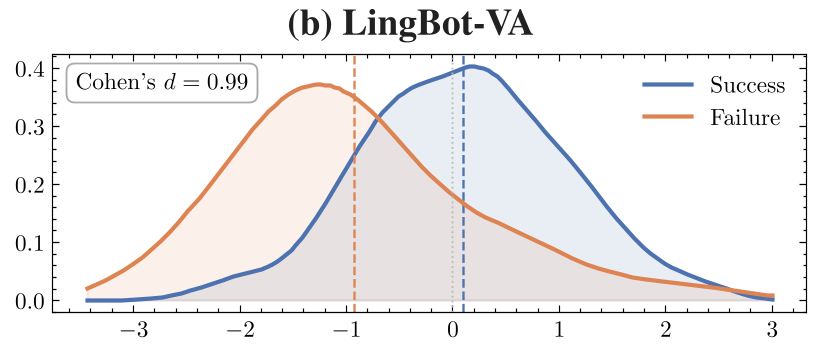 Figure 3: Density plots showing that successful episodes (blue) consistently have higher normalized consistency scores than failures (orange).
Critical Insight & Conclusion
This work shifts the focus from how good a model looks to how much a model can be trusted. By establishing action-state consistency, the authors provide a model-agnostic way to rank actions.
Takeaway for the field: We should stop treating World Models as mere video generators. They are physical simulators. Future WAMs shouldn't just output an action; they should output a "confidence score" based on how compatible that action is with the laws of their imagined world. While "Background Collapse" remains a hurdle, consistency-aware modeling is a clear path toward more robust, self-correcting autonomous robots.