
From Gaia to GaiaNIR: Unmasking the True Rotation of the Milky Way Bar
From Gaia to GaiaNIR: II. A new view of the Milky Way bar
This study investigates the dynamical properties of the Milky Way (MW) bar using Gaia DR3 RGB samples and mock catalogues. It introduces a systematic bias correction for the bar pattern speed () and evaluates how future missions like Gaia DR4, DR5, and GaiaNIR will revolutionize our understanding of Galactic structure.
TL;DR
The Milky Way's central bar is the engine of our Galaxy's evolution, yet its basic properties—how fast it spins and how long it is—remain subjects of intense debate. This study reveals that current Gaia DR3 data leads to a significant overestimation (by ~14 km/s/kpc) of the bar's pattern speed due to observational "blind spots." By correcting for this bias, the authors suggest a slower-rotating bar ( km/s/kpc) and demonstrate that the future GaiaNIR mission will provide the first clear, infrared view of this elusive structure.
The "Fog" of the Inner Galaxy
For decades, astronomers have struggled to peer into the heart of the Milky Way. The Galactic bar is shrouded in thick interstellar dust that absorbs optical light—the very light the Gaia satellite primarily detects. This causes a dramatic "hole" in our data (as seen in the masks near in density maps), biasing our view toward the near side of the bar and distorting our measurements of its symmetry and rotation.
Methodology: Mocking the Universe to Reveal the Truth
The authors didn't just look at Gaia DR3 data; they built a "Digital Twin" of the Galaxy. By creating mock catalogues from N-body simulations and applying the same observational constraints Gaia faces (extinction, magnitude limits, and parallax errors), they discovered a vital piece of the puzzle: the DSS (Dehnen-Schönrich-Salo) method, while powerful, consistently overestimates the bar's speed when data is incomplete.
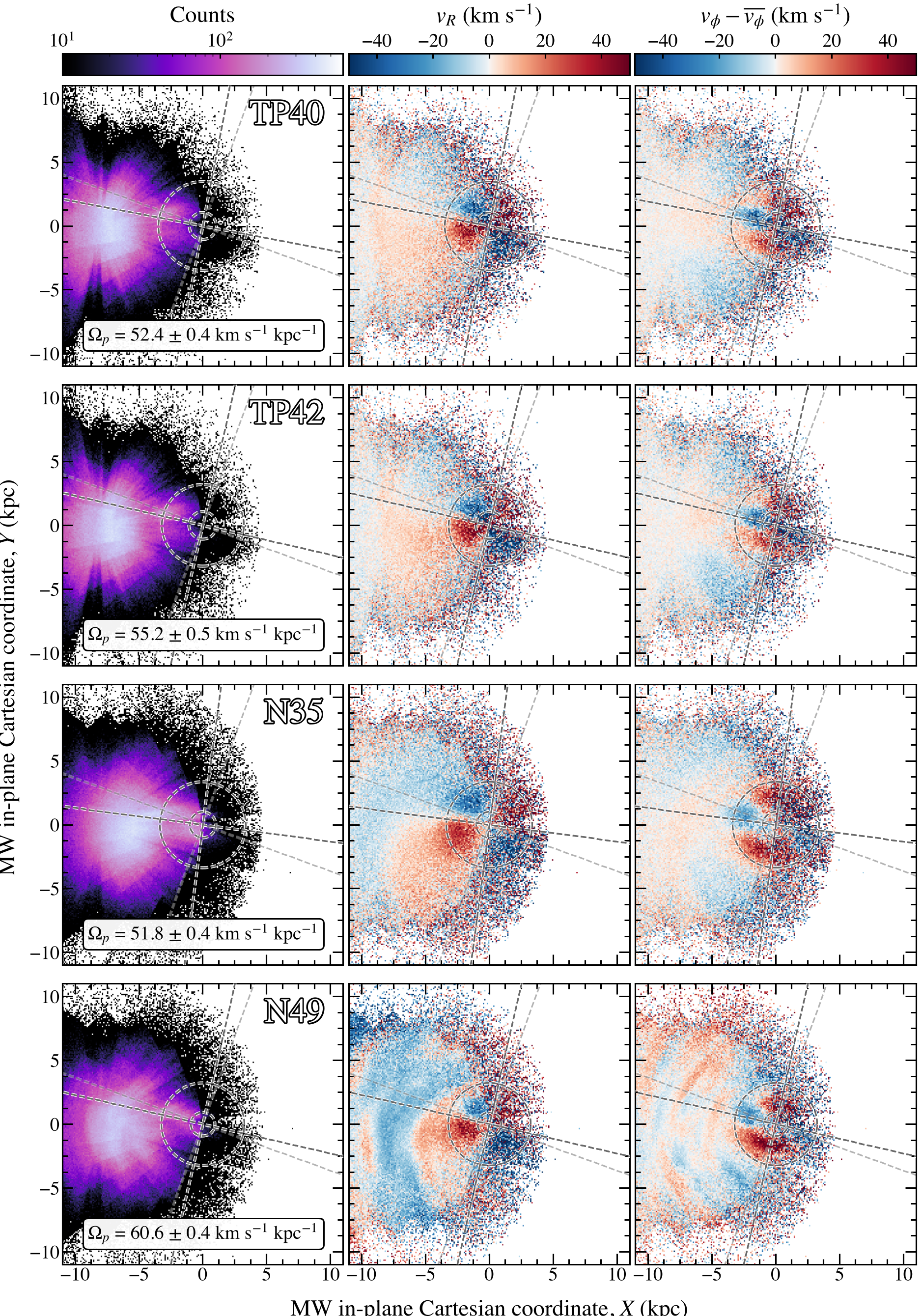 Figure 1: Comparing face-on velocity and density maps across different MW-like simulations. Note the "missing" data near the center where extinction is highest.
Key Findings: A Slower, Sharper Perspective
1. The Pattern Speed Correction
While the raw analysis of Gaia DR3 data suggested a "fast" bar spinning at 43.7 km/s/kpc, the mock simulations proved this was a systematic artifact.
- The Bias: km/s/kpc.
- The Reality: Once corrected, the speed drops to km/s/kpc, supporting models of a "slow, long bar" that exchanges significant angular momentum with the Dark Matter halo.
2. Orientation and Length
Using bisymmetric velocity perturbations, the study narrows the bar's orientation to with respect to the Sun-Galactic Center line. However, the study warns that "kinematic bar length" estimates based on radial velocity fractions are highly model-dependent and still lack a robust "gold standard" calibration.
The Future: GaiaNIR and The Infrared Revolution
The most exciting revelation is the leap from Gaia to GaiaNIR. By observing in the Near-Infrared, GaiaNIR will slice through the dust that blinds current instruments.
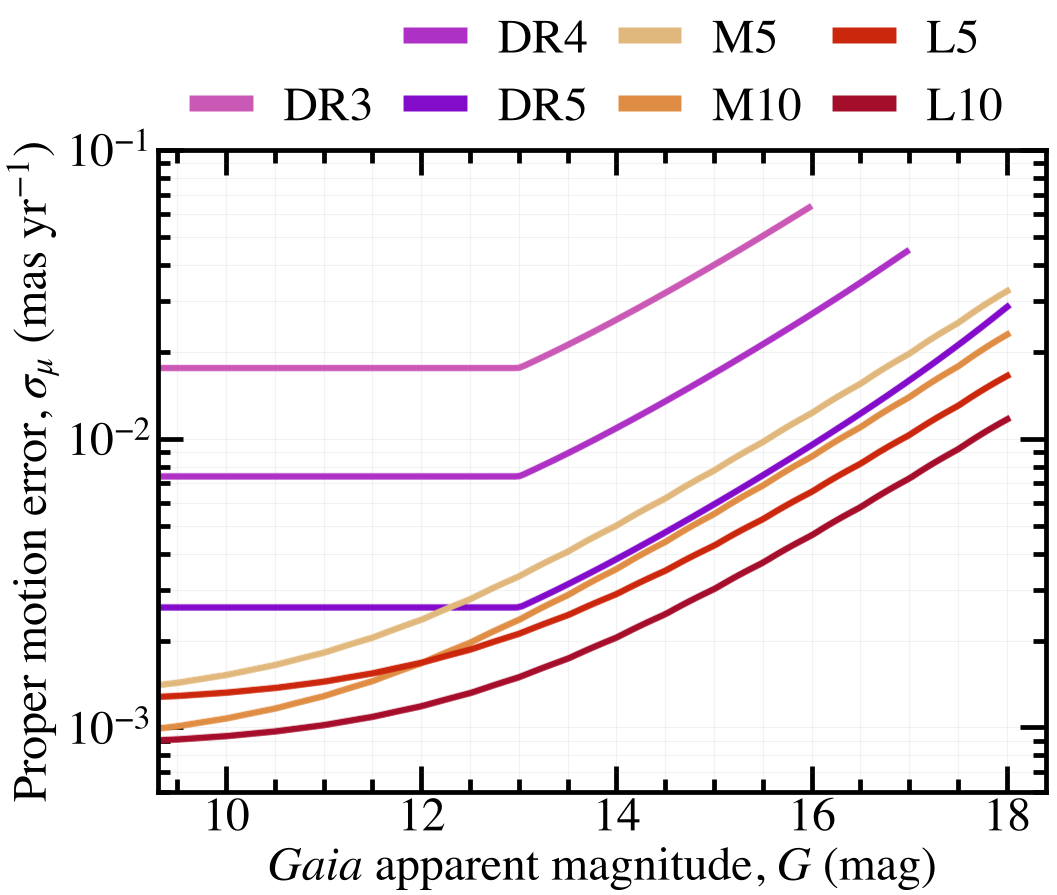 Figure 2: Proper motion uncertainty as a function of magnitude. GaiaNIR (warm colors) outperforms Gaia DR4/DR5 (purple), especially for stars buried deep in the Galactic bar.
With GaiaNIR, the systematic bias in rotation measurements is expected to plummet from 14 km/s/kpc down to just 5 km/s/kpc. More importantly, proper motion precision for bright stars will reach an incredible 0.001 mas/yr, allowing us to map the 3D "orbits" of bar stars with unprecedented clarity.
Critical Insight & Conclusion
This paper serves as a "reality check" for the Gaia era. It reminds us that Inductive Bias—in the form of the Gaia selection function—can lead to overconfident results if not rigorously tested against simulations.
The Takeaway: We are likely looking at a Milky Way bar that rotates significantly slower than a direct reading of Gaia catalogs would suggest. To move from "conservative limits" to "definitive measurements," the community must prioritize near-infrared astrometry missions like GaiaNIR.
- Limitations: The bias correction is based on a small number of mock realizations and assumes the bias is purely additive.
- Outlook: As Gaia DR4 and DR5 approach, we will see marginal improvements, but the leap to the Infrared is the only way to truly "see" the bar.