
Galactic Amnesia: Mapping the Limits of Our Galaxy's Memory
Galactic Amnesia: The Information Washout of the Milky Way Merger History
This paper introduces an information-theoretic framework using Shannon-normalized Mutual Information (MI) to quantify "Galactic Amnesia"—the process by which dynamical relaxation erases the signatures of a galaxy's merger history. By analyzing TNG50 and FIRE-2 simulations, the authors demonstrate that while gravitational potential and energy are long-lived tracers, kinematic information like radial velocity vanishes for mergers older than ~5 Gyr.
TL;DR
How much of the Milky Way's "birth certificate" is still readable? This paper quantifies the rate at which the Galaxy "forgets" its merger history. Using information theory on TNG50 simulations, the researchers found that while we can still see the ghosts of recent mergers in stellar velocities, the details of ancient events (like the Gaia Sausage Enceladus) are mostly erased from kinematics. To see our true history, we must look at Total Energy and the Outer Halo, which serve as the Galaxy’s long-term hard drives.
The Problem: The Fog of Dynamical Time
Galactic archaeology operates on the premise that the present-day positions and speeds of stars are "fossil records" of past mergers. However, galaxies are dynamic environments. Over billions of years, two main villains act to erase this record:
- Phase Mixing: Stars from a disrupted satellite drift apart along their orbits until they blend into a smooth background.
- Violent Relaxation: Massive mergers cause the entire gravitational potential to fluctuate, "scrambling" the energy of stars in a matter of hundreds of millions of years.
The authors ask a fundamental question: At what point does a signature become noise?
Methodology: Quantifying Information
Instead of just looking for "clusters" of stars, the authors use Mutual Information (MI). If you know a star's current energy, how much does that reduce your uncertainty about the mass of the galaxy it came from?
They normalized this MI by Shannon entropy to provide a scale from 0 (total amnesia) to 1 (perfect recall).
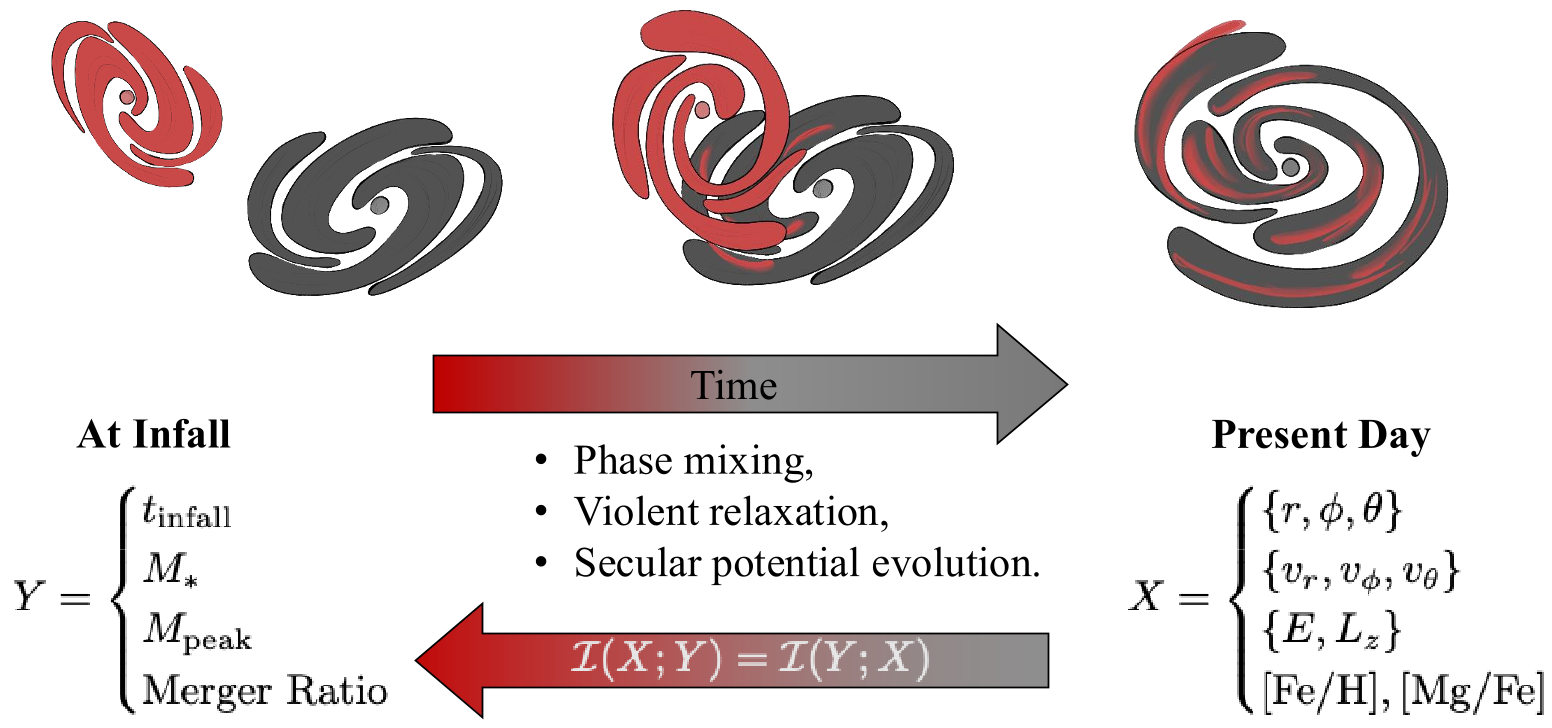 The study evaluates how present-day observables (Dynamics & Chemistry) relate to historical "truth" labels (Mass, Infall Time).
Key Insights: What We Remember vs. What We Forget
1. The Superiority of Energy
The study finds that Total Orbital Energy () and Gravitational Potential () are the "golden variables." Unlike individual velocity components, these quantities are approximately conserved.
- The Findings: Energy retains ~30-50% of merger information even for very old events.
- The Catch: This requires precise modeling of the Milky Way's total mass—something we are still perfecting.
2. The Rapid Decay of Radial Velocity
The "Sausage" signature (highly radial orbits) is how we discovered the Gaia Sausage Enceladus (GSE). However, the paper reveals a sobering reality: Radial velocity () information hits the noise floor after ~5 billion years.
This means the "Sausage" shape tells us a merger happened, but it's no longer a reliable way to measure exactly when it happened or how big it was.
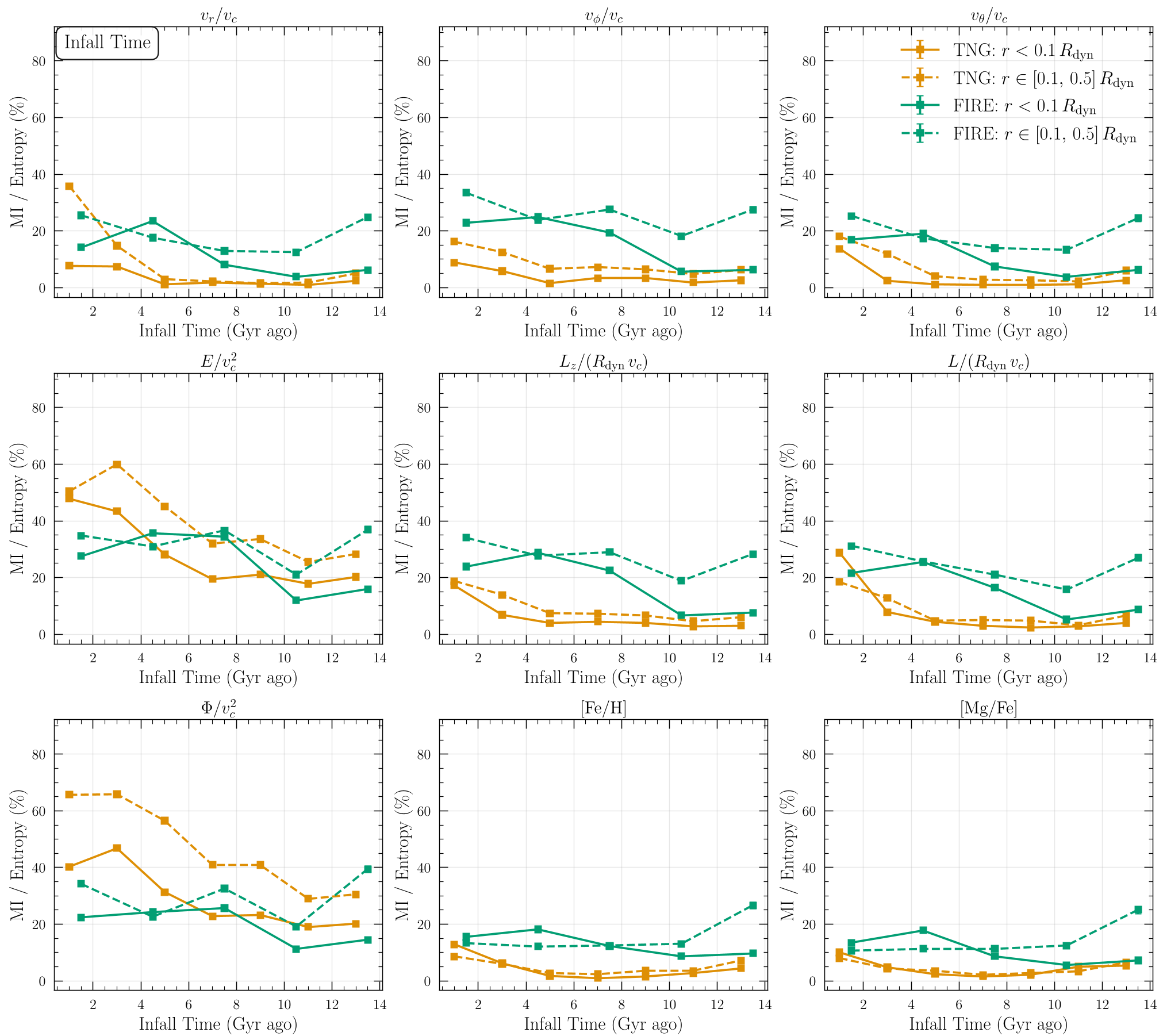 Comparison of information decay: Notice how Radial Velocity (vr) plummets while Potential and Energy remain relatively high.
3. The "Inner vs. Outer" Divide
Information is lost much faster in the inner galaxy ( kpc). Because stars in the core complete orbits much faster (shorter dynamical time), they "mix" more thoroughly. If you want to find the clear, unsmudged fingerprints of the Milky Way's first ancestors, you must look at the outer halo ( kpc).
The "Memory Horizon" for the Milky Way
One of the most impactful parts of the study is the mapping of common Milky Way mergers (like Sagittarius, Sequoia, and GSE) against the "Memory Horizon."
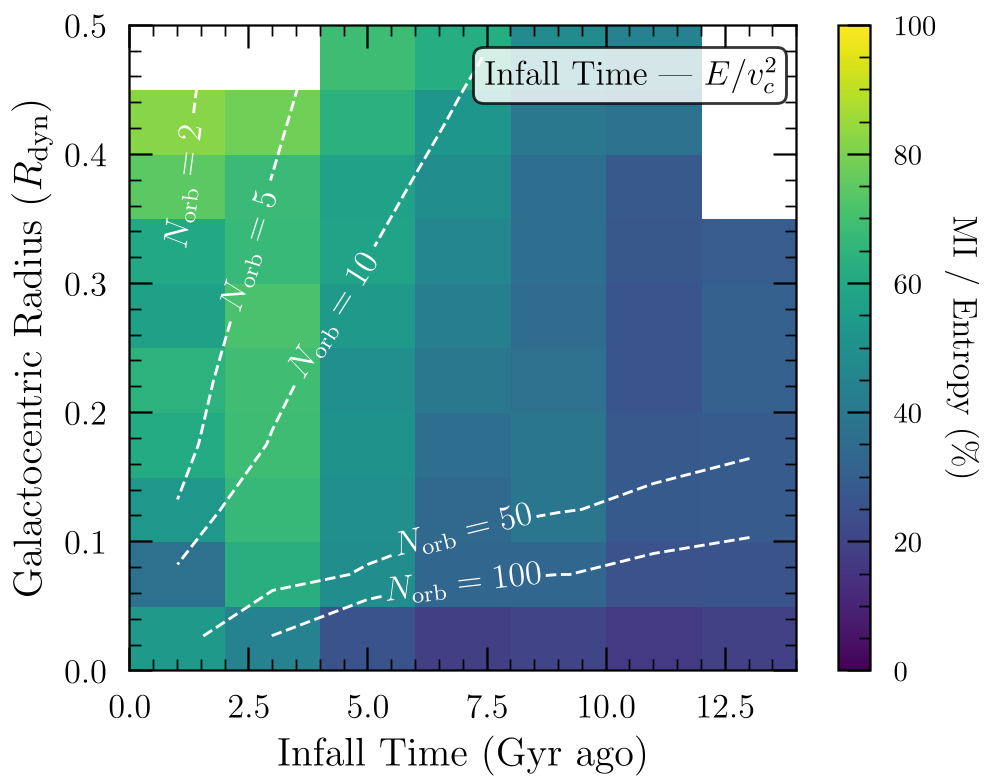 The 2D map shows that for the most massive mergers (Yellow), the information vanishes quicker due to dynamical friction pulling them into the high-mixing inner regions.
Critical Analysis & Conclusion
Takeaway
This work shifts the focus of Galactic Archaeology. We should spend less effort debating the specific "radial shapes" of ancient kinematic structures and more effort on high-precision potential modeling and outer-halo spectroscopy.
Limitations
- Simulation Dependency: The findings rely on TNG50's chemical models, which the authors admit are not perfect (chemistry MI was surprisingly low, though FIRE-2 showed slightly better results).
- Single-Variable focus: The authors looked at features individually. In reality, a "synergy" of chemistry + energy likely pushes the memory horizon slightly further back.
Final Thought
The Milky Way is an aging document with fading ink. While we might never recover the perfect "movie" of its assembly, this paper gives us the "spectoglasses" needed to identify which pages are still readable and which are gone forever to the void of dynamical amnesia.