
SLSNe Unveiled: Probing the Engines of the Universe's Brightest Explosions with Fermi-LAT
On the Gamma-ray Efficiency of Superluminous Supernovae: Potential Detections and Population-Level Constraints
This study presents a systematic search for GeV γ-ray emission from 223 hydrogen-poor superluminous supernovae (SLSNe-I) using 17 years of Fermi-LAT data. The authors utilize source-specific transparency windows based on the Bethe–Heitler (BH) time, finding no significant population-level detections but identifying a suggestive ~4σ excess for the nearby SN 2017egm.
TL;DR
Superluminous Supernovae (SLSNe) are the heavyweights of the transient world, but we still don't know what powers them. A massive new study of 223 events using 17 years of Fermi-LAT data finds that these explosions are remarkably "quiet" in the GeV gamma-ray band. The results place strict limits on magnetar and CSM-interaction models, suggesting that if magnetars are the engine, they must be more highly magnetized than previously assumed.
The Mystery of the Central Engine
What makes a supernova "superluminous"? We generally point to two culprits:
- The Magnetar: A rapidly spinning, highly magnetized neutron star dumping rotational energy into the debris.
- CSM Interaction: The ejecta slamming into a dense shell of pre-existing gas, converting kinetic energy into a brilliant light show.
Both models predict gamma rays, but there's a catch: Opacity. Early on, the explosion is too dense for gamma rays to escape. They are trapped by a process called Bethe-Heitler (BH) pair production. As the debris expands and thins out, there is a "transparency window" where GeV photons should finally break free.
Methodology: Timing the Transparency
The authors didn't just look at the sky blindly. They used optical data to model the Ejecta Mass () and Velocity () for each of the 223 SLSNe-I. From this, they calculated a unique —the moment the lights go on for gamma rays.
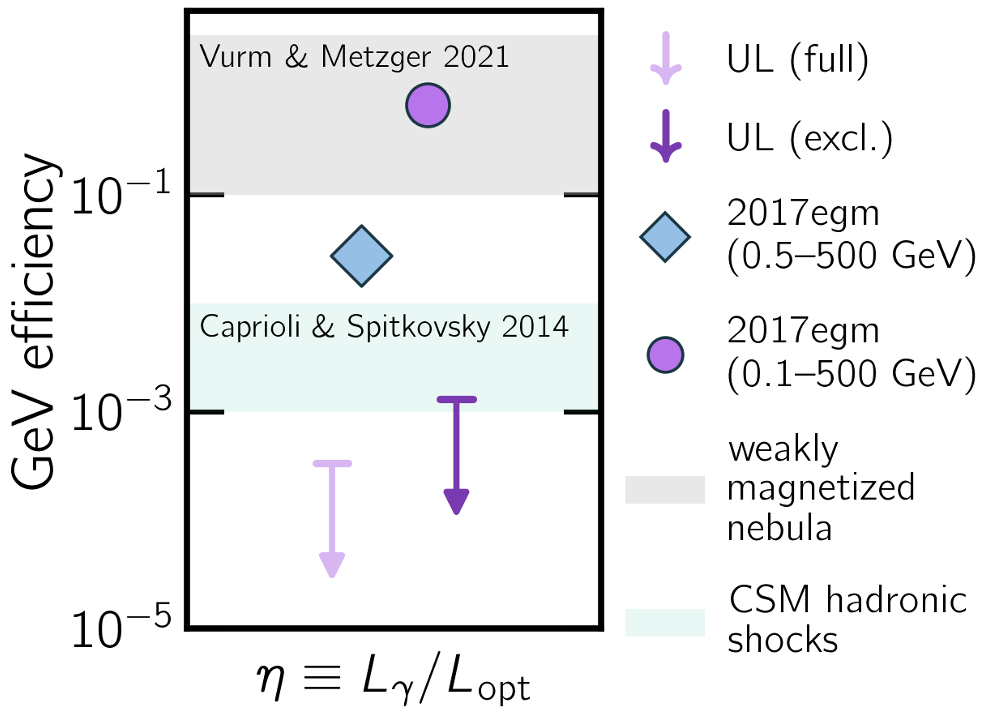 Fig 1: The theoretical efficiency (gamma-to-optical luminosity) compared across different models. The experimental limits (arrows) now sit far below the predictions for weakly magnetized magnetars.
Results: A Suggetive Spark in SN 2017egm
While the group-wide search (Joint Likelihood) came up empty, one specific source stood out: SN 2017egm.
- The Signal: A ~4σ excess localized in time near its calculated transparency window.
- The Efficiency: If real, its gamma-ray output is nearly 70% of its optical output ().
- The Verdict: This high ratio is extremely difficult for CSM-shocks to produce but fits the Magnetar Inverse Compton (IC) scenario perfectly.
However, science demands consistency. The authors looked at SN 2018bsz, which was even closer to Earth. If SN 2017egm is a "Standard Candle" for gamma rays, SN 2018bsz should have been a bright detection. Instead, it was silent.
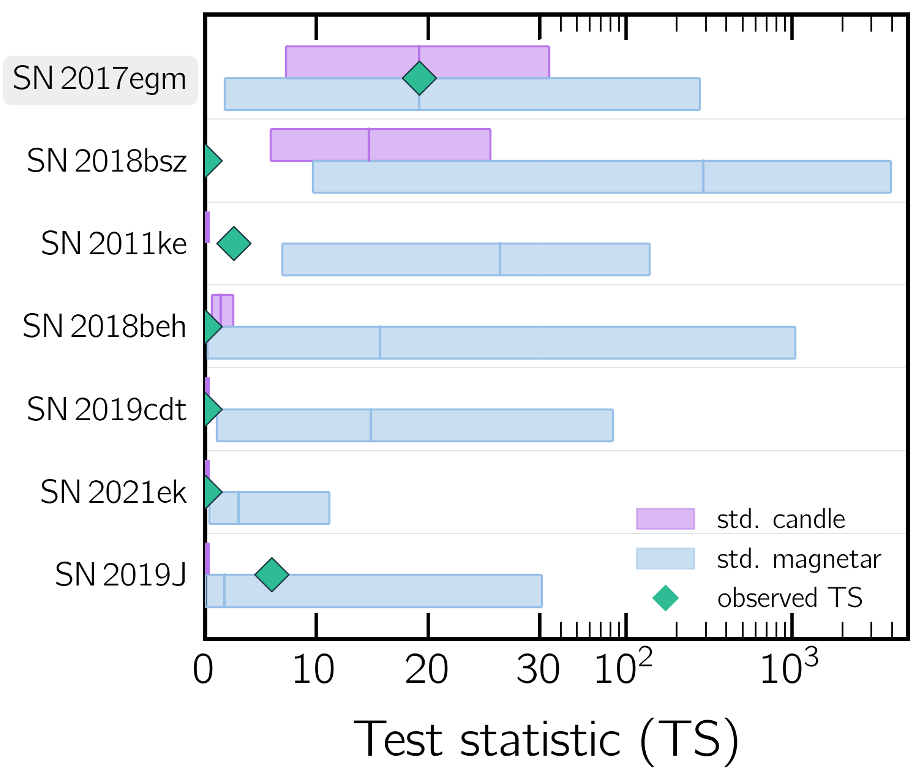 Fig 2: Comparison of the two nearest sources. Note the clear excess for SN 2017egm vs the null result for SN 2018bsz.
Deep Insight: Why the Silence?
The population-level upper limit for the GeV-to-optical ratio is now . Why is this so much lower than the expected ?
- Highly Magnetized Nebulae: If the magnetar's nebula has a high magnetic field, energy goes into X-rays (synchrotron) rather than GeV gamma rays (Inverse Compton).
- Diversity: Not all SLSNe are the same. SN 2017egm might have a "weak" magnetic field, while its cousins have "strong" ones, suppressing the signal for the rest of the population.
Conclusion & Future Outlook
This work represents the most rigorous "no" yet to the simple, weakly magnetized magnetar model for SLSNe. While SN 2017egm and the newly discovered SN 2024jlc offer tantalizing hints, we likely need another decade of monitoring or next-generation telescopes like VLAST to turn these "suggestive excesses" into a confirmed discovery.
For now, the central engine remains hidden behind its opaque veil, revealing its secrets only in occasional, frustratingly faint whispers.