
GDM: Balancing Fidelity and Plausibility via One-Step Generative Drifting
Generative Drifting for Conditional Medical Image Generation
This paper introduces GDM (Generative Drifting for Medical Imaging), a novel one-step generative framework for conditional 3D medical image generation tasks like MRI-to-CT synthesis and SVCT reconstruction. By combining an attractive-repulsive drift field with a multi-level feature bank from a medical foundation model, GDM achieves SOTA performance in anatomical fidelity and perceptual realism.
Executive Summary
TL;DR: GDM (Generative Drifting for Medical Imaging) is a new framework that solves the efficiency-fidelity-realism trade-off in 3D medical image synthesis. It moves the complex "distribution transport" (the heavy lifting of generative models) from inference time to training time, allowing for high-quality, realistic 3D CT reconstruction in a single forward pass (~1.5 minutes per volume).
Context: Currently, medical imaging is caught between "too blurry" (standard regression) and "too slow/hallucinated" (iterative diffusion). GDM is a SOTA-shaping work that introduces a deterministic, one-step generative paradigm specifically tailored for volumetric medical data.
The Problem: The High-Dimensional "Trilemma"
In tasks like MRI-to-CT synthesis, we need three things:
- Fidelity: The CT must match the patient's specific anatomy (no hallucinations).
- Plausibility: The image must look like a real CT (sharp edges, correct texture), not a blurry average.
- Efficiency: Clinical workflows cannot wait 45 minutes for a Diffusion model to sample a 3D volume.
Existing SOTA methods fail because standard L1/L2 losses regress to the "mean," causing blur. Conversely, Diffusion and Flow-Matching models, while realistic, are computationally expensive and can "drift" too far from the patient's ground truth during their iterative sampling process.
Methodology: The Core Mechanics
The authors' core "aha!" moment is treating generation as a Drifting process. Instead of refining an image through 100 noise-removal steps, the model is trained to "drift" its output Toward the real data distribution and Away from its own previous mistakes in a single step.
1. The Multi-Level Feature Bank
Drifting requires calculating how similar a generated sample is to real target samples. In raw 3D voxel space, this is nearly impossible due to the "curse of dimensionality." GDM solves this by using MedVAE-3D, a foundation model pretrained on 30,000+ images. It extracts:
- Global Descriptors: Overall anatomy.
- Spatial Neighborhoods: Local texture and boundaries.
- Energy Descriptors: Channel-wise intensity patterns.
2. Gradient Coordination via MGDA
Training for both pixel-perfection and distributional-realism is a tug-of-war. If you push for realism too hard, the anatomy breaks. GDM uses the Multiple Gradient Descent Algorithm (MGDA) to find a balanced update direction that satisfies both goals without one collapsing the other.
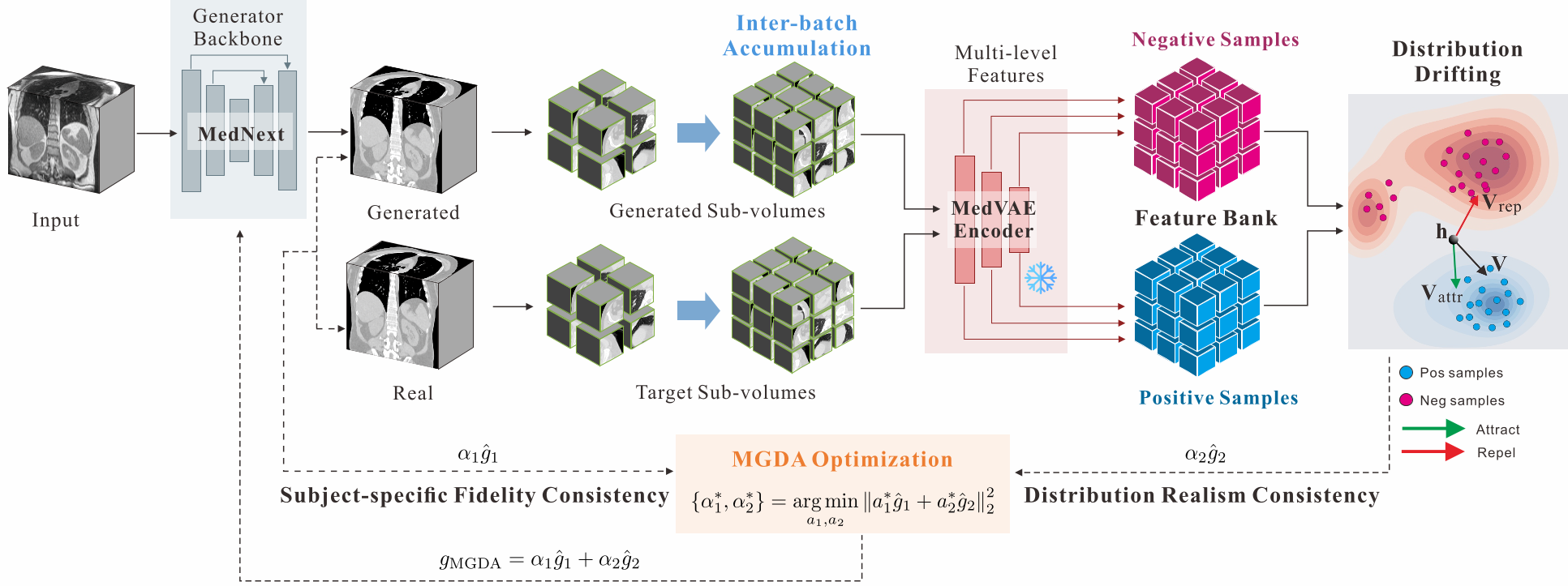 Fig 1. The GDM unified framework. Note how the Multi-level feature bank feeds into the Drifting Field for training-time alignment.
Experiments & Results
The model was validated on two major tasks: MRI-to-CT and Sparse-View CT (SVCT).
Superior Detail Preservation
Standard GANs and Diffusion models often distort organ boundaries or kidney shapes in SVCT. GDM maintains the sharp boundaries of a CT while staying anchored to the patient-specific geometry.
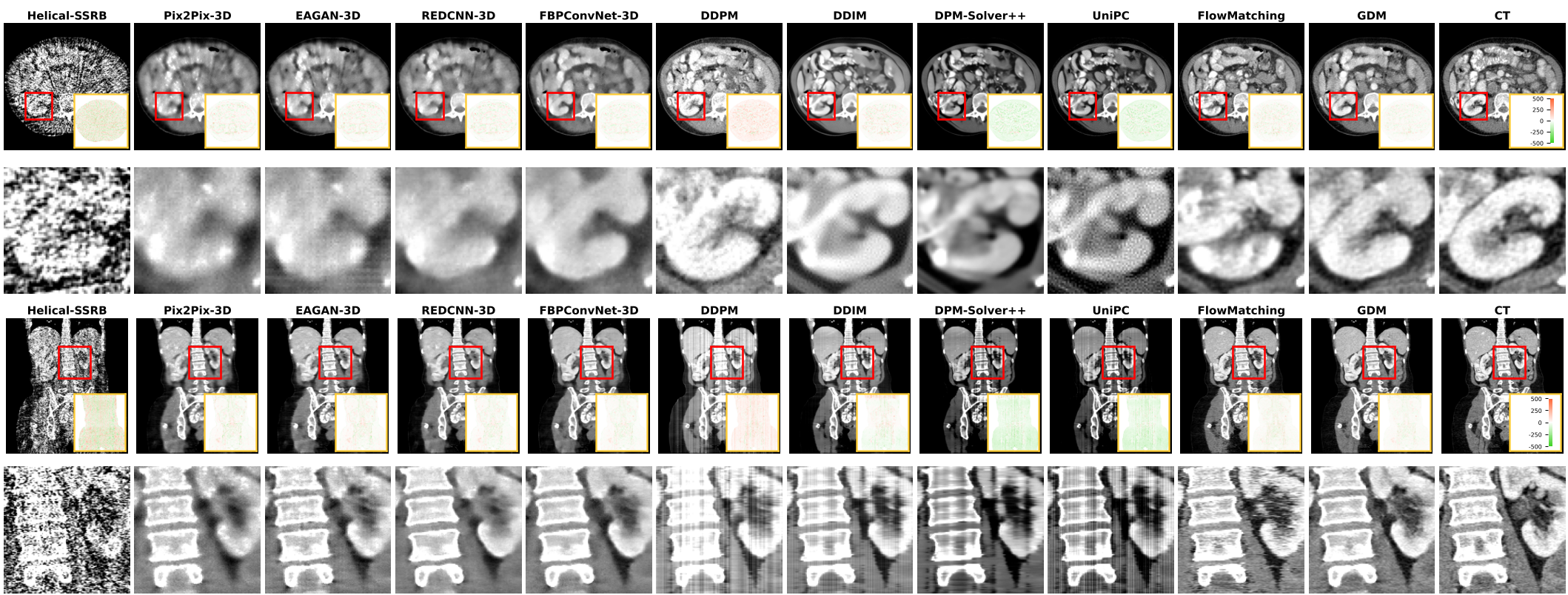 Fig 2. SVCT results. Notice how GDM (far right) suppresses artifacts better than traditional regression (middle) while maintaining higher fidelity than iterative Flow Matching.
Efficiency Benchmark
- Diffusion (DDPM): 8 hours per volume.
- Flow Matching: 31 minutes per volume.
- GDM: 1.5 minutes per volume.
Critical Analysis & Conclusion
Takeaway
GDM successfully demonstrates that the high-cost iterative refinement of Diffusion models is not strictly necessary for deterministic medical tasks. By shifting the "transport" logic into the training objective using stop-gradient drifting, we can get "generative-quality" results at "regression-speed."
Limitations
The method relies heavily on the quality of the "Feature Bank." If the foundation model (MedVAE-3D) hasn't seen a specific rare pathology, the drifting signal might become unreliable. Furthermore, the hyper-parameter (temperature) requires careful tuning—too high, and the model creates artifacts; too low, and it becomes blurry again.
Future Outlook
This work opens the door for Foundation Guided Generation. As medical foundation models become more robust, "Drifting" will likely become the standard for one-step, high-fidelity medical image translation.