
[Research Insight] Does Generative Recommendation Actually Generalize? The Memorization-Generalization Trade-off
How Well Does Generative Recommendation Generalize?
This paper presents a systematic study of Generative Recommendation (GR) versus item ID-based models (e.g., SASRec), introducing a framework that categorizes user interactions into "memorization" and "generalization" tasks. The authors demonstrate that while GR models significantly outperform traditional counterparts in generalization (+58.8%), they struggle with memorization (-43.6%), a trade-off explained through a novel token-level analysis.
TL;DR
The success of Generative Recommendation (GR) is often attributed to a "magic" ability to generalize. This paper demystifies that claim: GR models (like TIGER) excel at composing unseen transitions (Generalization) but lose to traditional ID-based models (like SASRec) at remembering what they've seen (Memorization). The secret sauce? What looks like item generalization is actually token-level memorization.
The "Why" Behind the Study: A Paradigm Shift
In traditional sequential recommendation, items are "black boxes" represented by unique IDs. Generative models break these boxes into Semantic ID tokens. While researchers observed that GR models performed better overall, no one had measured where that gain came from. Did the model just get better at finding popular items, or did it truly learn to "reason" about user behavior?
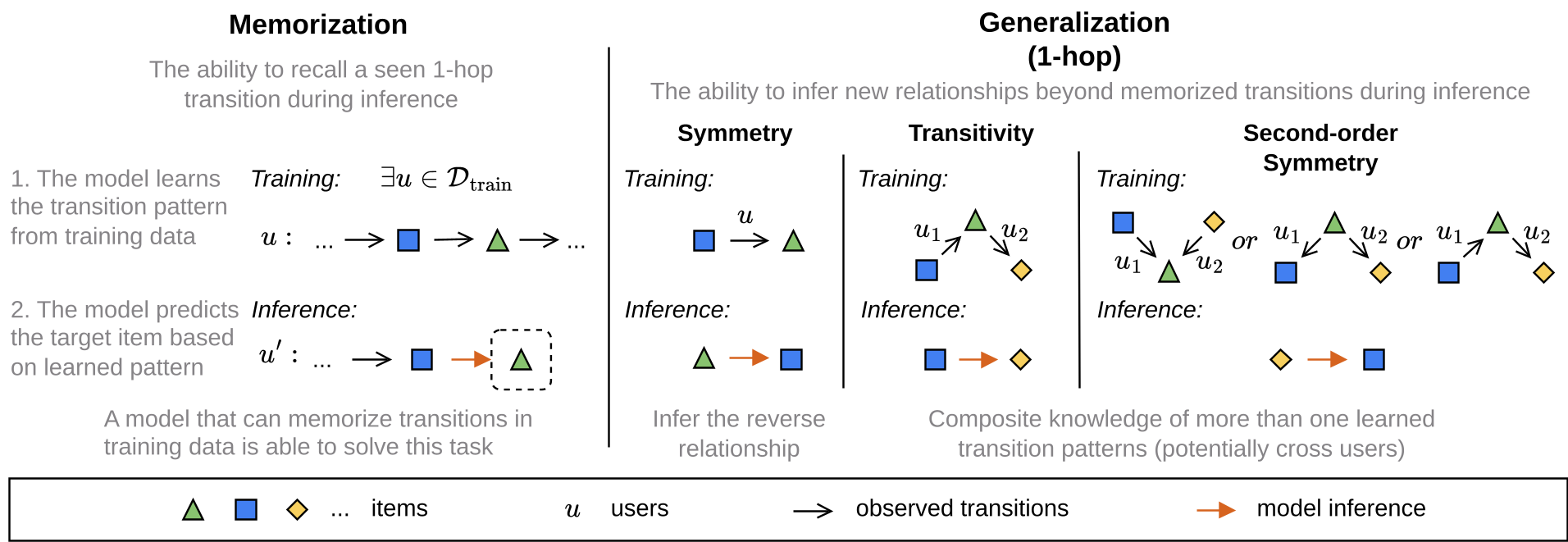
The authors argue that recommendation difficulty is defined by transitions (Item A Item B). If a transition was in the training set, it's a Memorization task. If it's new but follows a logic (like and were both seen), it's a Generalization task.
The Methodology: Decoding the Framework
The paper introduces four core flavors of generalization:
- Substitutability: Infilling missing steps in a sequence.
- Symmetry: If exists, can the model infer ?
- Transitivity: Inferring from and .
- 2nd-Order Symmetry: Complex relational mapping via a shared bridge item.
The Breakthrough: Token-Level Dilution
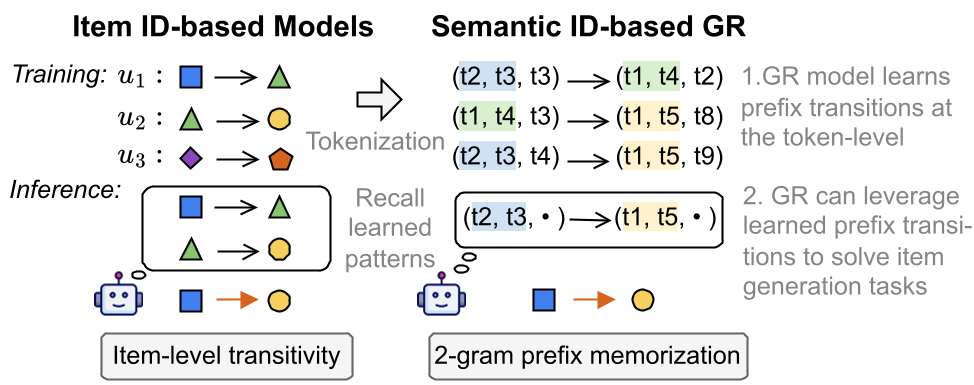
The most profound insight is the Token-Level Lens. Why does GR struggle to memorize?
- The Dilution Effect: Because GR models predict items as token sequences (e.g.,
[12, 45, 88]), different items often share the same prefix. When a model tries to memorize a specific item transition, the shared prefixes "dilute" the probability mass. It's like trying to remember a specific person's name when everyone in the room starts their name with "John." - The Generalization Engine: Conversely, this shared prefixing is exactly why GR generalizes. Even if item is unseen, if their prefixes have appeared in other contexts, the model can navigate the "token manifold" to make a correct prediction.
Experimental Battlefront: TIGER vs. SASRec
The results are stark. On the Yelp dataset:
- Memorization: SASRec (ID-based) absolutely dominates. Use Case: Re-identifying a user's routine behaviors.
- Generalization: TIGER (GR) wins by a landslide. Use Case: Recommending a new but logically related product.
| Metric | SASRec (ID) | TIGER (GR) | Winner |
|---|---|---|---|
| Memorization Score | 0.2816 | 0.1656 | SASRec |
| Generalization Score | 0.0128 | 0.0179 | TIGER |
Practical Innovation: The Adaptive Ensemble
Since both models are "specialists," why not use both? The authors propose an Adaptive Ensemble.
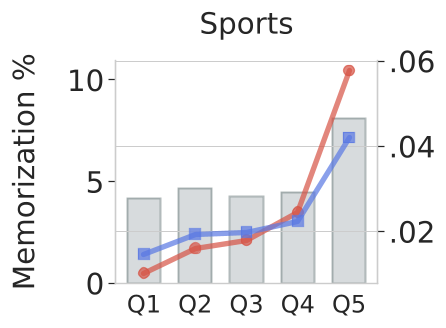
- Confidence Check: Use the ID-based model's confidence (Maximum Softmax Probability).
- Dynamic Weighting: If confidence is high (likely a memorization task), lean on the ID-based model. If low (likely a new pattern), switch to the GR model.
Conclusion & Future Outlook
This work confirms that Generative Recommendation is not a replacement for ID-based models, but a complementary paradigm. The "Generality" of GR is effectively a form of "blurred memorization" at the token level.
Future Work: We need tokenization methods that allow for "Hard Memorization" (unique identifier tokens) alongside "Soft Generalization" (semantic tokens) to get the best of both worlds without the overhead of two separate models.