
Decoding the Geometry of Particle Physics: The Unramified Double Covering in Feynman Integrals
Genus drop involving non-hyperelliptic curves in Feynman integrals
The paper investigates the "genus drop" phenomenon in Feynman integrals, reformulating the extra-involution mechanism as an unramified double covering of algebraic curves. It identifies Type I (non-hyperelliptic to hyperelliptic) and Type II (between hyperelliptic curves) drops, specifically demonstrating how three-loop diagrams across different representations achieve simplified geometric structures.
TL;DR
Calculating the probability of particle interactions involves solving complex Feynman integrals. Often, these integrals are associated with "curves" of high genus (complexity). This paper reveals that much of this complexity is an illusion: through a mathematical mechanism called unramified double covering, many high-genus curves can be simplified. The authors provide a unified framework explaining how spatial symmetries and integration choices can drop the genus, making seemingly impossible calculations manageable.
Context: Why Geometry Matters
In modern particle physics, precision is everything. As we move from two-loop to three-loop calculations, the integration kernels evolve from simple logarithms to elliptic curves, and eventually to higher-genus curves or even Calabi-Yau manifolds.
A persistent mystery in the field is that different ways of writing the same integral (representations) lead to different "apparent" geometries. How can the same physical process be a genus-5 curve in one mathematical language and a genus-3 curve in another? This paper answers that by looking at the mapping between these curves.
The Core Mechanism: Unramified Double Covering
The authors propose that the discrepancy in genus is not a mistake but a manifestation of the Riemann–Hurwitz formula. If a curve is a double cover of another curve , their genera are related by:
This is particularly powerful for Type I drops, where a curve changes from non-hyperelliptic (complex) to hyperelliptic (simpler).
Visualizing the Transformation
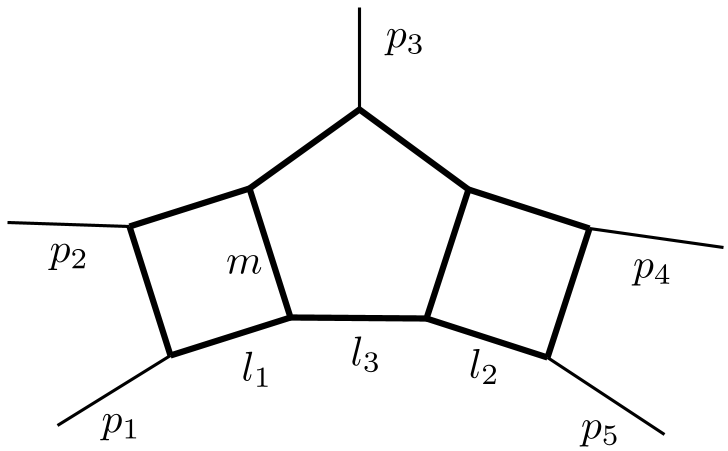 The Box-Pentagon-Box (BPB) diagram used to demonstrate the Type I genus drop.
Methodology: From Momentum to Baikov
The authors analyze the Box-Pentagon-Box (BPB) diagram.
- Momentum Representation: Applying the maximal cut here yields a genus-5 non-hyperelliptic curve.
- Loop-by-Loop Baikov Representation: Here, the curve appears as a genus-3 hyperelliptic curve.
By explicitly constructing a holomorphic map between these two, they prove the existence of an unramified double covering. They show that the genus-5 curve is actually isomorphic to a fiber product of simpler curves, and its Jacobian (a complex torus representing its periods) contains the simpler genus-3 Jacobian as a sub-variety.
Physical Intuition: Symmetries and Residues
Why does this happen physically?
- Type I (Residue Order): It depends on which "cut" you apply first. If you eliminate variables in a suboptimal order, you artificially inflate the genus of the intersection.
- Type II (Spacetime Symmetry): For diagrams like the Non-Planar Crossed Box, the external legs only span a 3D subspace of the 4D spacetime. This creates a reflection symmetry (). This discrete symmetry is the hidden "engine" that drives the extra involution, effectively folding the higher-genus curve into a simpler one.
Experimental Validation: The Prym Variety
The paper doesn't just claim the curves are related; it provides the Period Relations. By using Prym varieties, the authors show that the period matrix of the complex curve can be decomposed into the period matrices of simpler curves and using a linear transformation:
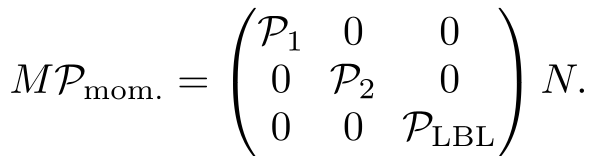
This ensures that even if a researcher uses the "wrong" (higher-genus) representation, the final physical result—the periods of the integral—remains consistent.
Limitations: The Genus-9 Wall
Not all curves can be simplified. The authors point to the Massive Pentagon-Box-Pentagon diagram. This diagram yields a genus-9 non-hyperelliptic curve. Despite their best efforts, no symmetry or residue trick has yet simplified this geometry. This suggests we are reaching the limit of "easy" simplifications, and genuinely non-hyperelliptic physics is on the horizon.
Conclusion
This work provides the most rigorous mathematical explanation to date for the "genus drop" phenomenon. By framing it as an unramified double covering, the authors have turned a geometric curiosity into a predictable tool. For future 3-loop and 4-loop calculations, looking for discrete Lorentz symmetries will be the gold standard for finding the minimal geometric representation.
Senior Editor's Note: This paper is a significant bridge between Algebraic Geometry and Quantum Field Theory, proving once again that the universe prefers the simplest possible description—provided you know where to look for the symmetry.