
Geo2: Unifying Geo-Localization and Bidirectional Image Synthesis with 3D Geometric Priors
Geo$^\textbf{2}$: Geometry-Guided Cross-view Geo-Localization and Image Synthesis
Geo2 is a unified geometry-guided framework that jointly addresses Cross-View Geo-Localization (CVGL) and bidirectional Cross-View Image Synthesis (CVIS). It leverages 3D geometric priors from Geometric Foundation Models (GFMs) like VGGT to achieve state-of-the-art performance across major benchmarks including CVUSA, CVACT, and VIGOR.
TL;DR
Geo2 is a novel framework that bridges the gap between Cross-View Geo-Localization (CVGL) and Cross-View Image Synthesis (CVIS). By leveraging Geometric Foundation Models (GFMs), it embeds ground and satellite views into a shared 3D-aware latent space. This not only pushes the SOTA in localization (R@1 +5.01% on VIGOR) but also enables high-quality, bidirectional image generation using a single flow-matching model.
The Core Challenge: The Appearance and Viewpoint Gap
In geo-spatial learning, the primary hurdle is the sheer difference in perspective. A street-level panorama looks nothing like a top-down satellite tile. Previous works often relied on "flat" geometric assumptions (like polar transformations) which break down in complex urban environments with varying heights and occlusions.
The authors' insight is profound: Geometric consistency is the universal language between views. If a model understands the underlying 3D structure (buildings, roads, layouts), the task of matching a location or "imagining" a view becomes significantly more manageable.
Methodology: GeoMap and GeoFlow
1. GeoMap: Bridging the 3D Gap
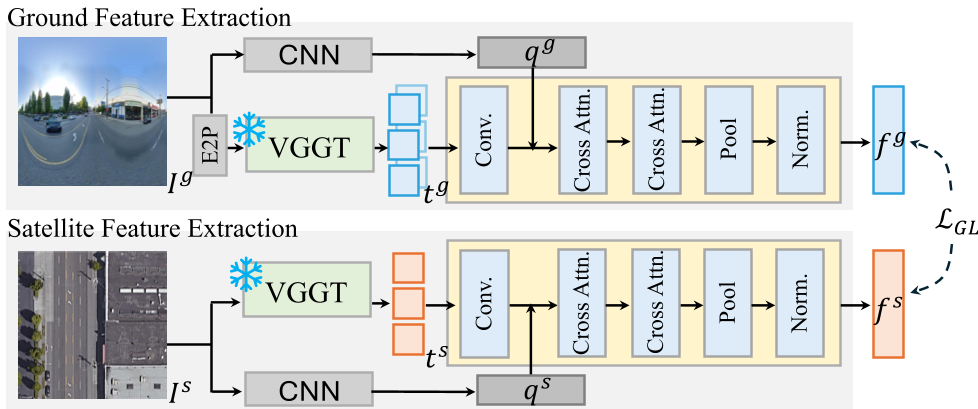
The authors utilize VGGT, a Visual Geometry Grounded Transformer, to extract dense 3D priors. However, GFMs are typically trained on perspective images, while ground data comes in distorted equirectangular panoramas.
- Solution: Geo2 uses an Equirectangular-to-Perspective (E2P) transformation, splitting the panorama into multiple perspective crops.
- Alignment: These features are then fused with semantic features (from ConvNeXt) into a shared geometry-aware latent space using cross-attention.
2. GeoFlow: Synthesis as Domain Translation
Instead of using standard GANs or Diffusion models that are often uni-directional, Geo2 adopts Flow Matching. By modeling the transformation as an Ordinary Differential Equation (ODE), the model can learn a vector field that "pushes" ground features toward the satellite domain.
- Bi-directionality: Because the ODE is reversible, a model trained to generate satellites from ground images can generate ground views from satellites simply by reversing the integration direction—no retraining required.
Experimental Excellence
Geo2 was tested on three major benchmarks: CVUSA, CVACT, and the highly challenging VIGOR.
| Dataset | Setting | Metric | Sample4Geo (Baseline) | Geo2 (Ours) | Improvement |
|---|---|---|---|---|---|
| VIGOR | Cross-Area | R@1 | 61.70% | 66.71% | +5.01% |
| CVACT | Val Set | R@1 | 90.35% | 94.36% | +4.01% |
The joint training strategy, where localization and synthesis tasks share a consistency loss, was proven vital. The synthesis task guides the localization features to be more representative of the scene's physical layout, while the localization task ensures the synthesis remains anchored to the correct geo-spatial features.
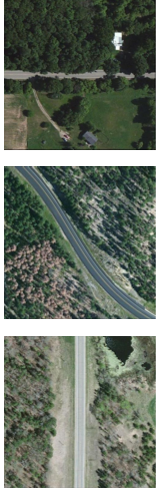 In the figure above, note how Geo2 accurately reconstructs building layouts and road orientations in both directions.
Critical Insight & Conclusion
The true value of Geo2 lies in its Inductive Bias. By injecting 3D geometric knowledge via GFMs, the model moves beyond simple pattern matching. It "understands" that a building in a satellite view has a corresponding facade in the street view.
Limitations: While powerful, the reliance on heavy GFM backbones (like VGGT) increases computational overhead during feature extraction. Future work could involve distilling these geometric priors into smaller, more efficient backbones for real-time edge applications.
Takeaway: Geo2 demonstrates that the unification of "retrieving" and "generating" is not just possible but beneficial, setting a new paradigm for how we approach cross-view intelligence.