
The Geometry of Efficient Nonconvex Sampling: Beyond the Convexity Paradigm
The Geometry of Efficient Nonconvex Sampling
The paper introduces an efficient "In-and-Out" algorithm for uniformly sampling from arbitrary compact nonconvex bodies in . By leveraging a warm start under the conditions of isoperimetry (Poincaré inequality) and a novel volume growth condition, the method achieves polynomial iteration complexity, significantly generalizing previous results limited to convex or star-shaped sets.
TL;DR
For decades, efficient high-dimensional sampling was synonymous with convexity. This paper breaks that bottleneck by proving that an algorithm named In-and-Out can uniformly sample from nonconvex bodies in polynomial time. The secret sauce? Replacing convexity with two more flexible geometric pillars: Isoperimetry (ensuring the set isn't "pinched" into two) and a Volume Growth Condition (ensuring the set isn't too "thin").
Background: Why Nonconvexity is the "Final Boss"
In optimization, we know that finding a global minimum in a nonconvex landscape is generally NP-hard because you can get stuck in local minima. Sampling faces a similar but subtler challenge. While we don't necessarily need to find a "peak," we need to explore the entire volume. If a set is nonconvex—like a dumbbell with a narrow neck—a random walk might take an eternity to cross from one side to the other.
Until now, provably efficient sampling was mostly restricted to:
- Convex Bodies: Where the Brunn-Minkowski theorem makes life easy.
- Star-shaped Bodies: A very specific type of nonconvexity where every point is "visible" from a central core.
The "In-and-Out" Mechanism
The authors analyze the In-and-Out algorithm, which is a practical realization of the Proximal Sampler. The process is elegant:
- The "Out" (Forward) Step: From your current point , take a Gaussian step to a point . This point might land outside the body .
- The "In" (Backward) Step: From , perform rejection sampling (drawing Gaussian samples) until you land back inside .
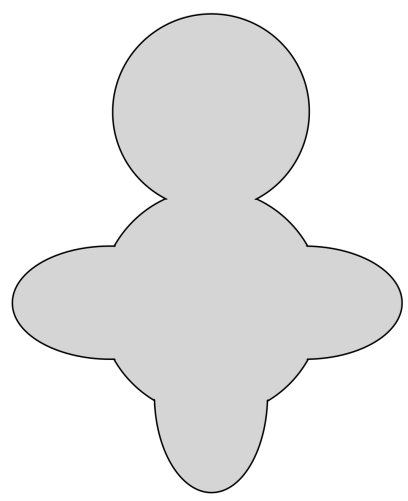 Typical nonconvex bodies (c) and (d) that can now be sampled efficiently.
Two Conditions for Success
The paper identifies that Poincaré inequalities (Isoperimetry) aren't enough on their own. You also need to ensure that when you step "out," you aren't so far away that the "in" step becomes impossible.
1. Isoperimetry (Poincaré Inequality)
This ensures that there are no "bottlenecks." If a set has a good Poincaré constant , the probability mass is well-connected, allowing the Markov chain to mix rapidly.
2. Volume Growth Condition
The authors define an -volume growth condition: This formula bounds how much the volume expands when you "fatten" the set by a radius . This is the crucial replacement for convexity. Interestingly, the authors prove that this condition is preserved under unions and set subtractions, meaning you can build complex nonconvex shapes and still sample them efficiently.
Results and Intuition
The main result is a tour de force in high-dimensional geometry. In the convex case, the "Forward" step is easy to analyze because a convex set always has a supporting halfspace. In the nonconvex case, the authors had to use a "ball containment" argument (as seen in Figure 3).
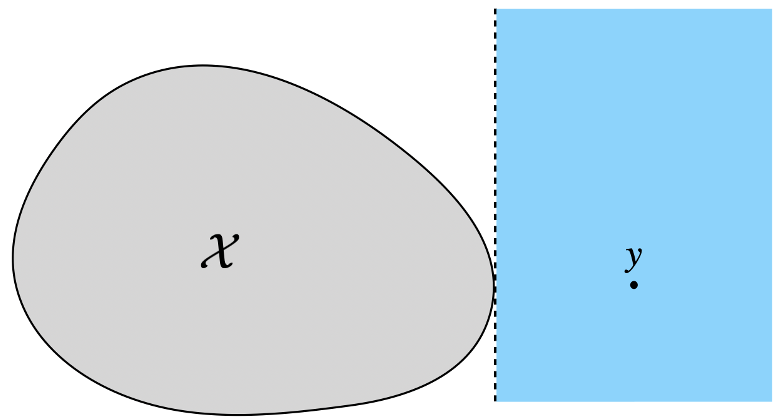 (a) In convex sets, a halfspace separates from . (b) In nonconvex sets, we can only rely on a ball of radius .
This geometric difference results in a slightly higher complexity: for nonconvex sets vs. for convex sets. However, this is a small price to pay for the massive expansion in the types of shapes we can now handle.
Critical Insights & Takeaways
- Mathematical Generality: The volume growth condition is much weaker than convexity. It allows for "holes" and "cracks" in the body, provided the global expansion is controlled.
- Rényi Divergence: The algorithm provides strong guarantees in Rényi divergence, which is a much more stringent error metric than simple Total Variation distance.
- Warm Start Dependency: Like many high-dimensional results, this assumes you start "near" the target distribution. The problem of finding a "cold start" in a nonconvex body remains a fascinating open challenge.
Future Outlook
This paper bridges the gap between the "ideal" world of convex geometry and the "messy" reality of nonconvex applications. It suggests that many sampling problems we previously thought were intractable might actually be solvable with standard algorithms, provided we look at them through the right geometric lens.