
[CVPR 2025/Related] GeoNDC: Revolutionizing Planetary Archives by Turning Data into Executable Models
GeoNDC: A Queryable Neural Data Cube for Planetary-Scale Earth Observation
GeoNDC is a queryable neural data cube that encodes planetary-scale Earth Observation (EO) data as a continuous spatiotemporal implicit neural field. It achieves massive compression (up to 380:1) and enables direct, on-demand spatiotemporal queries and cloud-free reconstruction without full-volume decompression.
TL;DR
Satellite Earth Observation (EO) has a scaling problem: we have petabytes of data but accessing it is an I/O nightmare. GeoNDC (Geographic Neural Data Cube) solves this by representing entire planetary archives—decades of global satellite imagery—not as files, but as continuous neural fields. It compresses files by up to 380x, fills in cloud gaps automatically, and allows you to query 20 years of history in milliseconds directly in a web browser.
Background: The Raster Bottleneck
For decades, we have stored the Earth's history in "tiles" and "chunks" (GeoTIFF, Zarr). If a scientist wants to see how a specific forest in the Amazon has changed over 20 years, they must:
- Download/Open thousands of individual files.
- Handle missing data caused by clouds.
- Align and interpolate the pixels.
This workflow is I/O bound and fragmented. GeoNDC argues that because the Earth's surface changes follow predictable patterns (phenology), we shouldn't store every pixel explicitly. Instead, we should "learn" the Earth's surface as a continuous function.
Methodology: The Architecture of Spatiotemporal Anisotropy
The core challenge in EO data is anisotropy: geography has sharp edges (roads, coasts), while time (vegetation growth) is usually smooth. A standard 3D neural network would blur the borders or create "temporal striping."
GeoNDC introduces a Decoupled Dual-Branch Architecture:
- Static High-Resolution 2D Branch: Uses a 2D HashGrid to "lock" the sharp physical boundaries of the landscape.
- Dynamic Coarse 3D Branch: Uses a scaled 3D HashGrid to capture regional temporal trends (phenology) while suppressing noise.
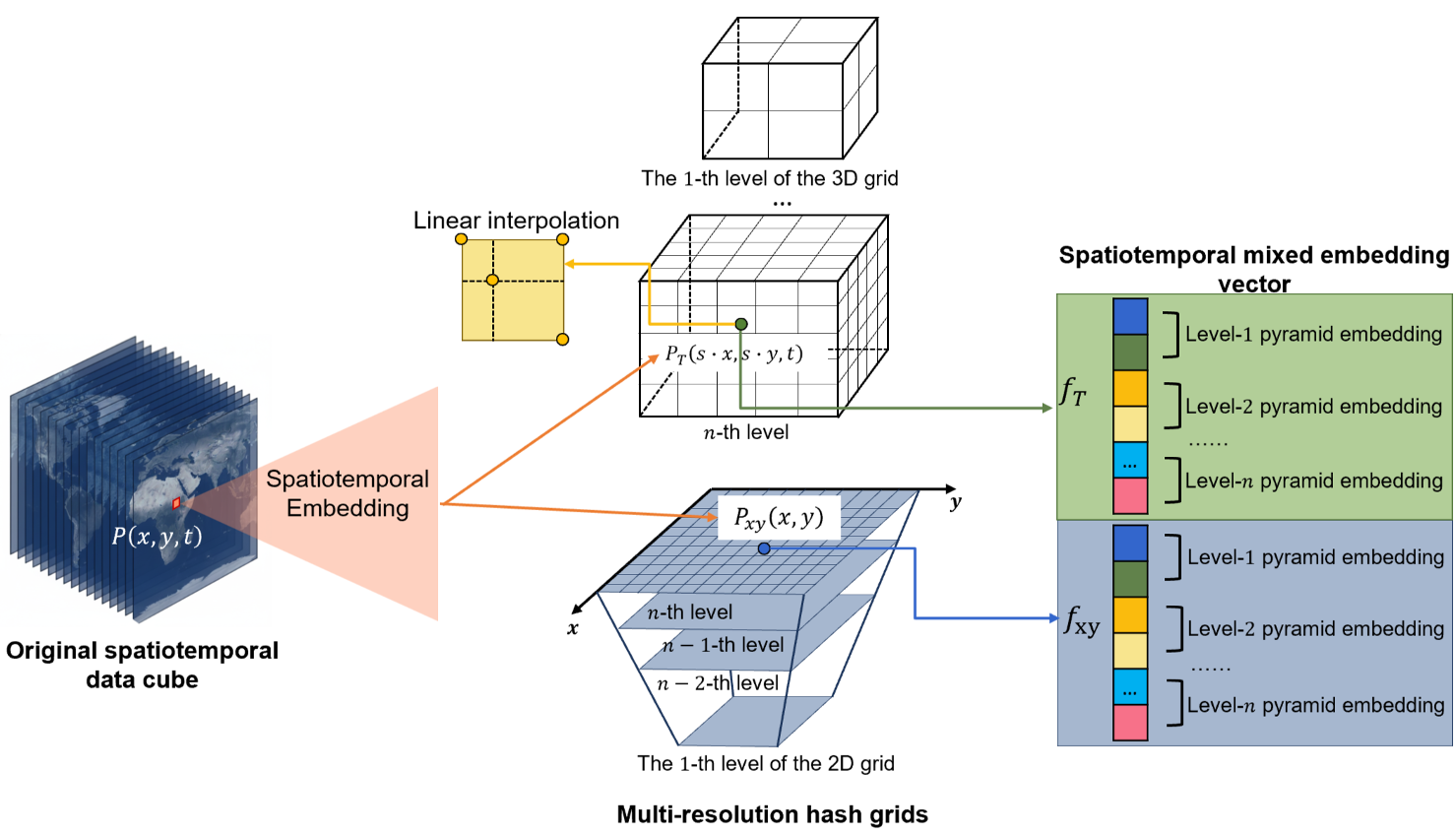 Fig. 1: The architecture maps (x, y, t) coordinates to a high-dimensional space, effectively "amortizing" the cost of storage across the temporal dimension.
Native Gap-Filling: "Invisible" Inpainting
Unlike traditional methods that "patch" holes left by clouds using heuristics, GeoNDC treats recovery as an inherent property of the representation. By training with a masked objective, the model learns the "topology" of the land surface from valid dates and naturally "predicts" what the ground looked like under the clouds.
In experiments with Sentinel-2 data, GeoNDC recovered surface details under 2km cloud banks with an R² > 0.85, significantly outperforming linear interpolation which failed to capture the non-linear growth of crops.
Experimental Performance: From 168 GB to a Single File
The results on the 20-year MODIS archive are staggering:
- Compression: A 168 GB raw archive (42 GB in optimized Int16) was shrunk to 0.44 GB.
- Query Speed: A single-pixel 20-year trajectory query took 8ms (81x faster than GeoTIFF).
- Fidelity: Near-perfect reconstruction (Mean R² > 0.98) across all spectral bands.
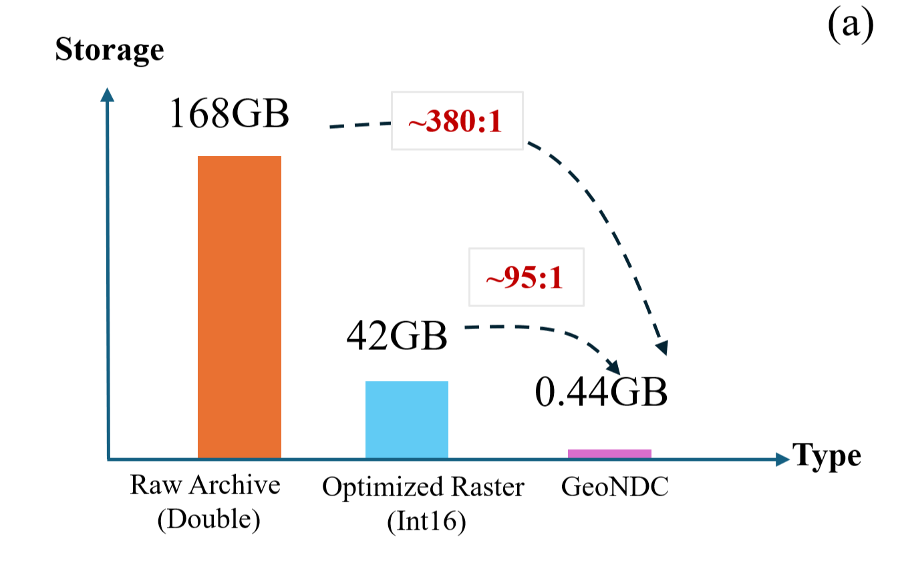 Fig 2: Comparison showing how GeoNDC maintains global patterns and allows for interactive visualization of decades of data.
Deep Insight: Data as an Executable Model
The most profound shift here is the GeoNDC Unified Storage Protocol. Since the data is now a lightweight neural network, the "archive" becomes executable.
The authors demonstrated a WebGPU-based viewer where the entire 20-year global record is loaded into the browser as a 440MB payload. The user navigates the globe and the browser performs real-time neural inference to "render" the Earth at any point in time. This eliminates the need for massive backend servers and data streaming.
Critical Analysis & Limitations
While GeoNDC is a breakthrough for "Analysis-Ready Data," it has trade-offs:
- Computational Cost: Encoding (training) the model is expensive upfront, though querying is cheap.
- Lossy Nature: It is a "semantic approximation." For legal or forensic applications, the raw bits of the original archive are still necessary.
- Transient Events: Extremely sudden changes (like a landslide or a flash fire) might be smoothed out by the temporal branch.
Conclusion
GeoNDC proves that the "Data Cube" of the future isn't a collection of rasters—it's a weights file. By unifying compression, query, and reconstruction into a single AI-native representation, it provides a blueprint for how we will interact with planetary-scale information in the age of Foundation Models.
Takeaway: This work represents the transition of Geospatial infrastructure from Static Storage to Neural Representation.
For more details, visit the GeoNDC Project Page.