
GigaWorld-Policy: Scaling World–Action Models with 9x Faster Inference and Physical Consistency
GigaWorld-Policy: An Efficient Action-Centered World--Action Model
GigaWorld-Policy is an action-centered World–Action Model (WAM) built on a 5B diffusion Transformer (Wan-2.0). It achieves state-of-the-art robotic manipulation by jointly modeling action sequences and future visual dynamics, outperforming the previous SOTA (Motus) with a 9x inference speedup and a 7% higher success rate in real-world tasks.
TL;DR
GigaWorld-Policy bridges the gap between massive video foundation models and real-time robotic control. By treating future video prediction as a training-time auxiliary task rather than an inference-time requirement, the model learns deep physical intuitions (visual dynamics) without the massive computational overhead of video generation during deployment. It delivers 9x faster inference than previous world models like Motus while setting new success rate benchmarks in complex real-world manipulation.
The "Supervision Sparsity" vs. "Latency" Tradeoff
Modern robotics faces a data bottleneck. While we have millions of frames of video (high-dimensional), we have very few high-quality action labels (low-dimensional/sparse).
- Standard VLAs (like π0.5) try to map images directly to actions. This often fails because the model doesn't "understand" the physics of the scene—it just mimics movements, often falling for contextual shortcuts.
- Conventional World Models (WAMs) solve this by forcing the model to predict the next video frame. However, these models are slow. If your robot has to run a full diffusion sampling loop to "dream" the future before taking a single step, the resulting latency makes closed-loop control impossible.
GigaWorld-Policy breaks this cycle with an Action-Centered approach.
Methodology: Causal Masking & Multi-Stage Curriculum
1. Unified Causal Architecture
The core innovation is the tokenization strategy and the Causal Self-Attention Mask. The model treats State (), Observation (), Action (), and Future Video () as a single sequence.
- Action reasoning: Actions can "see" the current state and images but are strictly blinded to the future video tokens to prevent information leakage.
- Physical Grounding: Future video tokens must attend to the actions, forcing the model to learn: "If I move the arm this way, the bowl will move that way."
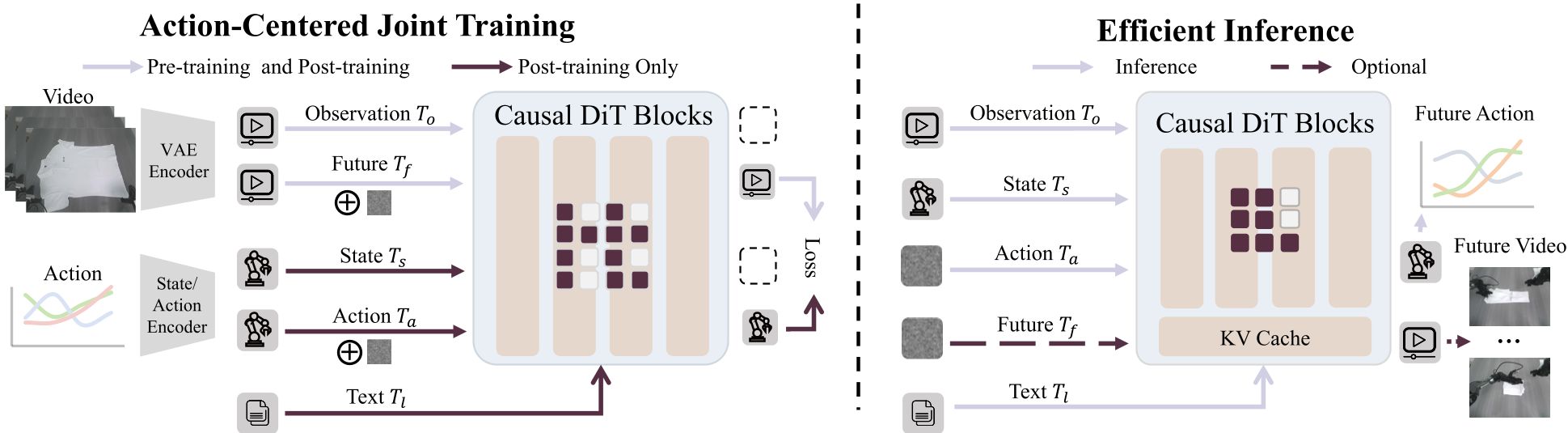 Figure 1: GigaWorld-Policy overview. During training, it learns both actions and video. At inference, the video branch is pruned for speed.
2. The Training Pipeline: From Web to Robot
The model undergoes a sophisticated three-stage "Evolution":
- Stage 1: Foundation: Initialized from Wan-2.0, a 5B diffusion video model.
- Stage 2: Embodied Pre-training: 10,000 hours of curated data, including human egocentric videos (Ego4D) and multi-robot recordings. This teaches the model "Hand-Object" interaction priors.
- Stage 3: Task Post-training: Fine-tuning on specific target robot data (e.g., PiPER arm) using Flow Matching for both actions and videos.
Experimental Breakthroughs
The results on RoboTwin 2.0 and real-world hardware confirm two major wins:
Efficiency and Speed
By enabling an "Action-only" mode at inference, GigaWorld-Policy drops latency to 360ms—comparable to standard VLAs but far superior to WAMs like Motus (3231ms) and Cosmos-Policy (1413ms).
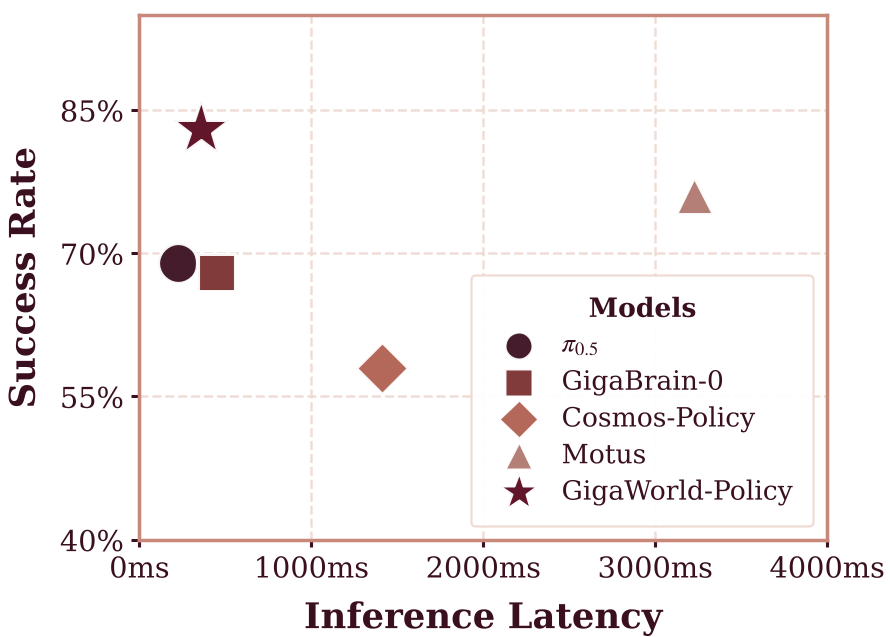 Figure 2: The Pareto front of Success Rate vs. Inference Frequency. GigaWorld-Policy occupies the top-right "sweet spot."
Data Efficiency
Perhaps the most striking result is found in the ablation on data scaling. GigaWorld-Policy reached the maximum performance of a standard VLA model using just 10% of the training data. The "World Model" objective acts as a massive multiplier for signal-to-noise ratio in low-data regimes.
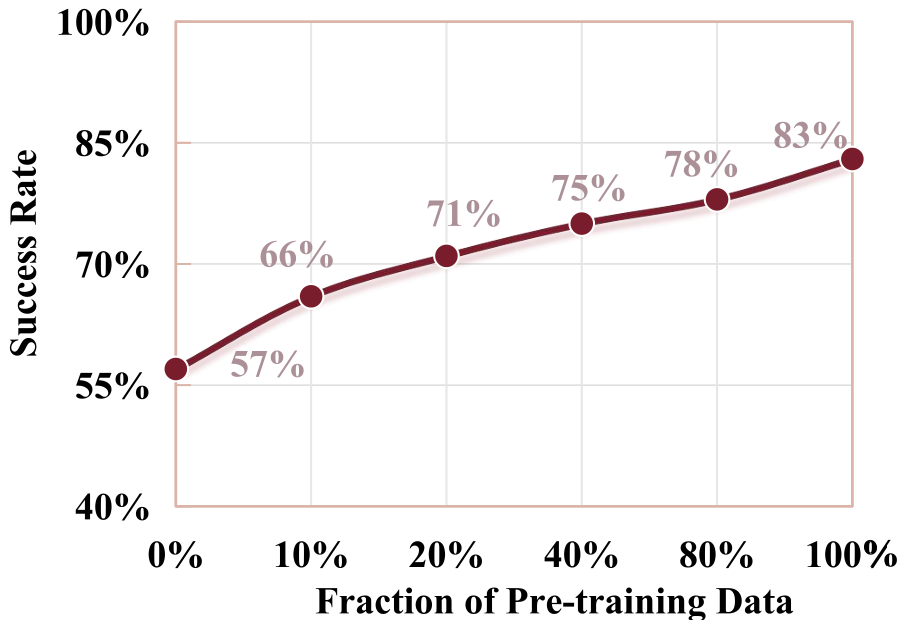 Figure 3: Success rate vs. Data fraction. The physical priors from video pre-training allow for extreme sample efficiency.
Critical Insight: Why Does It Work?
The authors found that predicting denser future videos (more frames) actually had diminishing returns. The "sweet spot" was predicting one future frame every 12 steps. This suggests that the model doesn't need to be a perfect video editor; it just needs a coarse mental model of future states to regularize its action choices.
The Causal Mask is the secret sauce here—by enforcing a factorized dependency, the model learns a cleaner mapping from "Action -> Expected Outcome" than unconstrained self-attention, which they proved via higher PSNR/SSIM scores in video reconstruction tasks.
Conclusion
GigaWorld-Policy represents a significant shift in Embodied AI. It treats "World Modeling" as a cognitive scaffold for training, rather than a heavy simulation engine for inference. For practitioners, this means we can finally deploy robust, physically-aware models on real hardware without the "Diffusion Latency Penalty."
Limitations: While the model is highly efficient, it still relies on a 5B backbone. Shrinking this further for edge-device deployment while maintaining the "World Model" benefit remains an open challenge.