
[Personize.ai] Governed Memory: Beyond RAG to Production Multi-Agent Infrastructure
Governed Memory: A Production Architecture for Multi-Agent Workflows
Governed Memory is a production-grade shared memory and governance architecture designed for multi-agent workflows. It introduces a dual memory model and tiered governance routing, achieving a 99.6% fact recall and 74.8% accuracy on the LoCoMo benchmark, outperforming existing memory primitives like Mem0 and Zep.
TL;DR
As AI agents move from experimental chatbots to distributed enterprise workflows, the limitation isn't just "what the model knows," but how that knowledge is governed and shared. Governed Memory is a new production architecture that bridges the gap between unstructured RAG and structured CRM systems. It achieves 99.6% fact recall and reduces token waste by 50% through session-aware context delivery, ensuring that agents across sales, support, and marketing act as a unified, governed entity.
The Problem: The Memory Governance Gap
Enterprise AI doesn't produce one agent; it produces dozens. An enrichment agent, a support bot, and a renewal agent all interact with the same customer, yet they are often "amnesiac" to each other's actions.
The authors identify that standard Retrieval-Augmented Generation (RAG) is a retrieval primitive, not an infrastructure layer. It fails because:
- Memory Silos: Intelligence doesn't accumulate; it stays trapped in one-off agent executions.
- Context Redundancy: In multi-step autonomous loops, the same policies are re-injected repeatedly, bloating costs and confusing the model.
- Unstructured Dead-ends: Free-text memories are great for prompts but useless for CRM synchronization or business analytics.
Methodology: The Four Pillars of Governed Memory
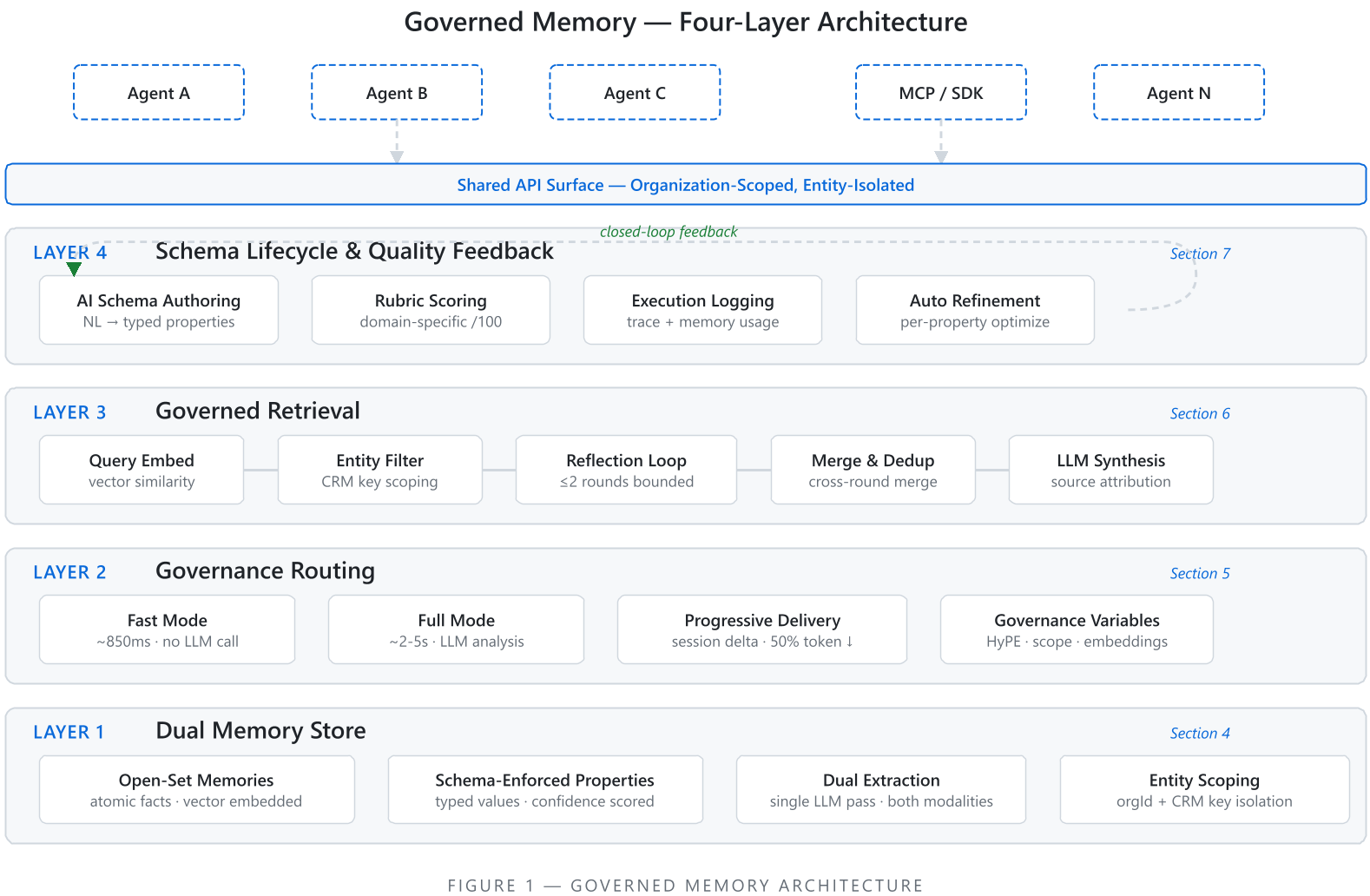
The architecture moves beyond simple vector search by introducing four distinct layers:
1. Dual Memory Store (Facts + Types)
Instead of choosing between a database (Structured) and a vector store (Unstructured), this model extracts both in a single pass.
- Open-Set Memories: Atomic, self-contained facts (e.g., "The CTO is evaluating three vendors").
- Schema-Enforced Memories: Typed properties (e.g.,
deal_value: 450000,currency: USD).
2. Tiered Governance Routing
Not every agent needs every policy. A "Fast Mode" ranks governance guidelines using keyword/embedding hybrids (~850ms), while a "Full Mode" uses LLM reasoning to select the most critical guidelines. Crucially, Progressive Context Delivery tracks what has already been sent to the agent in a session, preventing the "Lost in the Middle" problem by only sending "delta" updates.
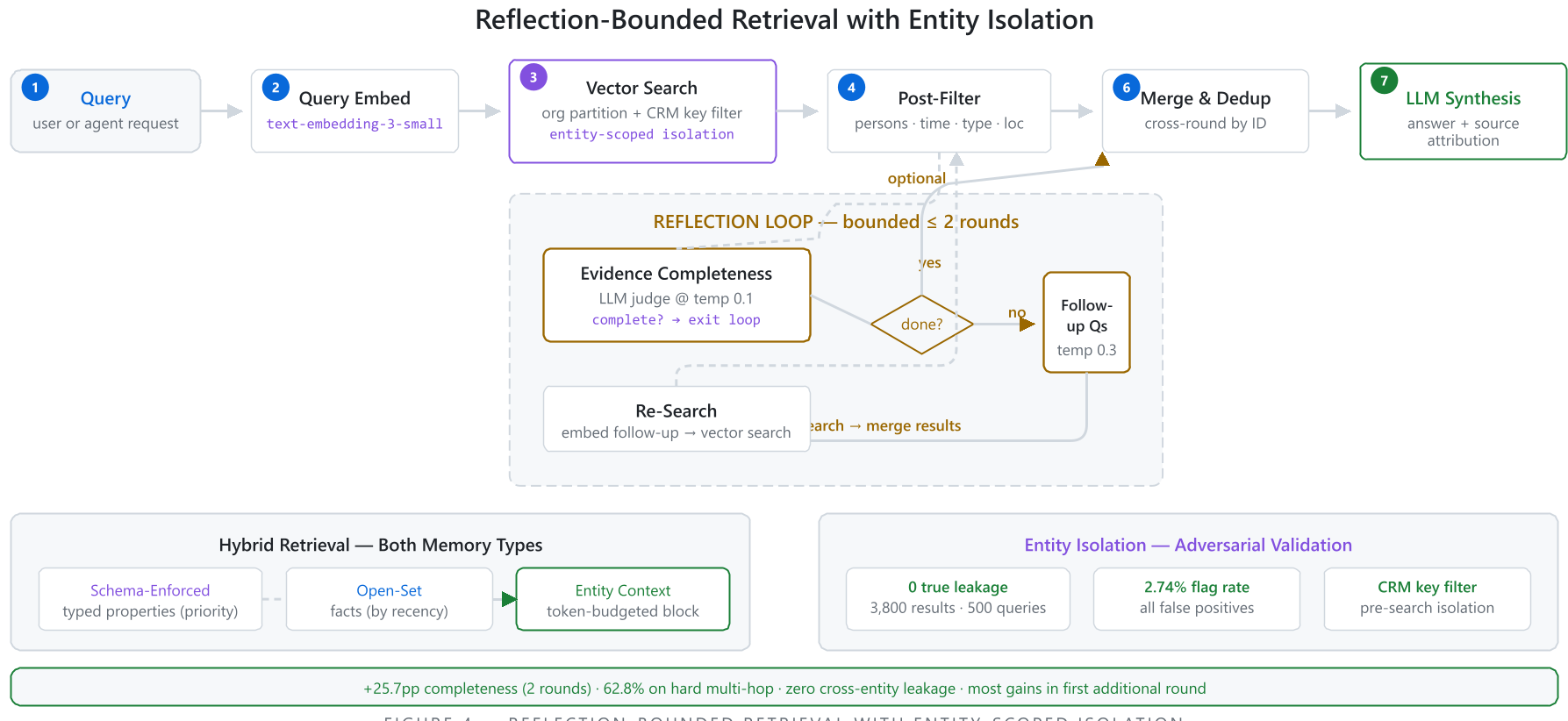
3. Reflection-Bounded Retrieval
Standard RAG often stops after one search. Governed Memory uses an iterative loop where an LLM judges if the retrieved evidence is "complete." If not, it generates targeted follow-up queries.
4. Schema Lifecycle Management
Schemas are treated as living documents. The system uses "AI-assisted authoring" to create schemas from natural language and "Self-Evaluation" to detect when extraction quality drops, automatically refining property definitions.
Experimental Results & Insights
The paper validates the architecture through a rigorous series of adversarial and performance tests:
- Token Efficiency: Progressive delivery saved 50.3% in tokens across multi-step workflows. In some cases, savings reached 89.6% for re-entrant tasks.
- Safety & Isolation: Under adversarial stress, the system showed zero cross-entity leakage. This is critical for HIPAA/GDPR compliance where Customer A's memory must never touch Customer B's agent.
- Conflict Resolution: When presented with "Stale" vs "Fresh" data (e.g., a customer changing their database provider), the exponential recency decay mechanism ensured a 83.3% correctness rate in surfacing the most current info.

Critical Analysis & Conclusion
Takeaway
The real value of Governed Memory isn't just better retrieval—it's Structured Actionability. By converting open-set facts into schema-enforced properties, the architecture allows AI agents to finally talk back to legacy systems like CRMs (Salesforce, HubSpot) with high confidence.
Limitations
The authors admit that Quality Gates currently rely on pattern-based heuristics rather than deep semantic analysis. There is also a "LLM-as-judge" bias in the self-evaluation layer, which requires further calibration against human experts.
Future Outlook
This work signals the end of "RAG-in-a-box" and the beginning of Agentic Memory Infrastructure. Future iterations will likely incorporate Graph-Enhanced Memory (GraphRAG) and more robust ML-augmented redaction to handle complex PII.
For those building production systems, the core lesson is clear: Memory is not just storage; it is a governance problem.