
Lensing of Gravitational Waves: A New Frontier in Precision Cosmology
Gravitational Lensing of Gravitational Waves from Astrophysical Sources: Theory, Detection, and Applications
This paper provides a comprehensive review of the gravitational lensing of Gravitational Waves (GWs), distinguishing between geometric-optics and wave-optics regimes. It outlines theoretical frameworks, source-lens populations, and detection strategies while establishing GW lensing as a high-precision tool for SOTA cosmological and astrophysical probing.
TL;DR
Gravitational waves (GWs) are not just signals to be heard—they are waves that can be bent, magnified, and diffracted. This paper provides a masterclass on how the gravitational lensing of GWs transitions from a geometric "mirage" to a complex wave-optics phenomenon. With the advent of third-generation detectors, we are on the verge of using lensed GWs to solve the Hubble tension and map the mysterious dark matter minihalos.
The "Why": Beyond the Mirror of Light
For decades, we have used the lensing of light to weigh galaxies. However, light is easily blocked by dust and contaminated by the lens's own brightness. Gravitational waves are different: they are "clean." They pass through galaxies unimpeded, carrying pristine information about the source and the path they traveled.
The core challenge lies in the wave nature of GWs. While light usually acts like a ray (Geometric Optics), GWs often behave like ripples in a pond (Wave Optics) when they encounter small lenses like stars or dark matter halos. This duality creates a unique "fingerprint" in the waveform that could reveal the secrets of the Universe.
Methodology: The Physics of Bending Spacetime
The paper bifurcates the theory based on the ratio of the GW wavelength () to the lens's Einstein radius ():
- Geometric Optics (): Think of this as multiple "images" of the same merger. We see the same black hole collision twice, separated by a time delay and a magnification factor.
- Wave Optics (): Here, diffraction takes over. There are no "images"—instead, the waveform itself is distorted, creating frequency-dependent interference fringes.
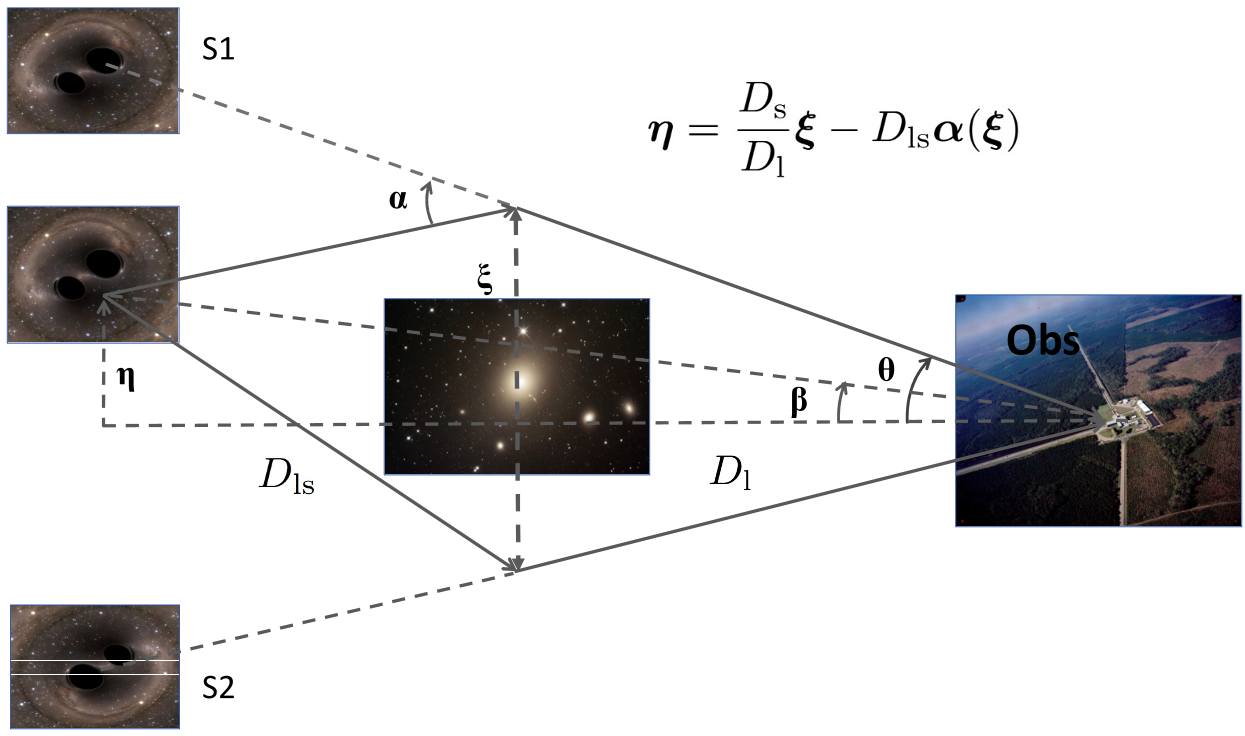 Figure 1: Schematic of a lens system showing the geometric relationship between source, lens, and observer planes.
Experimental Forecast: Hunting the Rare
Currently, the LVK (LIGO-Virgo-Kagra) network has detected over 300 events, but zero confirmed lensed cases. Why? The authors point out that coincidental overlaps—where two different mergers just happen to look similar—create high false-alarm rates.
However, the transition to 3G Detectors (Einstein Telescope and Cosmic Explorer) changes everything:
- Detection Rate: Tens to hundreds of lensed events per year.
- Localization: By exploiting the Earth's motion and the time delay between images, we can improve sky localization by a factor of 30, reaching sub-arcsecond precision.
- The "Dark Siren" Advantage: Unlike EM sources, we don't need to see the merger's light. We can reconstruct the lens potential and use the GW's internal "clock" to measure the expansion of the universe.
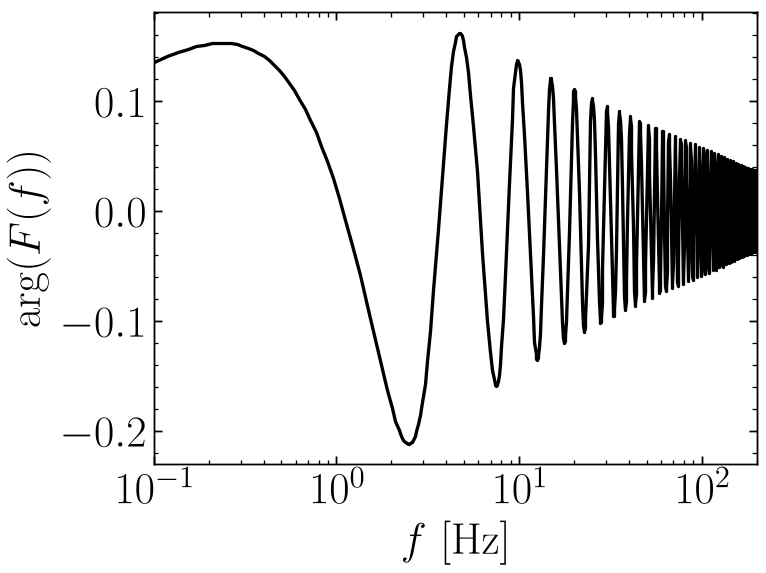 Figure 2: The frequency-dependent amplification factor in the wave-optics regime, showing how diffraction modulates the signal.
Critical Insight: Resolving the Hubble Tension
The Hubble Constant () is currently the subject of a "crisis" in physics, with different measurement methods disagreeing by 5. The paper advocates for Lensed GW Cosmography. Because the time delay between lensed images is measured in milliseconds but spans days of travel time, the precision is unmatched.
Specifically, "Dark Lensed Sirens" (sBBH mergers) could constrain to within 1% in just two years of 3G detector operation, providing a definitive tie-breaker in the Hubble debate.
Conclusion and Limitations
While the future is bright, several hurdles remain:
- Waveform Templates: We need more accurate "lens-aware" templates that include diffraction, especially for eccentric orbits.
- Numerical Complexity: Computing the diffraction integral for complex lenses (like entire galaxies filled with stars) is computationally expensive.
Ultimately, this review underscores that lensed GWs are the definitive tool for the next decade of "Dark Physics," allowing us to weigh the invisible (dark matter) and measure the vast (the Universe's expansion) with the same ripple in spacetime.