
[PRD 2026] Hairy Black Holes Leave a Mark: Decoding Gravitational Memory Beyond General Relativity
Gravitational Memory from Hairy Binary Black Hole Mergers
This paper presents the first calculation of gravitational-wave (GW) memory from full inspiral–merger–ringdown (IMR) simulations in scalar-Gauss-Bonnet (sGB) gravity. By evaluating the tensor null memory sourced by both tensor and scalar radiation, the authors demonstrate that the memory signal deviates from General Relativity (GR) predictions by up to 4% in certain binary black hole (BBH) configurations.
TL;DR
For the first time, researchers have calculated the gravitational-wave memory—the permanent "scar" left in spacetime—from the full merger of black holes in a theory beyond General Relativity (GR). Using scalar-Gauss-Bonnet (sGB) gravity as a testbed, the study reveals that "hairy" black hole mergers produce memory signals up to 4% different from GR, offering a new way for next-gen detectors like the Einstein Telescope to spot deviations in gravity.
The Mystery of the Permanent Displacement
Most gravitational waves are oscillatory; they stretch and squeeze space and then return it to its original state. However, GR predicts a nonlinear memory effect: a DC-like offset that leaves test masses permanently displaced after the wave has passed.
While we haven't detected memory yet (it requires stacking ~2000 events with current tech), it is a "hereditary" effect—it builds up by integrating the entire history of the energy radiated. This makes it a perfect magnifying glass for modified gravity. If a theory like sGB gravity changes the merger dynamics even slightly, the memory "remembers" and accumulates that difference.
Why Scalar-Gauss-Bonnet Gravity?
The authors chose scalar-Gauss-Bonnet (sGB) gravity for two deep reasons:
- Mathematical Health: Unlike many higher-derivative theories, sGB avoids "Ostrogradsky instabilities" (ghosts) and allows for a well-posed numerical evolution.
- The "Hair" Factor: In sGB, black holes are not "bald." They can carry a scalar field (hair), which provides an extra channel for energy loss during a merger.
Methodology: Mining the Merger
The team used full Numerical Relativity (NR) waveforms. Unlike previous Post-Newtonian attempts that only look at the slow inspiral, NR allows us to see the "strong-field" regime where the black holes actually collide.
They focused on the tensor null memory, which is sourced by the energy flux of both the gravitational waves () and the scalar field ().
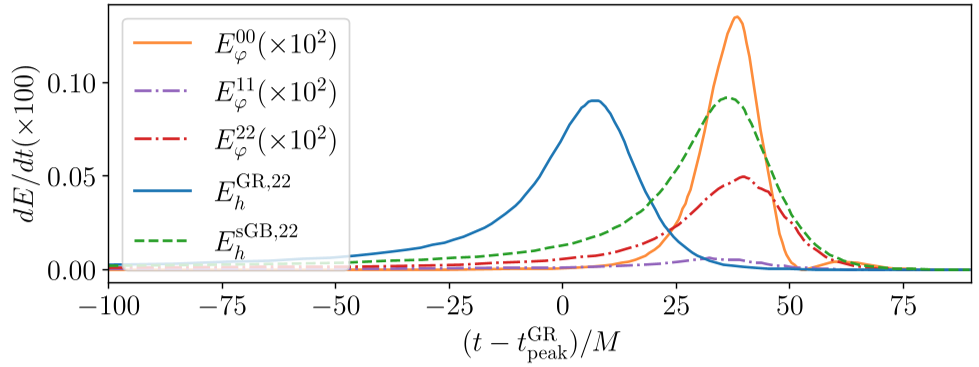 Figure: The scalar field and energy fluxes. While the scalar energy flux is smaller than the tensor flux, it indirectly alters the entire system's dynamics.
Key Finding 1: The 4% Deviation
The study analyzed two scenarios: shift-symmetric (always hairy) and dynamical scalarization (hair grows only during the merger).
In the shift-symmetric case with high coupling, the sGB memory amplitude was ~2.5% higher than the GR prediction for the same initial mass. When compared to the best-fit GR template (which accounts for parameter degeneracies), the difference grew to ~4%. This is significant because the Einstein Telescope is expected to constrain memory at the 2% level.
Key Finding 2: Breaking the Degeneracy
The most exciting part for data analysts is mismatch enhancement. Often, modified gravity effects can be "hidden" by shifting the estimated mass of the black holes in standard GR templates.
However, the authors found that including memory in the analysis increases the "mismatch" (the degree to which the models disagree) by more than an order of magnitude.
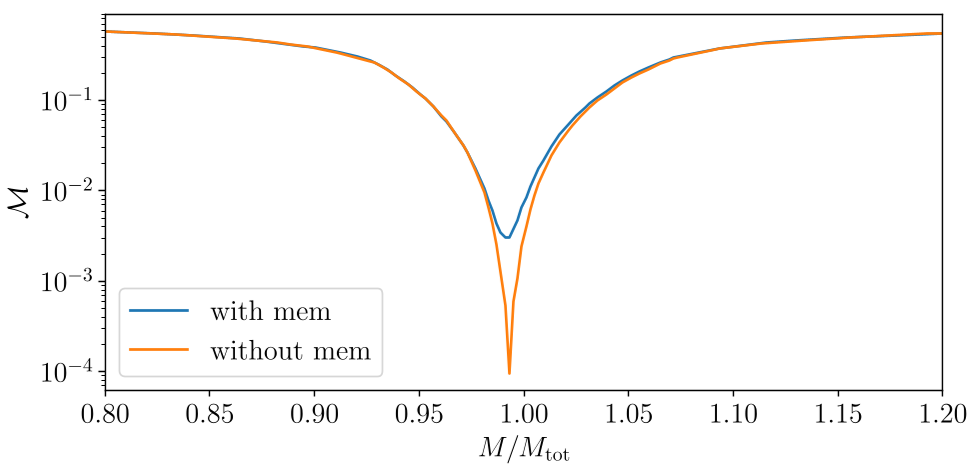 Figure: Mismatch as a function of total mass. Adding memory (solid red line) makes the sGB signal much harder to "fake" with a GR template compared to the oscillatory signal alone (blue line).
Critical Insight: Indirect vs. Direct Effects
A surprising technical takeaway is that the direct contribution of the scalar radiation to the memory is tiny (suppressed by orders of magnitude). The real change comes from the indirect effect: the scalar field changes how the black holes orbit and merge, which in turn significantly modifies the energy flux of the tensor (standard GW) waves.
Conclusion and Future Outlook
This work proves that gravitational memory is not just a theoretical curiosity; it is a vital tool for testing the limits of Einstein’s legacy.
Limitations: The simulations were relatively short (missing the early inspiral) and focused on non-spinning black holes. Next Steps: Extending this to spinning binaries and neutron star mergers where the scalar "dipole" radiation is even stronger.
As we move toward the era of the Einstein Telescope and LISA, our ability to detect the "scars" of a black hole merger might just be the key to discovering new physics.
Reference: Silvia Gasparotto, et al., "Gravitational Memory from Hairy Binary Black Hole Mergers," arXiv:2604.14.