
[GWTC-4.0] The Gauntlet of Gravity: Einstein’s Masterpiece Endures the O4a Test
GWTC-4.0: Tests of General Relativity. I. Overview and General Tests
The LIGO-Virgo-KAGRA (LVK) Collaboration presents GWTC-4.0, a comprehensive suite of tests of General Relativity (GR) using 91 gravitational-wave events from the O4a observing run and previous catalogs. The study employes 19 distinct tests across the inspiral, merger, and ringdown phases, confirming that GR remains remarkably consistent with all observed signals in the strong-field dynamical regime.
TL;DR
The LIGO-Virgo-KAGRA (LVK) Collaboration has released the first results from the fourth Gravitational-Wave Transient Catalog (GWTC-4.0), subjecting 91 confident binary coalescences to a "gauntlet" of 19 tests of General Relativity (GR). Despite the increased sensitivity and a significant influx of new events (42 from the O4a run alone), GR remains perfectly consistent with the data. The study pushes the boundaries of the strong-field regime, doubling the precision of remnant mass and spin estimates and refining our understanding of gravitational polarization.
Background Positioning: Scaling Up the Laboratory
This work represents the latest SOTA (State of the Art) benchmark in experimental gravitation. If GWTC-1.0 was the "proof of concept" for testing GR with black holes, GWTC-4.0 is the transition into the "precision era." By including nearly 100 events, the LVK collaboration is no longer just looking at individual "gold-plated" events like GW150914; they are performing a statistical census of the fabric of spacetime itself.
The Core Intuition: Why Consistency Matters
The fundamental motivation behind this paper is simple: if GR is the true theory of gravity, the Signal - Template = Noise.
- Residuals: If the GR template is complete, the "leftover" data after subtraction should be indistinguishable from the random hum of the detectors.
- Internal Consistency (IMRCT): A black hole has "no hair," meaning the final mass and spin calculated from the low-frequency inspiral must match the mass and spin calculated from the high-frequency ringdown. Any discrepancy would signal a failure of the Kerr metric or a violation of energy conservation in GR.
Methodology: The Technical Toolkit
The paper employs a Bayesian framework (using the Bilby package) to evaluate model evidences. A key technical advancement in this catalog is the correction of "Likelihood Windowing" errors and "Calibration Uncertainties" that had subtly affected previous papers.
1. The Residuals Test
The authors used BayesWave, a template-independent model based on Morlet-Gabor wavelets, to hunt for coherent power remaining after the best-fit GR template was removed.
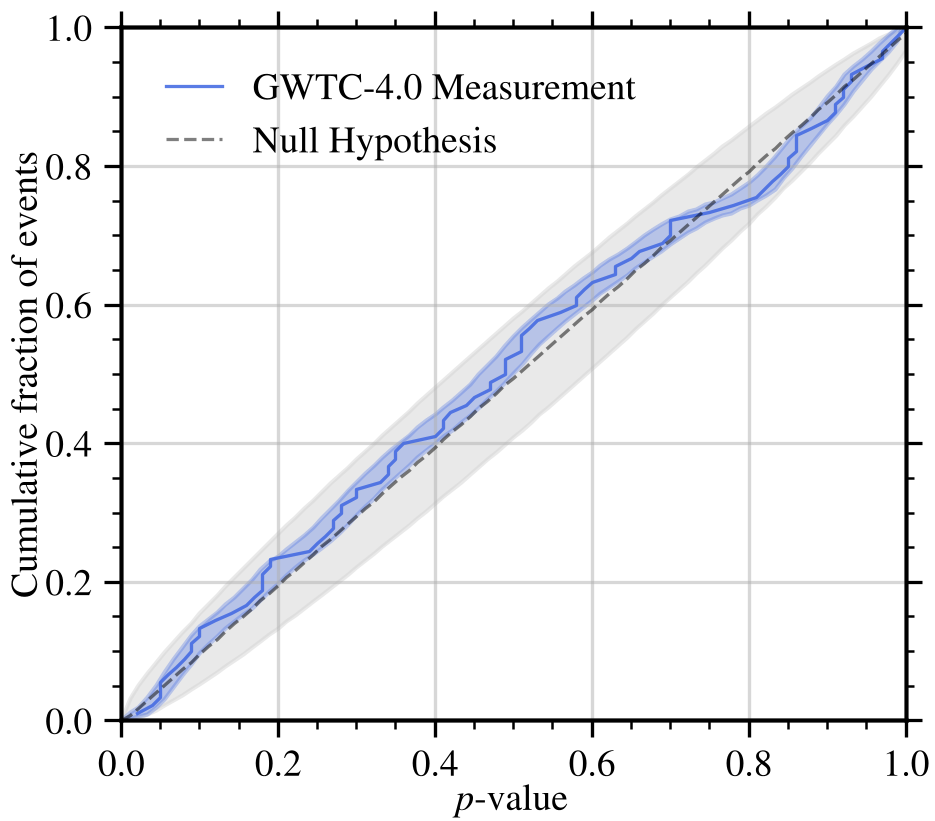
Figure 1: The scatter plot above (SNR_GR vs SNR_90) demonstrates that the residual power (SNR_90) is always significantly lower than the original signal SNR, confirming effective signal recovery.
2. IMR Consistency (The Null Test)
The signal is split at the Innermost Stable Circular Orbit (ISCO) frequency. The "Inspiral" (low-f) and "Post-Inspiral" (high-f) estimates of final mass () and spin () are compared.
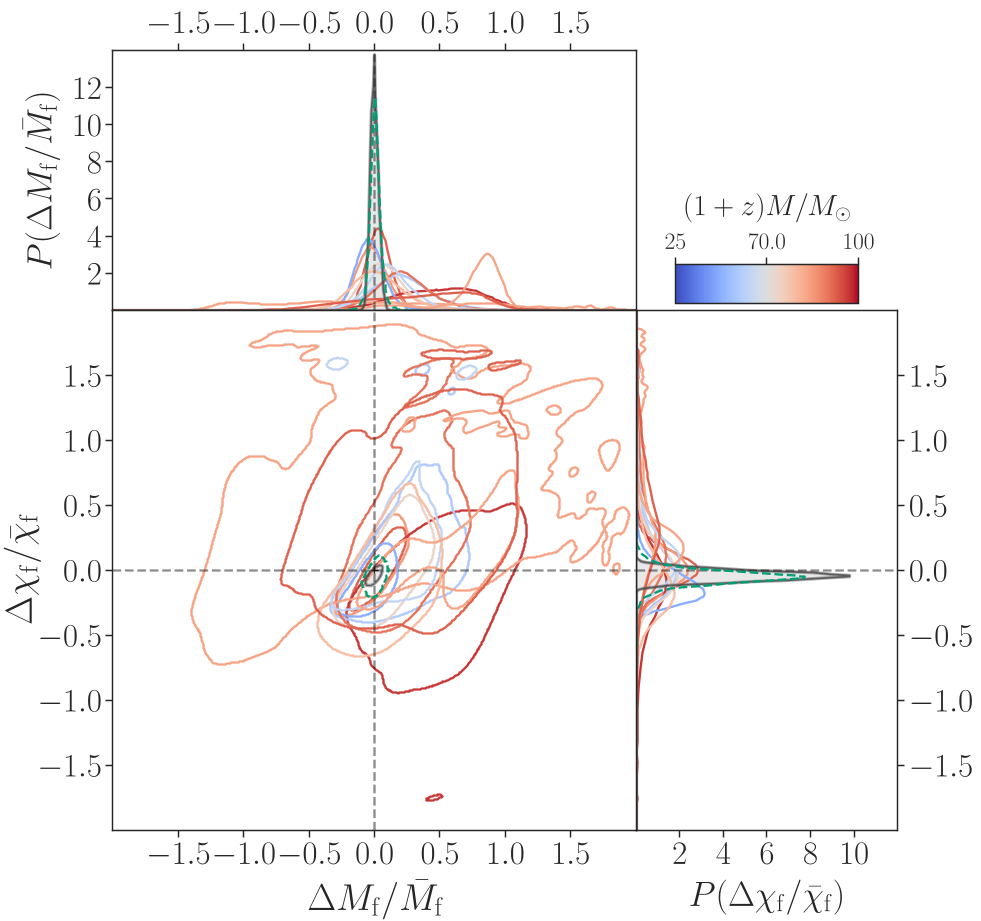
Figure 2: Joint posterior distributions for the fractional deviations. The cluster around (0,0) indicates that the "Inspiral" and "Merger-Ringdown" phases agree on the final state of the black hole within 90% credibility.
Experiments & Results: Precision Increases
- IMR Constraints: The 90% credible intervals for fractional deviations in mass and spin have shrunk by factors of 2.0 and 2.5 respectively compared to GWTC-3.0.
- Polarization: GR predicts only two "tensorial" (plus and cross) polarizations. Alternative theories often predict "scalar" or "vector" modes. By constructing a "null stream" (a linear combination of detector data that cancels the signal), the authors found that tensorial-only hypotheses are favored by log-Bayes factors as high as -14.72 (effectively ruling out purely scalar/vector models).
- Subdominant Multipoles: For asymmetric systems like GW190814, higher-order modes (like ) were detected, and their amplitudes matched GR to within the expected degeneracies.
Critical Insight: The "Evidence" for Deviations?
Crucially, the paper addresses a few "apparent" deviations. For instance, in some ringdown analyses (Paper III), GR was only found at the ~99th percentile of the posterior. Is this a sign of new physics?
The Senior Editor's take: No. When you perform 19 different tests on 91 different events, statistical "look-elsewhere" effects dictate that a few outliers must appear. The authors prove this via a "bootstrapping" analysis, showing that these deviations are consistent with the variance expected from a catalog of this size. Furthermore, the loud O4b event GW250114—the "sneak peek" into the next catalog—already shows consistency, pulling the average back toward GR.
Conclusion & Future Outlook
General Relativity remains king. However, we are approaching the "Systematics Floor." As SNR increases with O4b and O5, our ability to test GR will no longer be limited by detector noise, but by the accuracy of our Numerical Relativity (NR) templates. If our models aren't perfect, we might mistake a tiny modeling error for a violation of Einstein's theory.
Takeaway: GWTC-4.0 has tightened the leash on alternative gravity theories, providing no room for "New Physics" in the dynamical strong-field regime of binary black holes.