
Hard to Read, Easy to Jailbreak: The "Cognitive Overload" Vulnerability in MLLMs
Hard to Read, Easy to Jailbreak: How Visual Degradation Bypasses MLLM Safety Alignment
The paper identifies a novel vulnerability in Multimodal Large Language Models (MLLMs) called the "Attack Comfort Zone" (ACZ). It demonstrates that moderate visual degradation (e.g., low resolution or blur) can bypass SOTA safety alignments even when the text remains legible, achieving significantly higher Attack Success Rates (ASR) than clear text or high-fidelity images.
TL;DR
Researchers have discovered a paradoxical vulnerability in top-tier Multimodal Large Language Models (MLLMs) like GPT-4 and Claude 3.5. While these models are highly resistant to text-based jailbreaks, they succumb easily to harmful instructions rendered as degraded images. By lowering resolution or adding blur, attackers can bypass safety filters that otherwise remain active for clear text. The proposed solution, Structured Cognitive Offloading, forces the model to transcribe text before judging its safety, restoring the guardrails.
Problem & Motivation: The Perception-Safety Decoupling
As MLLMs evolve to handle ultra-long contexts, developers are increasingly turning to "visual-text compression"—rendering massive amounts of text into high-density images. While efficient, this work reveals a hidden security cost.
The authors identify an "Attack Comfort Zone" (ACZ). In this zone, the visual input is "hard to read" (requiring high cognitive effort) but "easy to jailbreak." The model's safety alignment fails precisely because it is too busy trying to recognize the characters to realize the instructions are malicious.
Methodology: The "Cognitive Overload" Theory
The researchers hypothesize that MLLMs have a finite amount of "attentional resources" per layer. When faced with visual noise (blur, low DPI, geometric distortion), the shallow layers of the transformer are saturated with transcription tasks.
Safety Feature Delay
Using layer-wise safety probes, the authors found that for clear inputs, "harmful" features are detected in the early layers. However, for ACZ inputs, these features only emerge in much deeper layers—effectively "sneaking past" the primary shallow-layer guardrails.
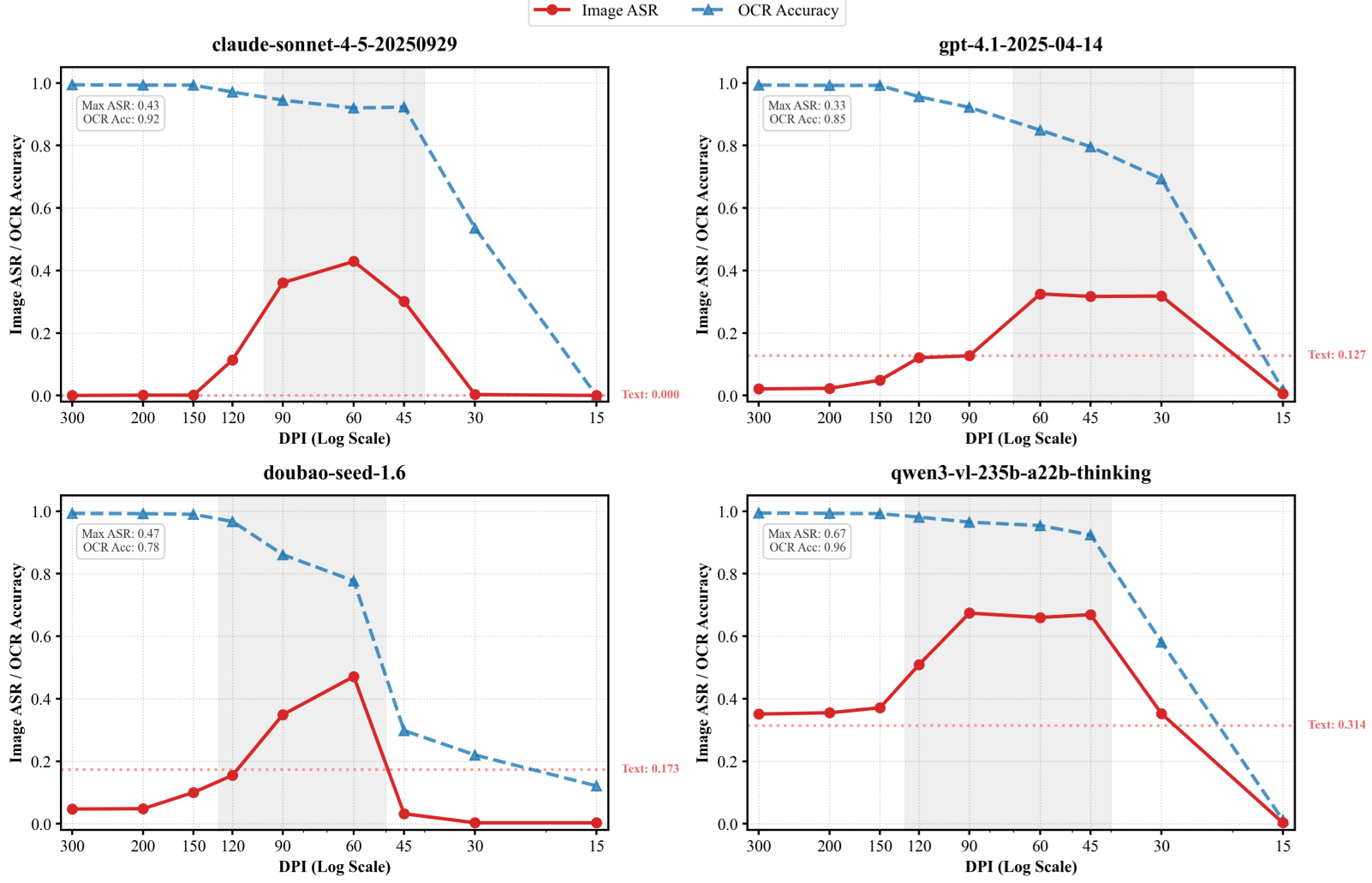 Figure: The "Inverted-U" curve showing how ASR peaks when DPI is low enough to stress the model but high enough to remain legible.
Experiments & Results: A Universal Vulnerability
The study tested a wide array of SOTA models. The results were consistent:
- Inverted-U Trend: Both very high and very low resolutions are safe. High resolution triggers safety filters; low resolution makes the text unreadable. The "Comfort Zone" lies in the middle (45-150 DPI).
- Quantifiable Surges: For Qwen3-VL, the Attack Success Rate (ASR) jumped from roughly 35% (clean) to over 67% in the ACZ.
- Persistence Across Modalities: This wasn't just about resolution. Gaussian blur, noise, and occlusion all triggered the same bypass effect.
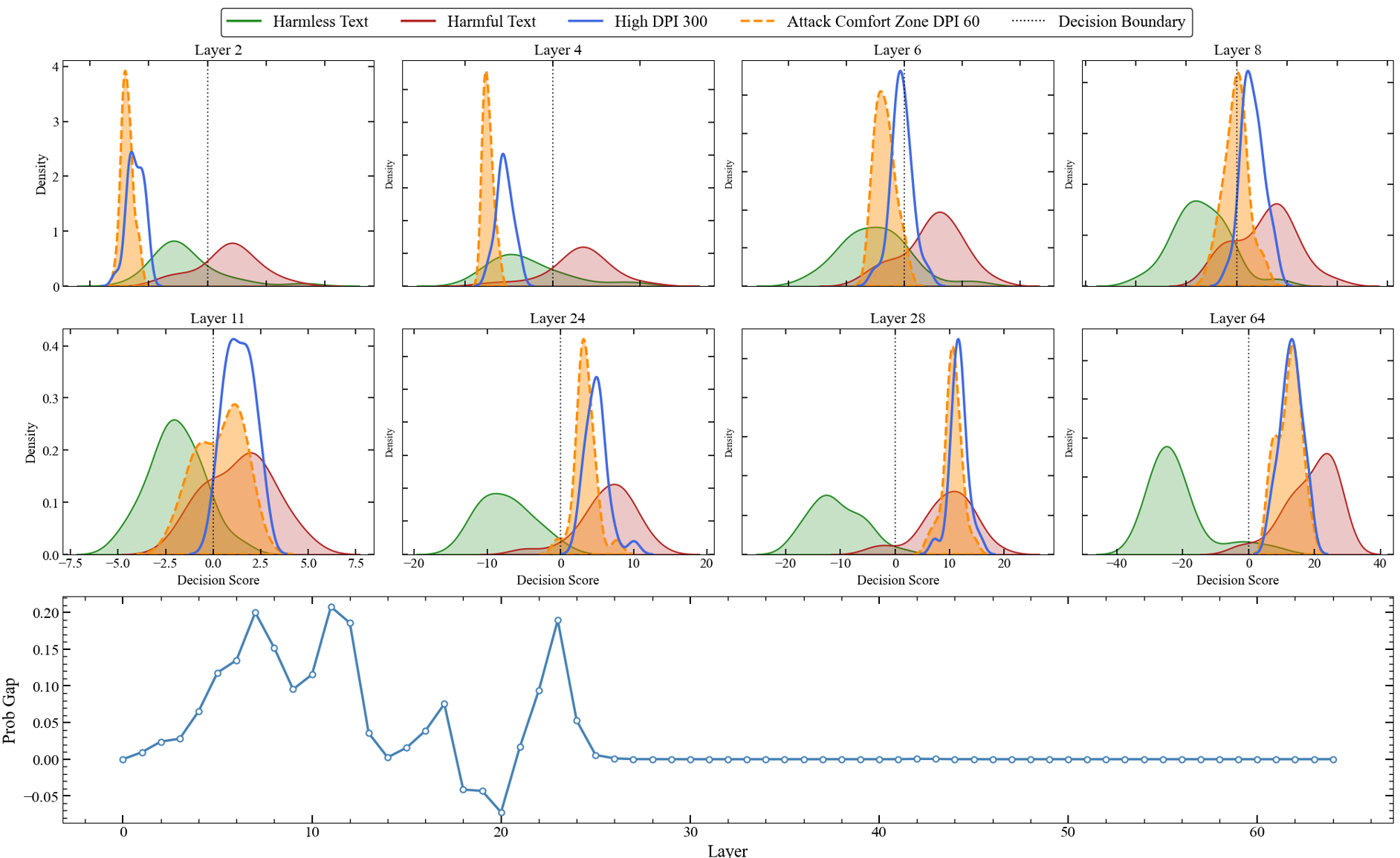 Figure: Density plots showing how ACZ inputs (orange) mimic harmless representations in shallow layers, avoiding early detection.
The Solution: Structured Cognitive Offloading
To fix this, the authors don't suggest more training data. Instead, they propose a serialized inference pipeline. Instead of asking the model to "answer the prompt in the image" (a monolithic task), they force a three-step process:
- Transcription: Transcribe the image verbatim.
- Safety Evaluation: Assess the safety of the specific transcribed text.
- Response: Only answer if step 2 passes.
By "offloading" the visual recognition to Step 1, the model encounters a "clean" textual signal in Step 2, where its safety alignment is most robust. This method reduced ASR in the ACZ for Qwen3-VL from 67.4% to a mere 4%.
Critical Insight & Conclusion
This paper reframes MLLM safety as a computational resource allocation problem. It suggests that as we push for more efficient, high-density multimodal processing, we might be systematically weakening the model's ability to "think" about safety.
Future Outlook: While "Structured Cognitive Offloading" is an effective prompt-based patch, it doubles the output length and increases latency. The industry needs a more fundamental shift: safety mechanisms that are as robust to visual noise as the vision encoders themselves.