
Breaking the Sampling Barrier: Potential Hessian Ascent for the SK Model at $\beta < 1/2$
Potential Hessian Ascent III: Sampling the Sherrington--Kirkpatrick Model at Beta < 1/2
Summary
Problem
Method
Results
Takeaways
Abstract
This paper introduces Potential Hessian Ascent (PHA) for sampling the Sherrington-Kirkpatrick (SK) model at high temperatures (). By integrating algorithmic stochastic localization (ASL) with the TAP free energy Hessian and Jarzynski’s equality, the authors achieve the first polynomial-time sampling algorithm with negligible total-variation distance (TVD) in this regime.
## TL;DR
The Sherrington-Kirkpatrick (SK) model is the "gold standard" for studying disordered systems. While optimization in this landscape is well-understood, high-precision sampling (Total Variation error $o(1)$) has remained elusive for temperatures near the transition point. This paper introduces an algorithm that uses the **TAP Hessian** to guide a stochastic localization process, corrects the path using **Jarzynski’s equality**, and finishes with local **Glauber dynamics**. The result: the first polynomial-time sampler for $\beta < 1/2$ with negligible TVD error.
## Problem & Motivation
In the world of spin glasses, the Gibbs measure $\mu_{\beta A}(x)$ hides in a high-dimensional hypercube with interactions defined by a random GOE matrix $A$. The difficulty lies in the **inverse temperature $\beta$**: as $\beta$ increases, the measure becomes increasingly concentrated and complex.
Previous attempts fell into two camps:
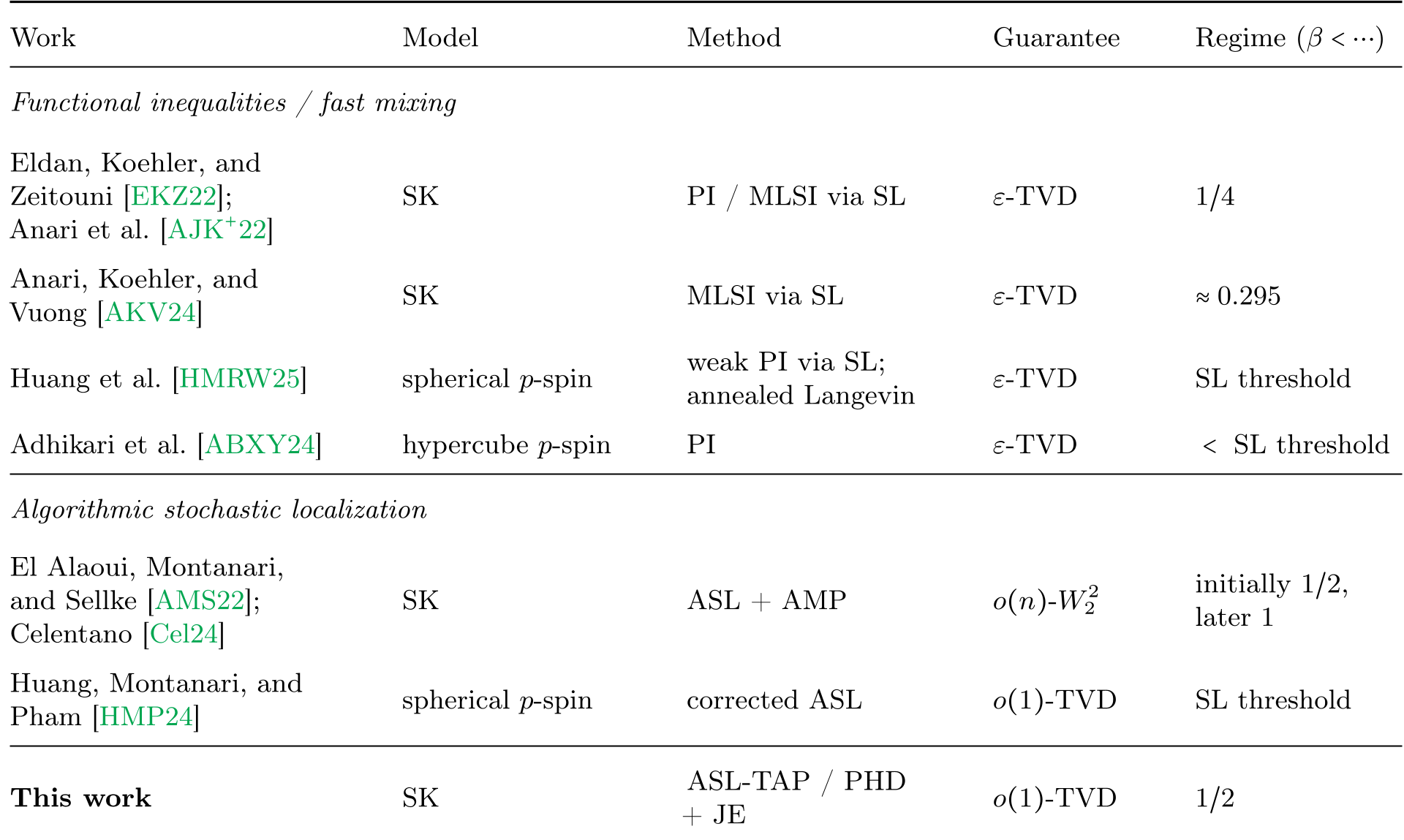
1. **Functional Inequalities**: Proving that the measure mixes quickly. This currently caps out at $\beta < 0.295$.
2. **Algorithmic Stochastic Localization (ASL)**: Transitioning from a flat measure to $\mu$ via an SDE. Prior works reached $\beta < 1$ but only with **Wasserstein error**, which doesn't guarantee that the samples are "correct" in a high-precision probability sense.
The authors' intuition was to use the **TAP (Thouless-Anderson-Palmer) Free Energy**. If the magnetization $m$ and the linear field $y$ joints extremize the TAP energy, the inverse of its Hessian should be an excellent surrogate for the true covariance of the measure.
## Methodology: The "Hessian" Path to Sampling
The core of the paper is the transition from **Stochastic Localization (SL)** to **Potential Hessian Dynamics (PHD)**.
### 1. The Surrogacy of the Hessian
The authors define the algorithmic covariance $\widehat{Q}(m)$ based on the TAP free energy Hessian:
$$\widehat{Q}(m) = \left(-\beta A + ext{diag}\left(\frac{1}{1-m^2}\right) + \beta^2(1 - \frac{\|m\|^2}{n})I_n - \dots \right)^{-1}$$
The SDE then evolves as:
$$dm_t = \widehat{Q}(m_t) dB_t$$
Through a rigorous application of **Free Probability**, the authors prove that this surrogate stays within $O(1)$ of the true covariance in Frobenius distance—a much tighter bound than previously thought possible.
### 2. Jarzynski Rejection Sampling
Even with a good Hessian surrogate, the SDE path drifts. For the first time in academic literature, the authors use **Jarzynski’s equality** from non-equilibrium thermodynamics to compute importance weights along the SDE path. These weights allow for a **rejection sampling** step that "corrects" the algorithmic distribution back toward the true Gibbs measure.
### 3. The Local Finish
Once the process reaches a constant time $T$, the measure is "localized" (concentrated) on a small subset of the hypercube called a **wedge**. The authors prove a **Log-Sobolev Inequality (LSI)** specifically for these wedges, enabling a final few steps of Glauber dynamics to perfect the sample.
## Key Mathematical Insight: Cavity Interpolation
To prove the $O(1)$ covariance bound, the authors used a **Planted Cavity Interpolation**. By isolating a single "spin" and interpolating between the true field and an auxiliary Gaussian field, they showed that "heavy" terms in the tracial expansion of the error cancel out exactly. This delicate bookkeeping ensures that the algorithm doesn't "blow up" as it approaches the $\beta = 1/2$ limit.
## Experimental Context and Results
While this is a primarily theoretical work, its placement in the state-of-the-art is clear:
* **Regime**: Extends high-precision sampling from $\beta \approx 0.29$ to $\beta = 0.5$.
* **Complexity**: Polynomial time $O( ext{poly}(n, 1/\epsilon))$.
* **Novelty**: First use of Jarzynski reweighting in a theoretical spin glass sampler.

*(Note: Mirror descent is used within the algorithm to solve the TAP equations efficiently at each time step, ensuring the magnetization $m$ stays consistently on the TAP manifold.)*
## Critical Analysis & Conclusion
**Takeaway**: This paper is a tour de force in combining disparate fields—free probability, thermodynamics (Jarzynski), and Markov Chain theory. It proves that the "Hessian Ascent" philosophy isn't just for optimization; it's a fundamental sampling tool.
**Limitations**: The current proof is limited to $\beta < 1/2$. The full replica-symmetric regime goes up to $\beta < 1$. The bottleneck is the **Needle Decomposition** used in the LSI proof, which requires a PSD (Positive Semi-Definite) matrix.
**Future Work**: The authors suggest that moving beyond $\beta = 1/2$ will require even more fine-grained control of the TAP energy landscape, potentially involving higher-order corrections or overcoming the PSD constraint in the localization scheme.