
[CVPR 2026] HEX: Humanoid-Aligned Experts—Bridging the Gap Between Semantic Intent and Whole-Body Coordination
HEX: Humanoid-Aligned Experts for Cross-Embodiment Whole-Body Manipulation
HEX is a state-centric Vision-Language-Action (VLA) framework designed for coordinated whole-body manipulation in full-sized bipedal humanoid robots. It introduces a humanoid-aligned universal state representation and a Mixture-of-Experts (MoE) Unified Proprioceptive Predictor, achieving State-of-the-Art (SOTA) performance in success rates and generalization across heterogeneous embodiments.
Executive Summary
TL;DR: HEX is a breakthrough VLA framework that solves the "uncoordinated limb" syndrome in humanoid robots. By introducing a Humanoid-Aligned Universal State Representation and a Mixture-of-Experts (MoE) Proprioceptive Predictor, HEX forecasts the robot's future physical state to guide action generation. This allows full-sized bipedal robots to perform complex, long-horizon tasks like kneeling to pick objects or walking while avoiding obstacles with unprecedented stability.
Positioning: This work moves beyond traditional VLA models (which often treat robots as generic "black-box" articulated arms) by treating the humanoid body as a structured physical system. It sits at the intersection of Foundation Models and Whole-Body Control (WBC).
Problem & Motivation: The Stability Gap
Standard VLA models (like OpenVLA or RT-2) excel at understanding what to do (e.g., "pick up the red cup") but struggle with how to stay balanced while doing it. In a humanoid, moving an arm shifts the center of mass; without "state foresight," the robot either stutters or falls.
The authors identified two fatal flaws in prior SOTA:
- Independent Part Control: Models often fail to recognize how the waist, legs, and arms must compensate for each other.
- Temporal Blindness: Existing models often lack a compact way to remember recent visual history and "foresee" the physical consequences of the next 100ms of movement.
Methodology: Review and Forecast
HEX operates on a hierarchical architecture where a high-level VLA policy interacts with a low-level RL-based controller.
1. Unified Proprioceptive Predictor (UPP)
Instead of feeding raw joint angles into a transformer, HEX organizes proprioceptive data into Canonical Part Slots (Arms, Hands, Legs, Waist, etc.).
- Morphology-aware MoE: Using a Mixture-of-Experts allows the model to use specific experts for different body parts (e.g., "Leg Experts" for walking vs. "Hand Experts" for grasping).
- Future State Forecasting: The UPP doesn't just encode the now; it predicts where the body will be over the next timesteps.
2. The Review-and-Forecast Paradigm
- Review: A history feature cache stores compact "query tokens" from previous frames, avoiding the massive computational cost of re-encoding old images.
- Forecast: The action expert uses Residual-Gated Fusion to blend visual-language intent with the predicted physical state.
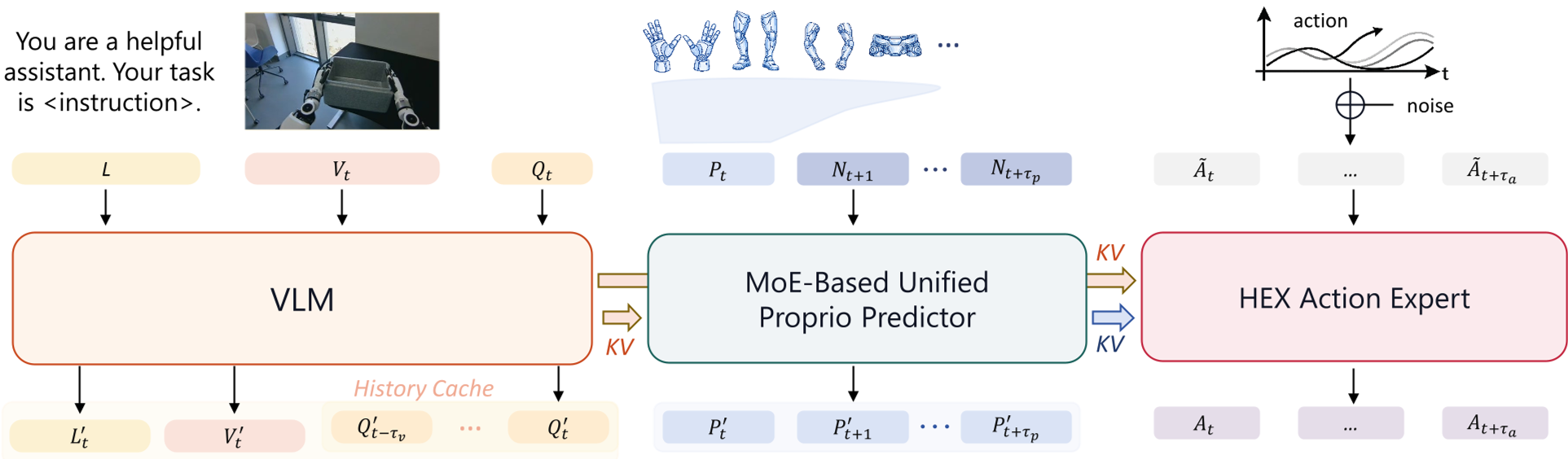 Figure 1: The HEX framework overview showing the UPP for state dynamics and the Action Expert for gated multimodal fusion.
Experiments: SOTA in the Real World
The researchers tested HEX against heavyweights like GR00T N1.5 and π0.5 across 7 complex real-world tasks on the Tienkung humanoid platforms.
Key Findings:
- Long-Horizon Stability: In the "Long-horizon box convey" task (squat -> walk -> squat), HEX maintained a 53.3% success rate at the final stage, while baselines dropped to 13-20% due to accumulated errors.
- Robust Generalization: HEX demonstrated superior performance in "Pose Mimicry" even when a human distractor was dancing in the background, thanks to its gated attention mechanism that filters out irrelevant visual noise.
- Inference Efficiency: Despite its complexity, HEX runs at 73ms per inference, making it viable for real-time control.
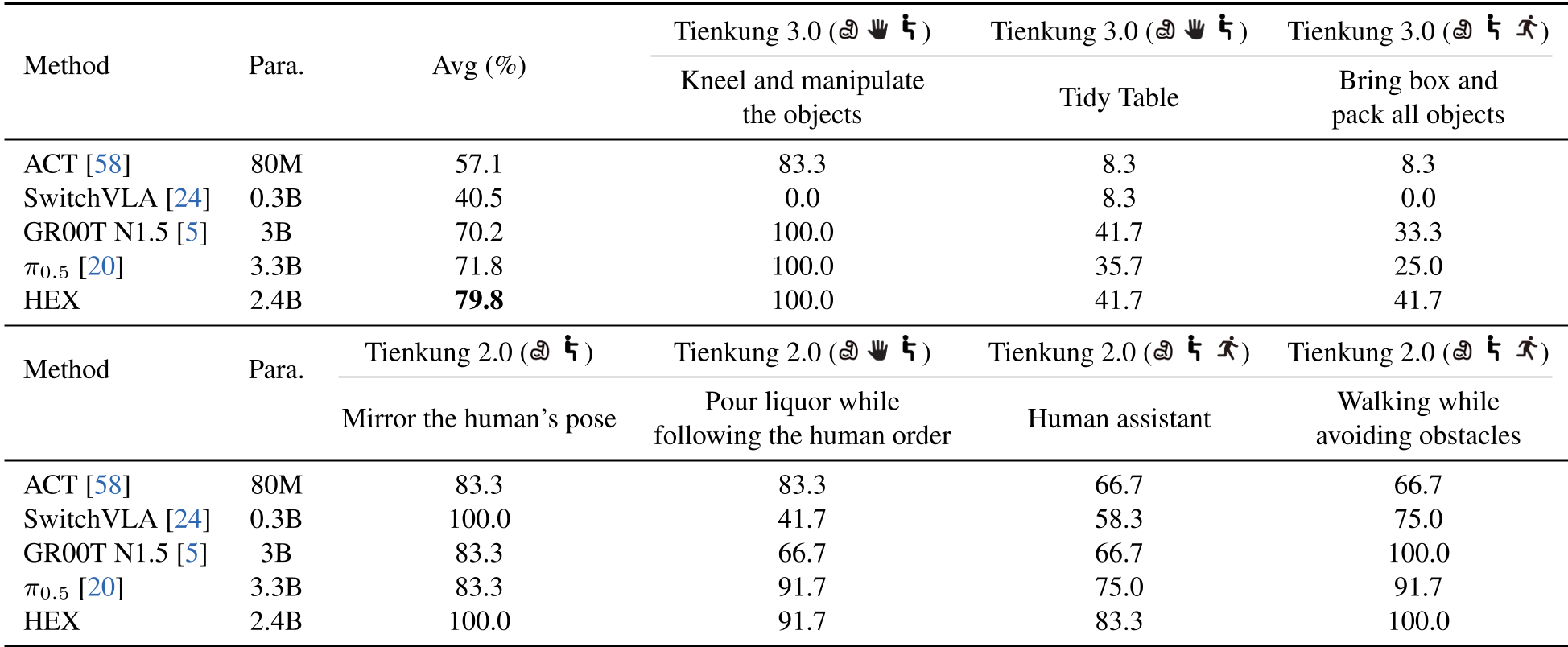 Table 1: HEX consistently out-performs large-scale VLA baselines across both Tienkung 2.0 and 3.0 platforms.
Critical Analysis & Conclusion
Takeaway
The success of HEX proves that embodiment alignment is just as important as semantic alignment. A robot that "knows" it has two legs and a specific mass distribution will always outperform a generic model that treats every DOF the same.
Limitations
- Data Hungry: Pretraining required 1,000 A100 GPU hours and 12M frames of data.
- Low-Level Dependence: While the high-level policy is robust, it still relies on a pre-trained RL low-level controller for balance. A truly end-to-end whole-body foundation model remains a future challenge.
Future Outlook
HEX sets the stage for "Multi-Embodiment Foundation Models." By using canonical slots, we could potentially train one massive "Humanoid Brain" that controls any bipedal robot, regardless of whether it has 20 or 50 joints, simply by "plugging in" the correct part-experts.