
High-Dimensional Statistics: Navigating the Frontiers from Sparse Tensors to LLMs
High-Dimensional Statistics: Reflections on Progress and Open Problems
This paper provides a comprehensive synthesis of recent progress in high-dimensional statistics, focusing on four pillars: computational-statistical trade-offs, data integration, high-dimensional asymptotics, and the intersection with modern AI (e.g., LoRA, in-context learning). It identifies core themes like the "blessing of computational barriers" and establishes a roadmap for addressing open problems in complex, large-scale data environments where .
Executive Summary
TL;DR: This landmark review synthesizes two decades of progress in high-dimensional statistics, where the number of features rivals or exceeds the sample size . It moves beyond simple estimation to explore the "geometry of hardness"—why some problems are statistically solvable but computationally impossible—and provides the first rigorous statistical mapping of modern AI phenomena like LoRA and In-Context Learning.
Background: The field has evolved from a "low-dimensional" classical era to a "structural" era. It now stands as a unifying bridge between optimization, information theory, and deep learning, providing the mathematical tools to explain why massive models work and where they fail.
1. The Geometry of Intractability: Computational-Statistical Gaps
One of the paper's most profound insights is the formalization of the Computational-Statistical Gap. In many high-dimensional tasks (e.g., Sparse PCA, Community Detection), there exists a "Hard" regime: a zone where enough information exists to solve the problem, yet no polynomial-time algorithm can find the solution.
Frameworks for Proof
The authors detail five critical lenses used to prove these gaps:
- Reductions: Mapping hard problems (like Planted Clique) to new statistical tasks.
- Statistical Query (SQ): Limiting algorithms to coarse "averages" of data.
- Landscape Analysis: Identifying the Overlap Gap Property (OGP), where local optima are disconnected from the global signal.
- Sum-of-Squares (SoS): A powerful SDP hierarchy serving as a proxy for "all efficient algorithms."
- Low-Degree Polynomials: A "lite" version of SoS predicting thresholds based on polynomial degree.
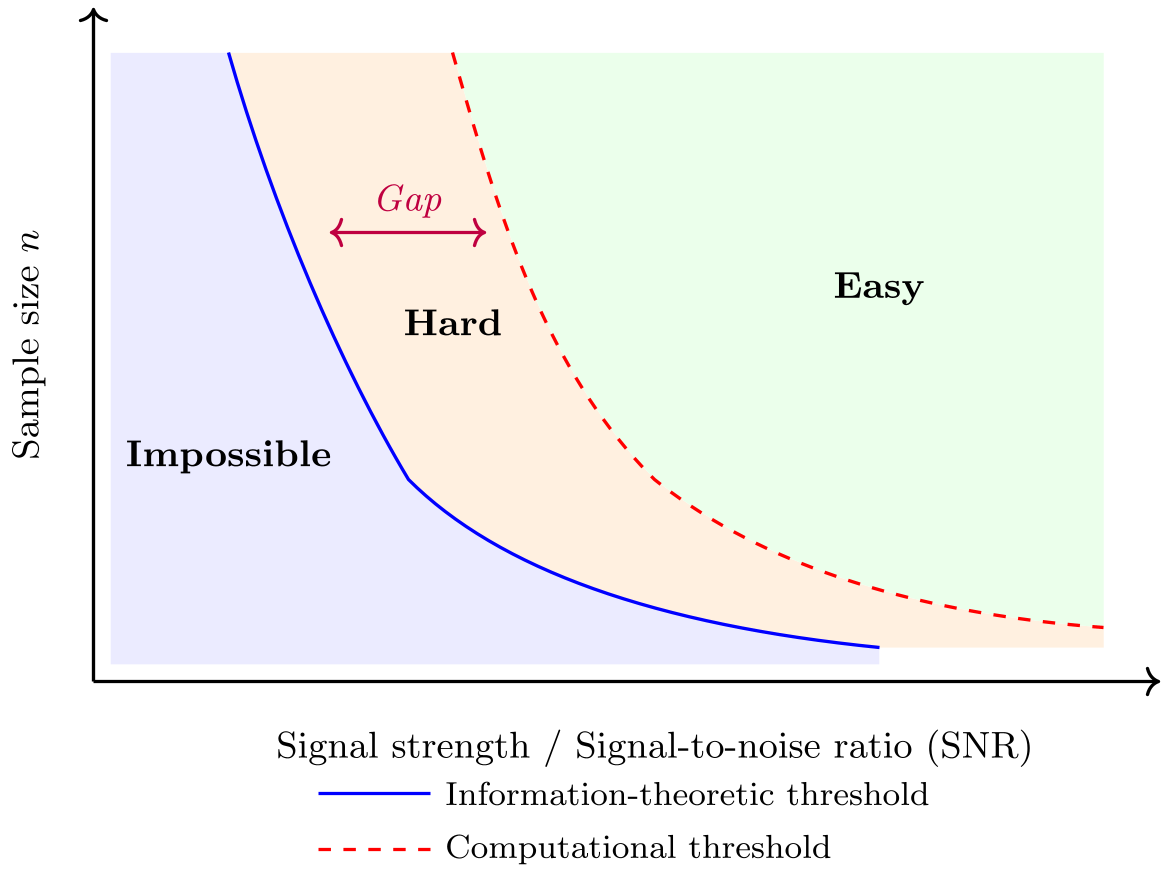 Figure 1: The Hard Regime is bounded by the Information-Theoretic limit (can it be solved?) and the Computational threshold (can it be solved quickly?).
2. Methodology: Beyond Gaussian Thinking
For years, high-dimensional theory was "trapped" in Gaussian i.i.d. assumptions. The paper highlights the shift toward Universality and Structured Designs.
- AMP & CGMT: Tools like Approximate Message Passing allow us to track the evolution of an algorithm's error as a Gaussian process.
- Universality: The remarkable realization that results derived for Gaussian matrices often hold for any distribution with matching first two moments.
- Rotationally Invariant Designs: Moving toward semi-random matrices (like those in MRI or X-ray crystallography) where the singular values are fixed but the basis is random.
3. High-Dimensional Statistics in the Age of AI
The most "forward-looking" section of the paper treats AI components as high-dimensional statistical estimators.
LoRA: Low-Rank Adaptation as PCA
The authors interpret LoRA (Low-Rank Adaptation) not just as a trick for fine-tuning, but as a structured dimension reduction in the parameter space. It assumes the "update" resides in a low-intrinsic-dimensional manifold, effectively performing an implicit PCA on the gradient landscape.
In-Context Learning (ICL): Transformers as Statisticians
In a shocking turn, recent theory suggests that Transformers performing ICL are actually implementing classical algorithms:
- Linear Attention can be viewed as a single step of Gradient Descent.
- Pre-trained Transformers often behave as Bayes-optimal predictors for linear regression tasks provided in the prompt.
4. Scaling Laws and Verifiable Rewards
Why does loss decline as a power law of compute ()? The authors argue that these Neural Scaling Laws are high-dimensional asymptotic limits. As we hit the "data wall" (exhausting the internet's text), we move to a data-constrained regime where multi-epoch training and Reinforcement Learning with Verifiable Rewards (RLVR) become the new frontiers.
RLVR is modeled as a high-dimensional estimation problem with sparse, binary feedback. By choosing different "surrogate rewards" (linear, log, or arcsin), researchers are implicitly choosing different statistical bias-variance trade-offs.
5. Critical Synthesis & Future Work
The Blessing of Barriers
In a counterintuitive twist, the authors note that the same "Computational Barriers" that prevent us from reaching the information-theoretic limit often make the resulting inference sharper. If the signal is strong enough for an efficient algorithm to work, it is often strong enough to exhibit asymptotic normality without the complex "debiasing" steps required at lower SNRs.
Limitations & Open Problems
- Non-convexity: Most "rigorous" tools (CGMT, Leave-one-out) still require convex losses or log-concave posteriors.
- General Designs: We still lack sharp constants for matrices with spatial or temporal dependence (e.g., time-series data).
- Machine Unlearning: How do we "forget" a high-dimensional point in a non-convex neural network while providing a mathematical "Certificate of Erasure"?
Conclusion
High-dimensional statistics has matured from a niche subfield of probability into the theoretical backbone of Data Science. The next frontier is not just "solving" , but understanding the computational cost of inference and the statistical behavior of the massive, non-convex systems that govern modern AI.