
Pulsars as High-Frequency Gravitational Wave Beacons: Mapping the MHz Astrophysical Foreground
High-Frequency Gravitational Waves from the Galactic Pulsar Population
This paper identifies pulsar polar caps as a significant astrophysical foreground for High-Frequency Gravitational Waves (HFGW) in the MHz band. By utilizing particle-in-cell (PIC) simulations calibrated to physical scales, the authors demonstrate that repeated plasma charge-discharge cycles generate gravitational radiation that could partially obscure cosmological signals like the Thermal Cosmic Gravitational Microwave Background (CGMB).
TL;DR
While high-frequency gravitational wave (HFGW) research usually hunts for "new physics," it turns out the Standard Model has a "loud" presence in the MHz band. This paper reveals that the plasma discharge cycles in the polar caps of the Galactic pulsar population create a persistent gravitational wave foreground. This signal is strong enough to potentially obscure thermal ripples from the early Universe, effectively setting the "noise floor" for future HFGW telescopes.
The "Background-Free" Myth
In the hunt for the Cosmic Gravitational Microwave Background (CGMB)—the thermal relic of the Big Bang—researchers have long eyed the MHz–GHz frequency range. Unlike the LIGO audio band, which is crowded with black hole mergers, the HFGW band was thought to be nearly empty.
The authors of this study challenge this assumption. They identify that pulsar polar caps are not just radio emitters; they are dynamic plasma engines. As electrons and positrons are whipped through intense magnetic fields, they create rapidly varying anisotropic stress—the exact ingredient needed to cook up gravitational waves.
Methodology: From Plasma Microphysics to Galactic Scales
The research moves through three sophisticated layers of modeling:
- 1D PIC Simulations: The researchers used the
Tristan-MPcode to simulate plasma cascades along a pulsar's open field lines. Unlike previous models using arbitrary units, these were calibrated to real physical scales—resolving the "skin depth" of plasma over meters of gap height. - The Mixed Channel Breakthrough: Traditionally, researchers looked at the squared electric field () as the GW source. This paper points out a much larger term: the Mixed Channel (). Because the background magnetic field () of a pulsar is so massive, even tiny fluctuations () induced by the plasma discharge create much more stress—and thus more GWs—than the electric field alone.
- Cap-Scale Reconstruction: Pulsars aren't points; their polar caps have structure. The authors developed a "screened-envelope" profile to describe how the gap height changes from the center to the rim.
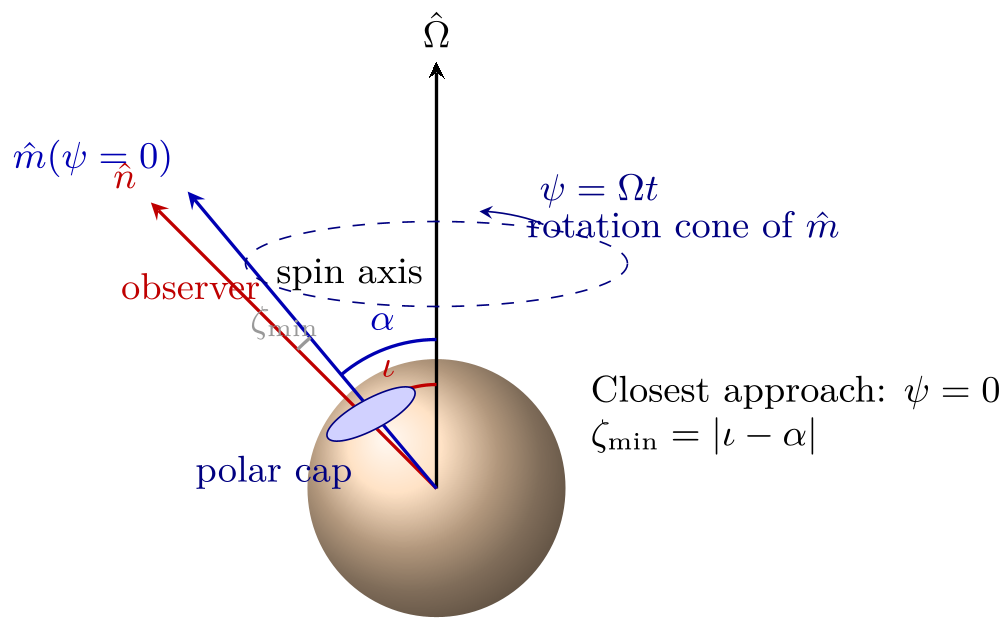 Figure 1: The oblique-rotator geometry used to calculate how the rotating pulsar's signal is projected toward Earth.
Key Results: Obscuring the Early Universe
The study’s most striking finding is the Population Level Signal. By summing up the contributions of normal pulsars in our Galaxy, they created a "spectrum of noise."
- The Baseline: The normal pulsar foreground peaks in the MHz range.
- The Conflict: This foreground overlaps with CGMB predictions for reheating temperatures () between and GeV. If we want to see the thermal signals of the Big Bang, we will have to look "past" the pulsars.
- Variations: The authors also explored "Inward-developing gaps" and Millisecond Pulsars (MSPs), which could shift or heighten this background depending on the specific physics of the pair-production cascade.
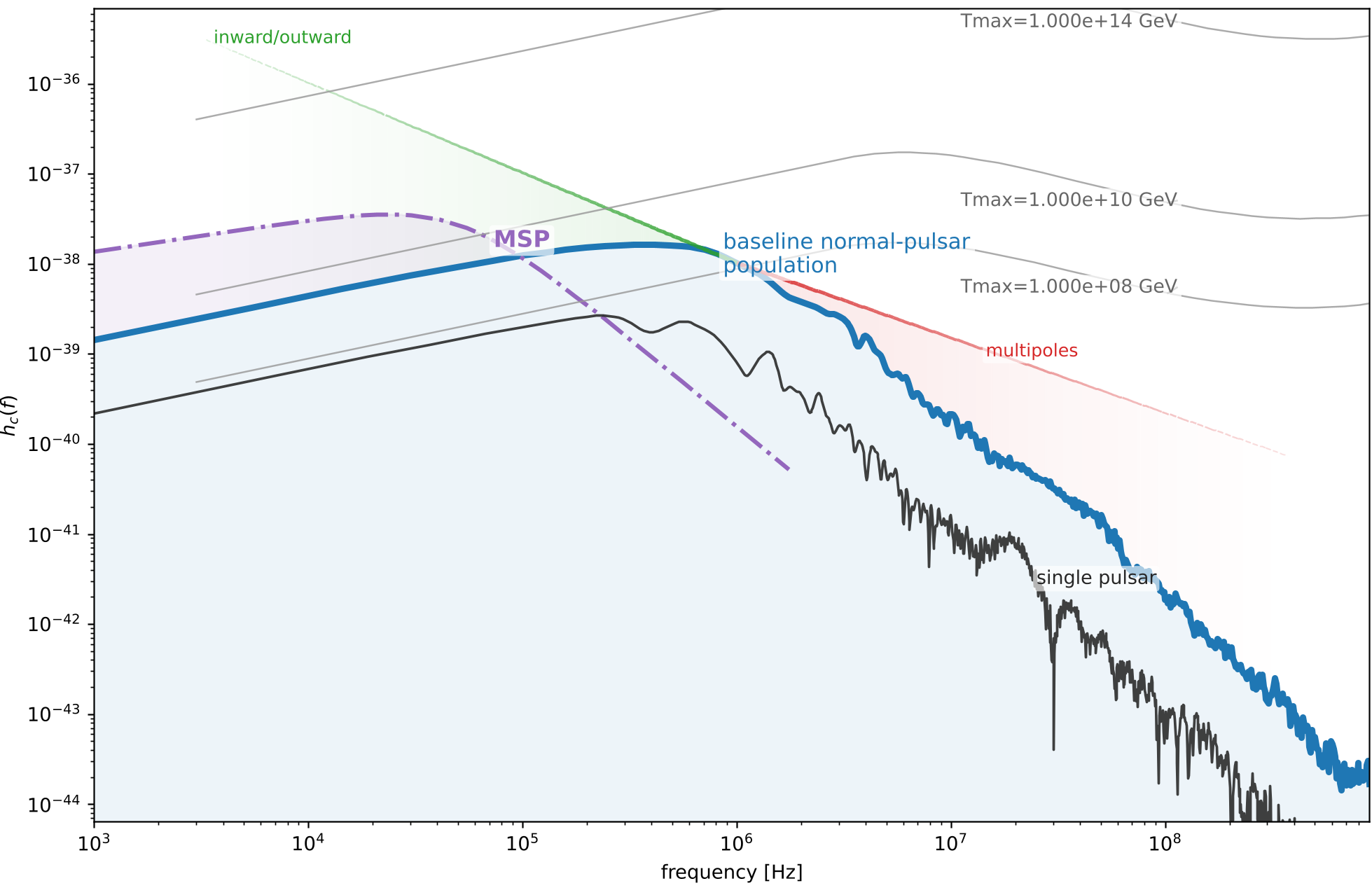 Figure 2: The characteristic strain () of the Galactic pulsar foreground (solid blue/purple) compared to thermal CGMB benchmarks (dotted lines). Note the overlap in the – Hz range.
Critical Insight: Why This Matters
The predicted strain is incredibly small—roughly to . For context, LIGO detects waves at . While today's technology can't hear this "hum" from the pulsars, the study serves as a crucial Standard Model benchmark.
In the same way that 21cm hydrogen radiation is both a signal and a foreground for cosmology, pulsar GWs are now a established "standard candle" (or perhaps "standard noise") for high-frequency gravity research.
Conclusion & Future Look
The paper effectively maps the HFGW landscape. It moves the field away from simplified "vacuum gap" models into the messy, realistic world of plasma physics.
Limitations: The model depends on the coupling coefficient (the ratio of induced magnetic fluctuation to the electric field), which requires even more massive 3D simulations to pin down precisely. Outlook: Future detectors targeting the MHz band must now treat the Galactic pulsar population as a known quantity, developing subtraction techniques similar to those used in microwave background (CMB) astronomy.