
High-Pressure Breakthrough: Reaching 74 K in Infinite-Layer Nickelate Membranes
High-temperature superconductivity in Nd$_{0.85}$Sr$_{0.15}$NiO$_2$ membranes under pressure
This study demonstrates high-temperature superconductivity in freestanding infinite-layer Nd0.85Sr0.15NiO2 membranes under extreme pressure. By integrating these membranes into a diamond anvil cell (DAC), the researchers achieved a superconducting transition temperature (Tc) of ~74.2 K at 91.5 GPa, showing a non-saturating linear enhancement.
Executive Summary
TL;DR: Researchers from Stanford and SLAC have shattered the previous temperature limits for infinite-layer nickelate superconductivity by applying extreme pressure (up to 91.5 GPa) to freestanding membranes. By removing the "handcuffs" of the growth substrate, they achieved a of 74.2 K, moving from the liquid helium to the liquid nitrogen temperature regime.
Background Positioning: This work represents a massive leap in the nickelate field. It moves the study from "epitaxial strain tuning" (limited to ~40 K) to "extreme volumetric compression," revealing a unique linear scaling of that distinguishes nickelates from the well-known "dome" behavior of cuprates.
The "Substrate Bottleneck"
Since the 2019 discovery of superconductivity in , the community has known that "squeezing" the lattice (lattice contraction) increases . However, experts faced a wall:
- Epitaxial Limits: Thin films are grown on substrates. If you squeeze too hard, the film cracks or the substrate dictates the structural response.
- High Pressure Failures: Previous attempts to compress films on their substrates led to sample deterioration at relatively low pressures (~12 GPa).
The authors' insight was simple but technically daunting: Delete the substrate. By using a water-soluble sacrificial layer, they created a freestanding "nickelate leaf" that could be placed directly into a Diamond Anvil Cell (DAC).
Methodology: The Freestanding Advantage
The core of the experiment involves a complex transfer process (Fig. 1). The membrane is only about 6.7 nm thick, protected by capping layers. Once freed, it behaves like a 2D material flake.
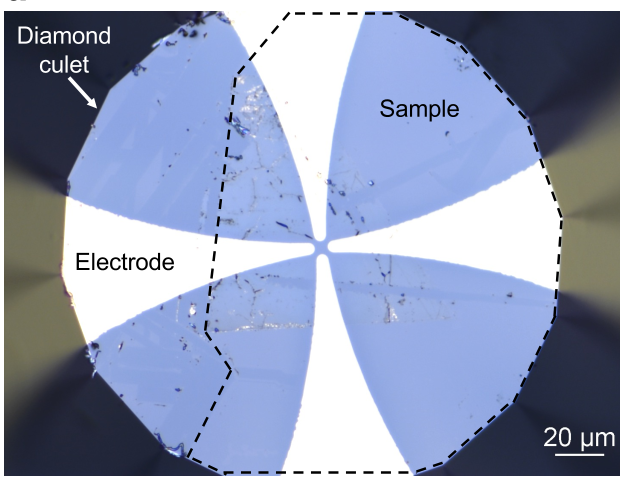 Fig 1: Development of the DAC platform for freestanding membranes. Note the van der Pauw geometry for electrical contacts directly on the diamond culet.
By using silicone oil as a pressure-transmitting medium, the researchers subjected the membrane to nearly hydrostatic pressure. Unlike previous studies, the membrane survived up to the mechanical limits of the diamonds (~90 GPa).
Results: Breaking the "Dome"
The most striking finding is the Linearity. In almost all unconventional superconductors (Cuprates, Fe-based, etc.), eventually hits a peak and falls (the "superconducting dome") because of over-doping or structural changes.
In , the just keeps going.
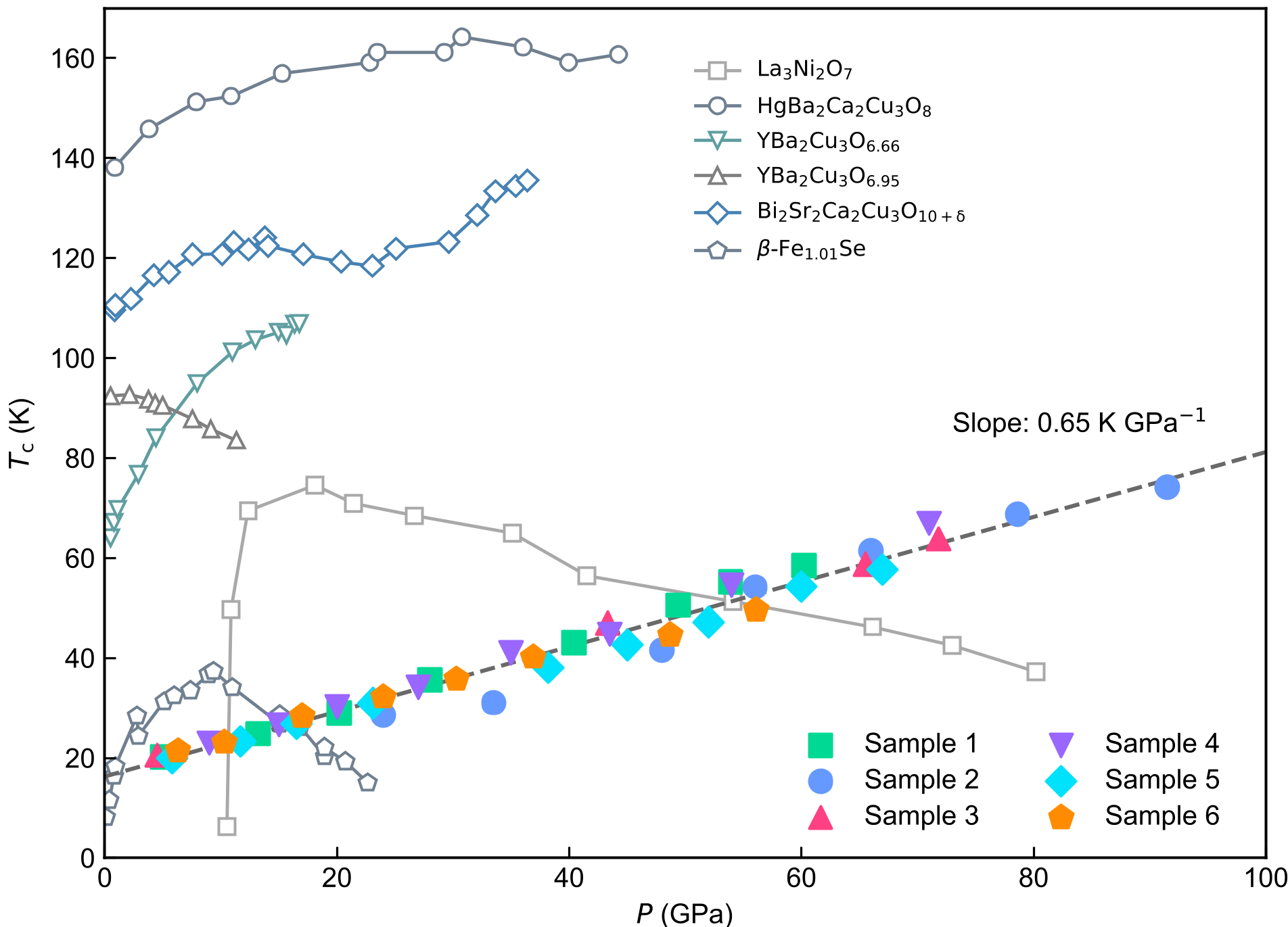 Fig 2: Comparison of Tc(P) across different materials. The nickelate membrane (solid symbols) shows a persistent linear rise of ~0.65 K/GPa with zero sign of saturation, unlike the bilayer nickelate (La3Ni2O7) or Hg-based cuprates.
Key Metrics:
- Maximum : 74.2 K (at 91.5 GPa).
- Scaling: 0.65 K per GPa.
- Coherence Length (): Reduced from 2.39 nm to 1.54 nm, indicating that the Cooper pairs are more tightly bound as pressure increases.
Deep Insight: Why Doesn't it Overdope?
Theoretically, pressure should cause "self-doping" by compressing the rare-earth electron pockets, which usually suppresses superconductivity at high levels. The fact that the hasn't peaked suggests:
- The pairing mechanism in infinite-layer nickelates is incredibly robust against self-doping.
- The lack of buckling (structural simplicity) in the infinite-layer phase allows the electronic structure to evolve cleanly without the "structural noise" that plagues more complex cuprates.
Conclusion & Future Outlook
This work demonstrates that the "speed limit" for in nickelates is much higher than previously thought. If the linear trend continues, 100 K+ might be achievable if diamond technology allows for higher pressures.
Limitations: The transition width at high pressure is relatively broad, likely due to the non-hydrostatic nature of solidified silicone oil above 3 GPa. Future experiments using Helium as a pressure medium might yield even cleaner results.
Takeaway: The "freestanding membrane + high pressure" workflow is a new gold standard for exploring the limits of 2D materials and unconventional superconductors.