
HiSpatial: Taming Hierarchical 3D Spatial Understanding in Vision-Language Models
HiSpatial: Taming Hierarchical 3D Spatial Understanding in Vision-Language Models
HiSpatial is a hierarchical framework for 3D spatial understanding in Vision-Language Models (VLMs). It introduces a four-level task taxonomy—from geometric perception to abstract reasoning—and an automated pipeline generating 2B QA pairs from 5M images. By integrating metric-scale 3D point maps, the 3B-parameter model achieves state-of-the-art performance, surpassing GPT-5 and Gemini-2.5-Pro on spatial benchmarks.
TL;DR
Researchers have introduced HiSpatial, a principled framework that breaks down 3D spatial intelligence into four cognitive levels. By training a 3B-parameter VLM on a massive dataset of 2 billion QA pairs and augmenting it with metric-scale 3D point maps, HiSpatial achieves SOTA results across multiple benchmarks, outperforming even the largest proprietary models like GPT-5 and Gemini-2.5-Pro in spatial reasoning tasks.
The Problem: The "Flatland" Limitation of VLMs
While modern VLMs excel at 2D recognition, they often live in a "Flatland." Ask a model "which chair is closer to the door in 3D meters?" and it frequently hallucinates. The root of the problem is twofold:
- Lack of Structure: Most models lack a systematic hierarchy of spatial concepts.
- Data Scarcity: 3D-grounded data is rare, usually confined to specific indoor datasets like ScanNet, which don't generalize to the "wild."
Methodology: A Taxonomy of Spatial Intelligence
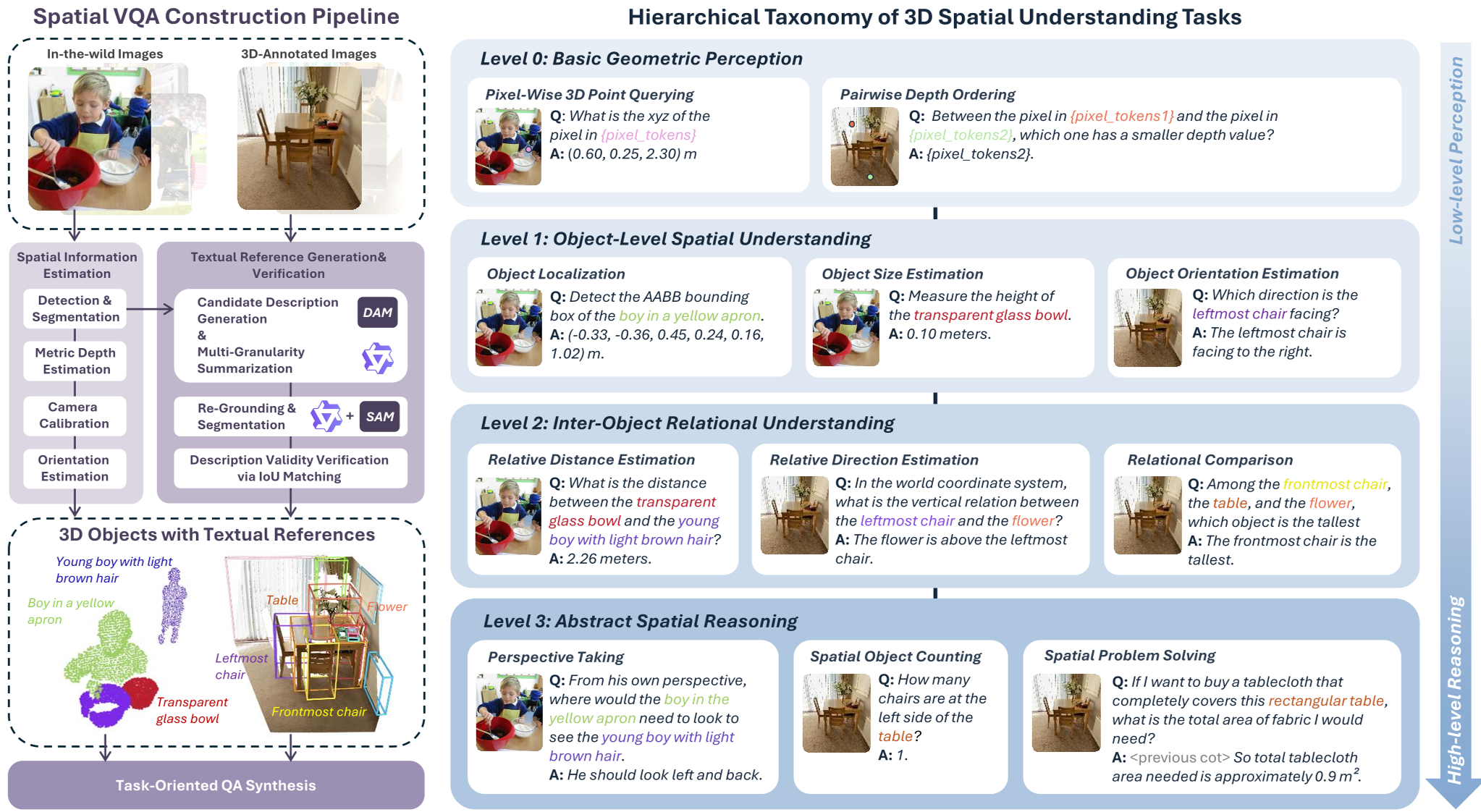
HiSpatial proposes a four-level hierarchy that mimics human spatial development:
- Level 0: Geometric Perception: Direct inference of depth (pointing to a pixel and getting XYZ).
- Level 1: Object-Level Understanding: Inferring intrinsic properties like size, orientation, and 3D bounding boxes.
- Level 2: Inter-Object Relations: Relative distancing, directional vectors, and comparisons.
- Level 3: Abstract Spatial Reasoning: High-level problem solving, perspective-taking, and mental simulations.
Architecture: RGB + Metric Point Maps
Unlike previous attempts that used "relative depth" (which lacks absolute scale), HiSpatial integrates metric-scale point maps.
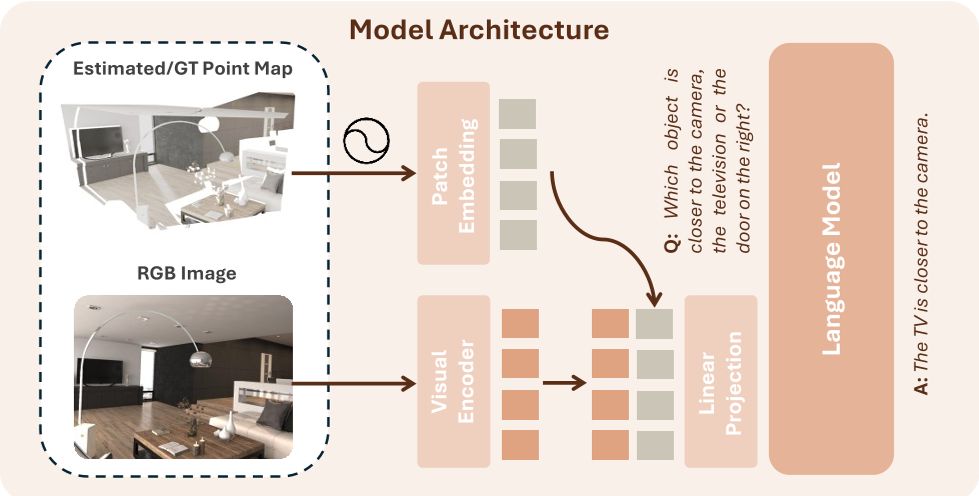
The model uses a PaliGemma-2 backbone. The 3D point map (estimated via MoGe-2) undergoes sinusoidal positional encoding and is concatenated with RGB features. This gives the transformer a direct "physical sense" of the 3D world.
The Data Engine: Scaling to 2 Billion Pairs
The paper introduces a massive automated pipeline that:
- Extracts spatial info using monocular geometry estimators.
- Generates textual descriptions (referring expressions).
- Synthesizes hierarchical QA pairs using LLMs to formulate multi-step reasoning problems.
Performance: Small Model, Big Brain
Despite having only 3 billion parameters, HiSpatial-3B dominates the leaderboard.
| Model | SpatialRGPT (L1-2) | 3DSRBench (L1-3) |
|---|---|---|
| GPT-5 | 40.47 | (Not Reported) |
| Gemini-2.5-Pro | 26.57 | 48.47 |
| HiSpatial-3B (Ours) | 79.28 | 63.81 |
One of the most profound findings is the Inter-level Dependency. The authors proved that Level 3 (Abstract Reasoning) is nearly impossible to master without the mathematical grounding provided by Levels 0-2. Removing Level 1 (Object properties) caused a massive 14.51% drop in high-level reasoning accuracy.
Critical Insights & Future Outlook
HiSpatial proves that 3D intelligence is emergent when trained with the right hierarchy. However, the model is currently limited to monocular inputs. The next frontier is extending this hierarchical reasoning to multi-view videos and temporal dynamics, which will be vital for the future of mobile robotics and autonomous agents.
Conclusion
HiSpatial stands as a masterclass in "curriculum design" for AI. It demonstrates that we don't necessarily need 100B+ parameter models to understand the physical world—we need smarter, more structured data and a framework that acknowledges the cognitive building blocks of spatial awareness.