
[CORFU 2025] Holographic Quantum Foam: The Universe as a Turbulent Froth
Holographic Quantum Foam: Theoretical Underpinnings and Observational Evidence
The paper introduces "Holographic Quantum Foam" (HQF), a model of spacetime graininess derived from the holographic principle where distance fluctuations scale as (). It establishes HQF as a theoretical foundation for the dark sector (dark energy and dark matter) and provides observational evidence through the blurring of distant point-sources like GRB221009A.
TL;DR
Is spacetime a smooth stage or a bubbling foam? This paper argues for the latter, proposing a Holographic Quantum Foam (HQF) model where distance measurements inherently fluctuate. By applying the holographic principle to the cosmos, the authors not only predict the existence of the dark sector but also provide the first "clear observational evidence" of spacetime graininess using the record-breaking GRB221009A.
Background: Beyond the Smooth Metric
Since John Wheeler first proposed "Quantum Foam" in 1957, physicists have sought to quantify the "jiggle" of spacetime at the Planck scale. While general relativity treats spacetime as a smooth manifold, quantum mechanics suggests a violent, turbulent structure at meters. The core debate lies in the scaling parameter in the uncertainty relation . If , the effect is too small to see; if , images of distant stars would be a total blur. This work champions , the "Golden Mean" dictated by the Holographic Principle.
The "Why": Why Dark Energy Must Exist
One of the most profound theoretical insights in this paper is the link between HQF and the Dark Sector.
- The Scaling Tension: If the universe contained only ordinary matter (Bose/Fermi statistics), the spatial resolution would be much coarser ().
- The Prediction: To map spacetime to the higher resolution required by HQF (), the universe must contain a more energy-dense information carrier—the Dark Sector.
- Exotic Statistics: The authors argue that these "dark" quanta do not respect the Pauli Exclusion Principle. Instead, they follow Infinite Statistics (Quantum Boltzmann Statistics), where the Gibbs factor is absent, making particles fundamentally distinguishable and the theory non-local.
Methodology: The Quantum-Foam-Induced PSF
To move from theory to observation, the authors derived a modified Point-Spread Function (PSF). The intuition is that as photons travel across the universe, their wavefronts "accumulate" phase errors from the foam.

Key components of the method:
- Phase Degradation: . Short wavelengths (Gamma rays) are affected more than long ones (Radio).
- Horizon Crossing: At extremely high energies, photons are scattered so much they could arrive from anywhere, effectively creating a "halo" around point sources.
- The "Theta" Constant: The model introduces a characteristic angle , which acts as a "cosmic seeing" limit, analogous to atmospheric turbulence in ground-based astronomy.
Experimental Evidence: The Case of GRB221009A
The research utilizes the "Brightest of All Time" (BOAT) Gamma-Ray Burst, GRB221009A. Unlike Quasars, GRBs are compact (less than a parsec), providing a perfect "point source" test.
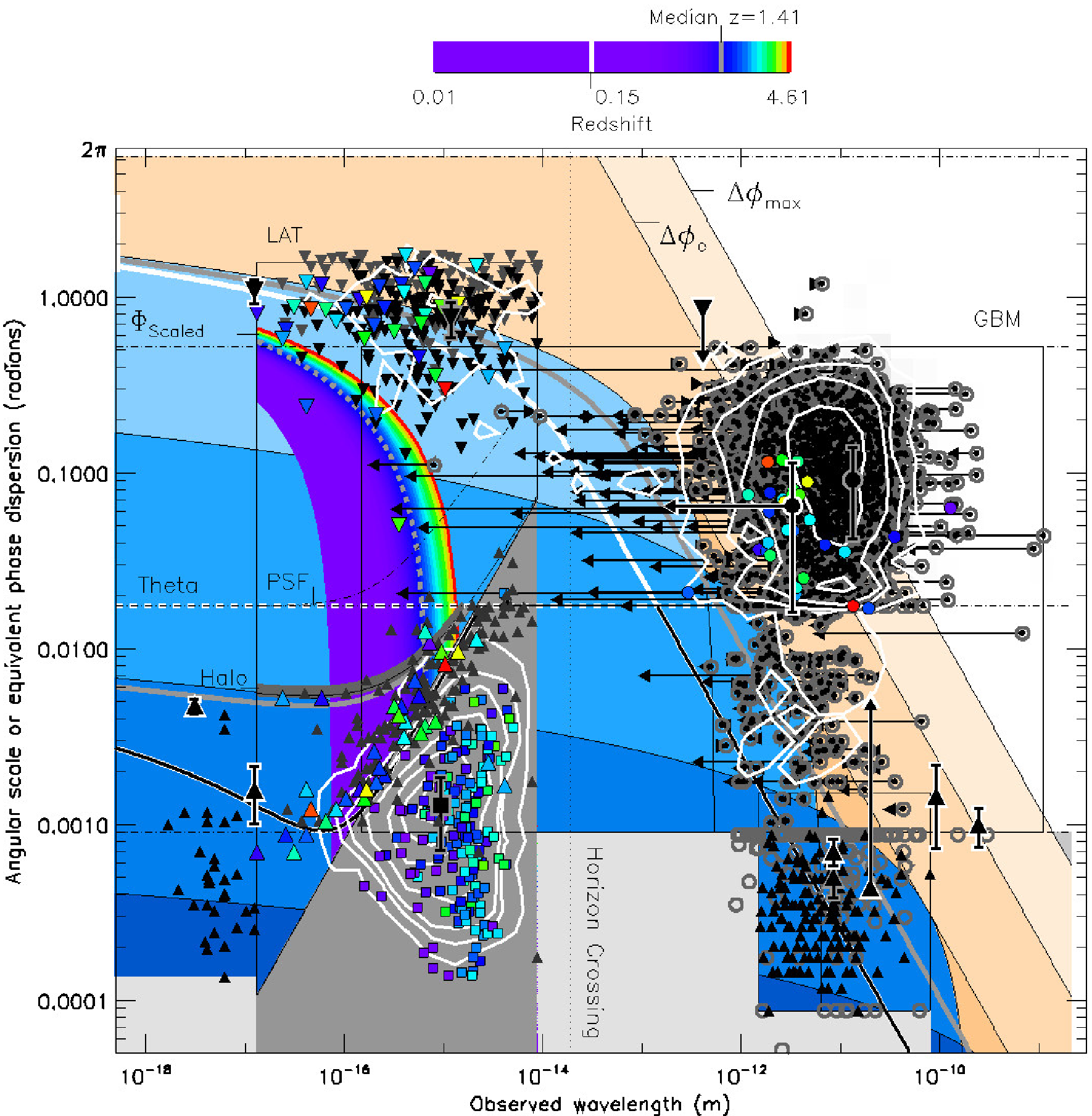
Key Findings:
- The Halo Match: The observed blurring in Fermi LAT data (the "poorest resolved" bursts) fits the HQF "Halo" curve perfectly when .
- Multi-messenger Consistency: The model explains why we can see 251 TeV photons (scattered by degrees) yet still identify the source galaxy in optical wavelengths (where the effect is negligible).
- Resolution Floor: HQF explains why the Fermi LAT PSF "tails off" at low energies—it’s not just the instrument; it’s the vacuum itself.
Deep Insight & Conclusion
This work elegantly bridges the gap between high-energy astrophysics and the foundations of quantum gravity. By treating spacetime as a turbulent fluid (referencing Kolmogorov's 2/3 law), the authors provide a physical intuition for the holographic principle.
Limitations & Future Work: While the fit for GRB221009A is compelling, "Infinite Statistics" remains a mathematically challenging frontier. Most current Quantum Field Theories are local; a non-local theory for the dark sector "must be started from scratch." Future laser interferometers (like upgraded LIGO/Virgo) may provide a complementary "local" test of this displacement noise.
Takeaway: Spacetime is not an empty void; it is a complex, information-bounded froth. Our inability to detect "Dark Matter particles" might simply be because they don't follow the statistics we expect.