
Emergent Spacetime from Optimal Transport: Why the Universe Might Be a Wasserstein Manifold
Holography and Optimal Transport: Emergent Wasserstein Spacetime in Harmonic Oscillator, SYK and Krylov Complexity
This paper proposes a novel framework for the holographic principle based on the "Manifold Hypothesis" and "Optimal Transport." By analyzing quantum harmonic oscillators and the SYK model, the authors demonstrate that the 1-Wasserstein distance between Husimi Q-representations of quantum states allows a finite-dimensional holographic spacetime to emerge, effectively reducing the infinite-dimensional Hilbert space to a curved geometry.
TL;DR
How does a 1D quantum system "create" a 2D or 3D gravitational spacetime? This paper suggests that the extra "holographic" dimension is not just energy—it is the cost of transporting quantum information. By applying the 1-Wasserstein distance to the Husimi Q-representation of states, the authors show that spacetime geometry (including black holes) naturally emerges from the way quantum states "shape-shift" over time.
Background: The Dimensionality Problem
In the holographic principle, gravity in a "bulk" spacetime is dual to a quantum theory on the boundary. A major headache for physicists is why the infinite dimensions of a Hilbert space collapse into a neat, 4D manifold. This paper turns to Machine Learning for an answer: the Manifold Hypothesis. It posits that high-dimensional data actually lives on a low-dimensional curved surface.
The authors argue that for holography to work, we need three things:
- A specific representation of quantum states.
- A distance measure that perceives "shape" (not just overlap).
- A set of representative states (like energy eigenstates).
Methodology: Transporting the Vacuum
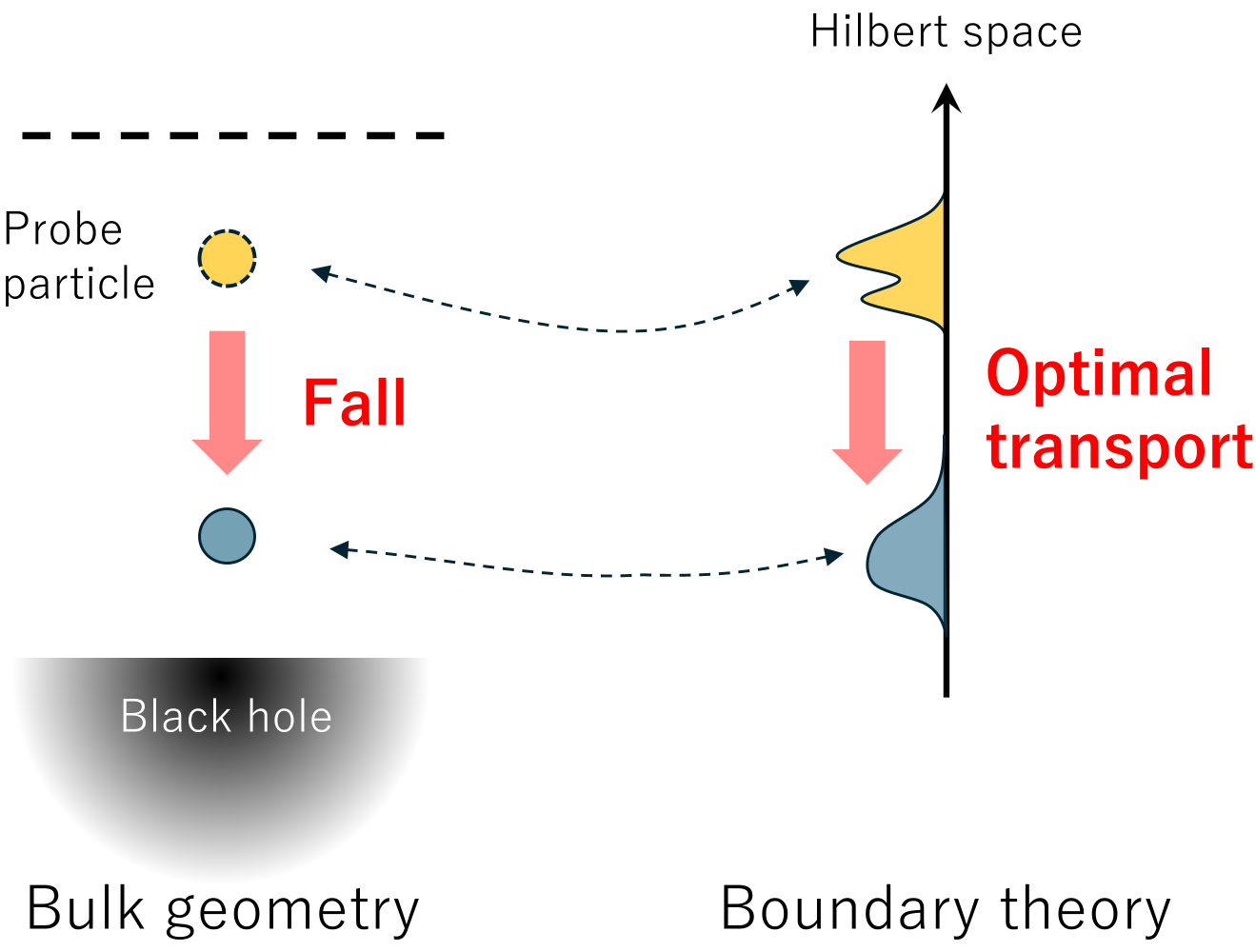
The core insight is that Optimal Transport (moving one probability distribution to another with minimum work) mimics the principle of least action in gravity.
1. The Best Metric: 1-Wasserstein
The authors tested various "p-Wasserstein" distances and representations. Using Multidimensional Scaling (MDS), they found that only the 1-Wasserstein distance () applied to the Husimi Q-representation (a phase-space probability distribution) yielded an exact 1D spatial coordinate ().
2. Adding Time: The Lindblad Evolution
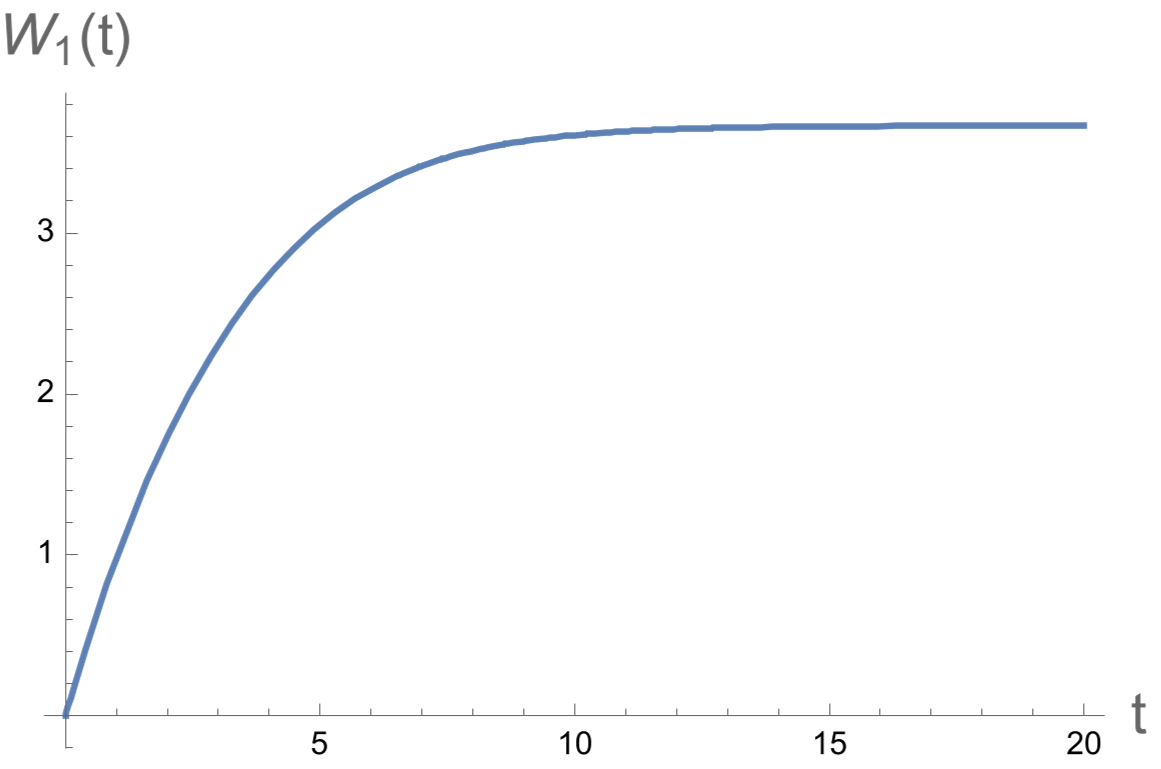
To get spacetime, you need time. By coupling a harmonic oscillator to a "bath" (using a Lindblad master equation), the researchers simulated energy dissipating. This creates a trajectory in the Hilbert space. As the state relaxes toward the ground state, its "distance" (transport cost) from the start point grows, looking exactly like a particle falling into a black hole.
Results: The Birth of a Black Hole
When the authors reconstructed the metric () from this transport flow, they didn't just get any geometry—they got a Black Hole.
- Near the Boundary: The growth is linear, indicating a flat-ish space.
- Near the "Horizon": The growth slows down exponentially. In GR, this is known as gravitational redshift.
- SYK Model: When applied to the SYK model (a famous holographic toy model), the math perfectly reproduced the AdS2 Schwarzschild metric.
Deep Insight: Wasserstein is Krylov Complexity
Perhaps the most profound discovery in the paper is the link to Krylov Complexity. Krylov complexity measures how "spread out" an operator becomes over time in a quantum system. The authors proved that for their specific setup, the 1-Wasserstein distance is mathematically equivalent to a generalized Krylov complexity.
This suggests that the "Distance" between two quantum states is literally how "Complex" it is to transform one into the other. Gravity, then, is the physical manifestation of quantum complexity.
Critical Analysis & Takeaways
- Universal metric space: Unlike previous attempts, the Wasserstein approach doesn't depend on the initial state—it's a universal geometric property of the Hilbert space.
- Limitation: The study focuses on 1D/Open systems. Scaling this to a full-blown 3D Quantum Field Theory (QFT) remains a massive challenge.
- Future Outlook: If the "cost of transport" defines our distance, then geometry is an emergent property of information efficiency. This could revolutionize how we think about the "pixels" of spacetime.
Conclusion
This paper elevates Optimal Transport from a tool for GANs and logistics into a fundamental language of physics. It provides a concrete recipe: Husimi Q + 1-Wasserstein = Emergent Spacetime.