
[Research Insight] HorizonMath: Pushing AI Beyond Known Boundaries into Mathematical Discovery
HorizonMath: Measuring AI Progress Toward Mathematical Discovery with Automatic Verification
HorizonMath is a novel benchmark of 100+ predominantly unsolved problems in computational and applied mathematics, featuring an open-source framework for automated verification. It targets the "generator-verifier gap," where solutions are hard to discover but computationally efficient to validate, enabling objective measurement of AI's progress toward autonomous mathematical discovery.
TL;DR
HorizonMath is a groundbreaking benchmark consisting of over 100 unsolved problems in applied math and physics. Unlike standard datasets where AI "re-solves" what humans already know, HorizonMath challenges models to perform actual research. Its key innovation is an automated verification pipeline that leverages the gap between the difficulty of finding a solution and the ease of checking it. Early results show GPT-5.4 Pro making potential breakthroughs in Kakeya sets and Ramsey numbers, while other models remain at a standstill.
The "Saturation" Crisis in AI Evaluation
For years, datasets like MATH and GSM8K were the gold standard. However, 2024/2025 marked a turning point: frontier models reached near-perfect accuracy. The academic community faced a dilemma: Is the AI getting smarter, or is the training data just leaking?
Traditional research benchmarks (like FrontierMath) often rely on private datasets or manual grading by PhDs to avoid contamination. HorizonMath offers a more elegant solution: Evaluate AI on problems that no human has solved yet. If the AI proposes a closed-form expression that matches a 20-digit numerical reference, it hasn't "memorized" the answer—it has discovered it.
Methodology: The Geometry of Discovery
The authors categorize the search for new math into three machine-verifiable buckets:
- Closed-form Discovery: Finding the exact symbolic expression for numerical constants (e.g., Airy function moments).
- Optimization: Beating a current world record (baseline) for a mathematical bound.
- Existence: Constructing a complex object (like a Hadamard matrix) that satisfies specific rigid constraints.
The Automated Execution Pipeline
The framework uses a strict Python-based environment. Models must output a proposed_solution() function. This is then passed through a Compliance Checker to ensure the model isn't cheating (e.g., by using numerical root-finding or hard-coded constants) before being verified against high-precision ground truths.
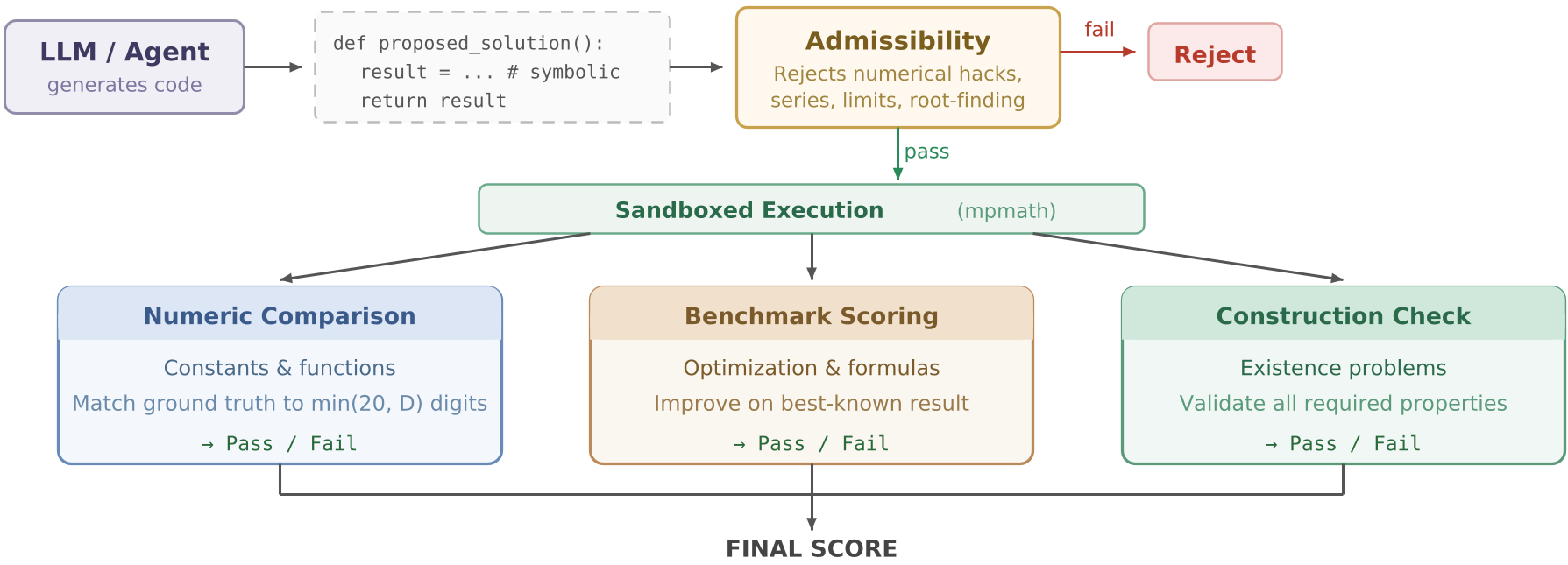 Figure 1: The HorizonMath evaluation workflow, showing the transition from model generation to automated multi-mode verification.
Experimental Showdown: GPT-5.4 vs. The Unknown
The results are a reality check for AI enthusiasts. On the "Solvability Tier 1-3" (the truly hard stuff), most models—including Claude Opus 4.6 and Gemini 3.1 Pro—scored a round zero.
However, GPT-5.4 Pro demonstrated a "spark" of research capability. It produced two significant results:
- Ramsey Numbers: It proposed a new quintic correction function that improved the upper bound constant for diagonal Ramsey numbers from ~3.799 to ~3.696.
- Kakeya Sets: It optimized intercepts for thin-triangle unions, achieving a 4.9% reduction in area over the previous SOTA (AlphaEvolve).
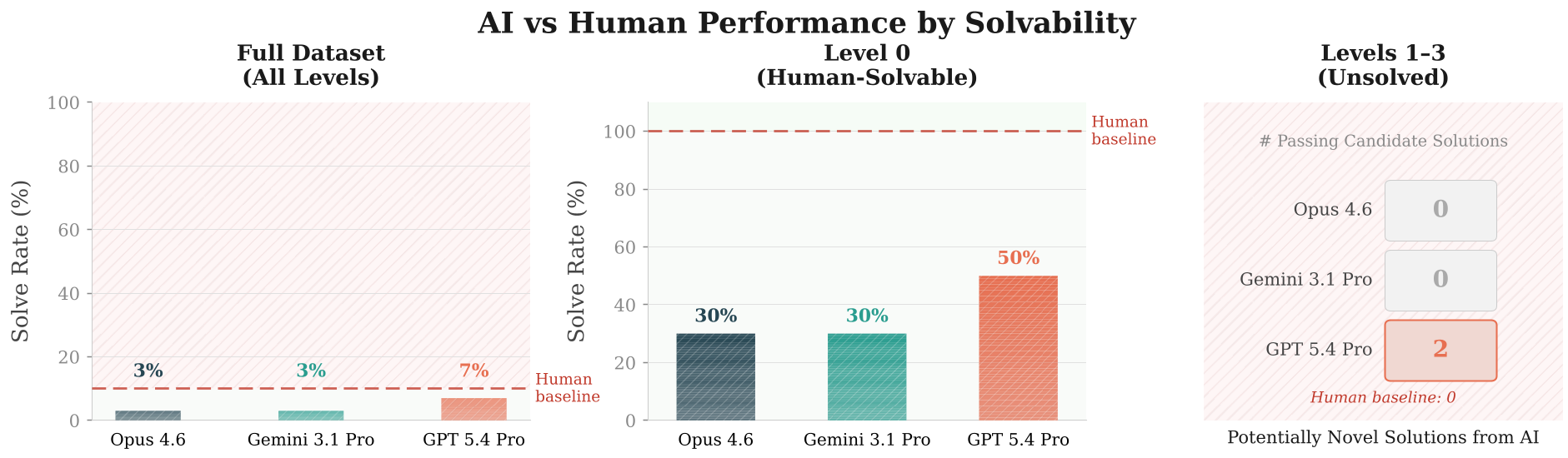 Figure 2: Current state of model performance. Note the dominance of GPT-5.4 Pro in the "novel discovery" (rightmost graph) despite low overall accuracy.
Critical Perspective: Conjecture vs. Proof
A vital caveat is that numerical matching is not a formal proof. While HorizonMath can verify a construction beats a bound with high precision, it cannot "prove" a theorem in the way a system like Lean can.
The authors argue, however, that conjecture is the precursor to proof. By providing a platform where AI can rapidly iterate on valid conjectures, HorizonMath accelerates the human-AI loop. The next step for this research is clear: integrating these verifiable candidates with formal proof assistants to complete the cycle of discovery.
Conclusion
HorizonMath represents a shift in the AI evaluation paradigm. It moves away from "Human-as-Judge" to "Math-as-Judge." For the first time, we have a scalable metric to see if AI can actually contribute to the frontier of human knowledge, rather than just summarizing it.
Takeaway for Researchers: If your model is hitting 95% on traditional benchmarks, it's time to test its mettle on HorizonMath. The true test of intelligence isn't answering a known question, but finding a new answer.