
NGTS-10A b: Caught in the Act of Horizontal Chemical Quenching
Horizontal transport as a source of disequilibrium chemistry on the nightside of a hot exoplanet
This study uses JWST/NIRSpec to observe the full orbital phase curve of the hot Jupiter NGTS-10A b, identifying H2O and CO on both its day and night sides. The researchers discovered a significant depletion of CH4 on the nightside compared to chemical equilibrium predictions, confirming horizontal transport as the dominant mechanism for disequilibrium chemistry.
TL;DR
Astronomers using the JWST have provided the most definitive evidence to date that planetary-scale winds "smear" the chemistry of hot Jupiters. By observing NGTS-10A b, a short-period exoplanet, researchers found that methane (CH4) is almost entirely absent from its cool nightside—despite temperatures that should allow it to thrive. This confirms that horizontal winds advect carbon monoxide (CO) from the hot dayside so quickly that the atmosphere never has time to settle into its expected chemical state.
The Problem: The Mystery of the Missing Methane
Hot Jupiters are laboratory-like environments for extreme physics. Tidally locked to their stars, they have a permanent dayside (often >1800K) and a cooler nightside.
In standard thermochemical equilibrium:
- Dayside: Carbon stays in the form of CO.
- Nightside: Carbon should transition into CH4.
For years, models have suggested that winds moving at kilometers per second should transport dayside gas to the nightside faster than the chemical reaction can occur. However, proving this was "horizontal transport" rather than "vertical mixing" (upwelling from the deep interior) remained a persistent challenge.
Methodology: A Multi-Pronged Spectral Attack
The team observed the full orbital phase curve of NGTS-10A b using JWST/NIRSpec/PRISM, covering a massive wavelength range from 0.6 to 5.3 µm. This range is critical because it captures the spectral signatures of H2O, CO, CO2, and—most importantly—CH4.
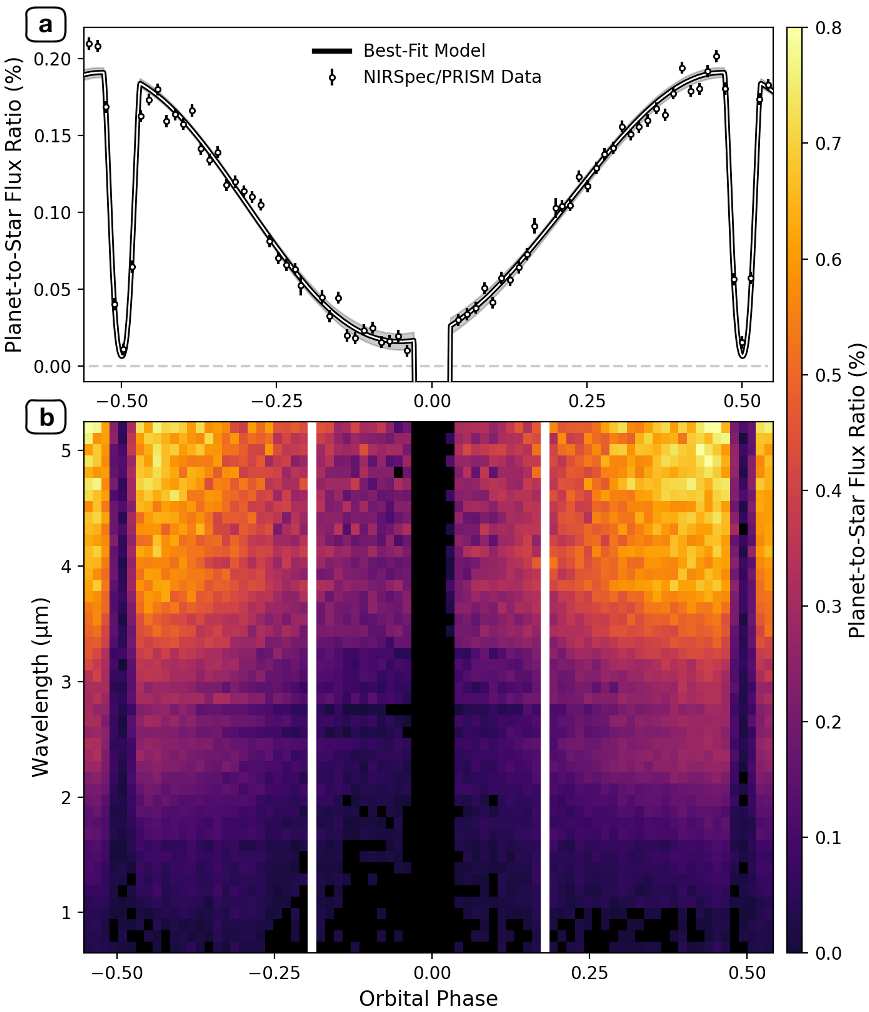 Fig 1: The spectroscopic phase curves showing thermal emission. Wavelengths >1.5µm clearly detect the planetary nightside.
The researchers used a two-step modeling approach:
- Free Retrievals: They didn't assume any chemistry; they let the data tell them how much of each gas was there.
- Equilibrium Models: They calculated what should be there if chemistry were local and "settled."
The "Smoking Gun": Comparison of Day and Night
The results revealed a startling consistency: H2O and CO abundances were nearly identical on both hemispheres.
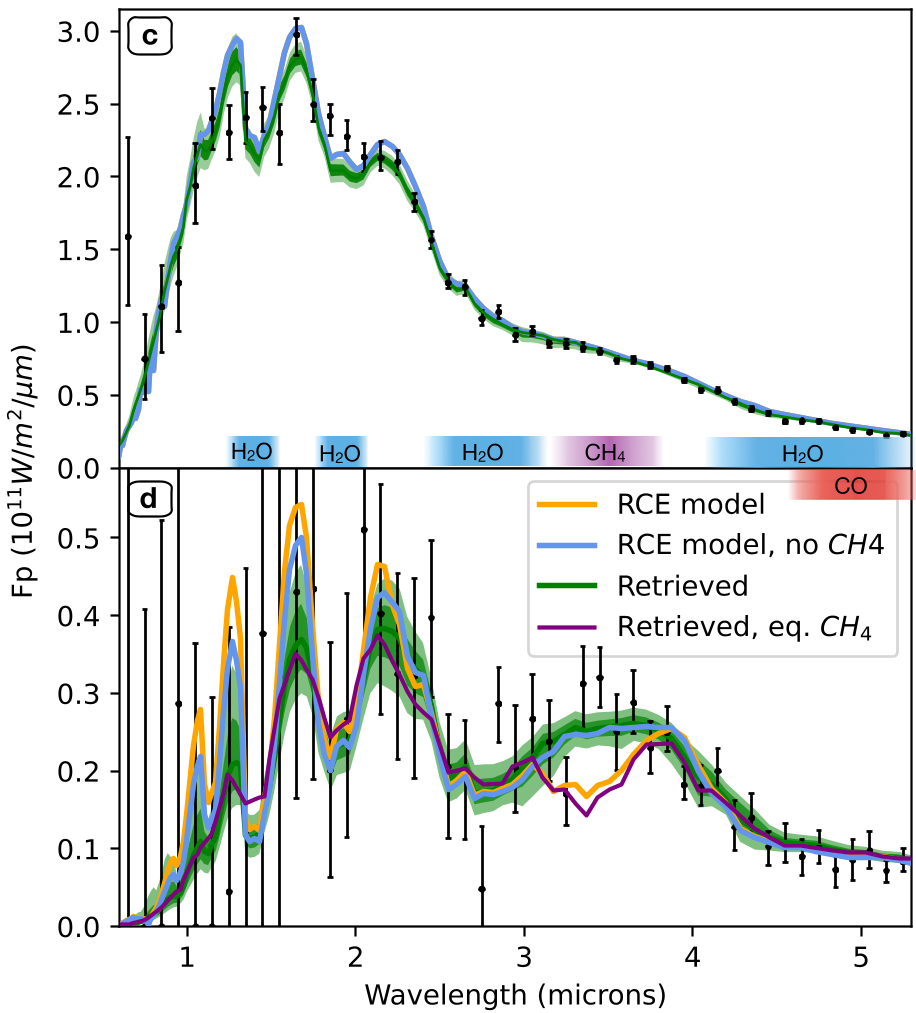 Fig 2: Comparison of Day and Night spectra. While CO and H2O are present on both, the predicted CH4 (purple line) is clearly missing from the actual nightside data.
Why it's not Vertical Mixing
The team went a step further to rule out vertical mixing. By modeling the planet's interior, they found that even with an unusually large core, the internal temperature () could not exceed 500 K. To deplete CH4 via vertical mixing alone, the interior would need to be much hotter (>600 K) to reach the -dominant regime at depth. This leaves horizontal transport as the only viable explanation.
Experimental Results & Insights
- Nightside CH4 Ceiling: The 3-σ upper limit is established at , whereas equilibrium demands .
- Heat Redistribution: Efficiency () was measured at , suggesting that while winds are fast enough to move chemistry, they are likely slowed by drag or clouds, preventing perfect temperature equalization.
- Contrast with WASP-121b: Unlike the ultra-hot Jupiter WASP-121b (which shows some methane), NGTS-10A b is cool enough that the absence of CH4 can only be attributed to rapid advection quenching.
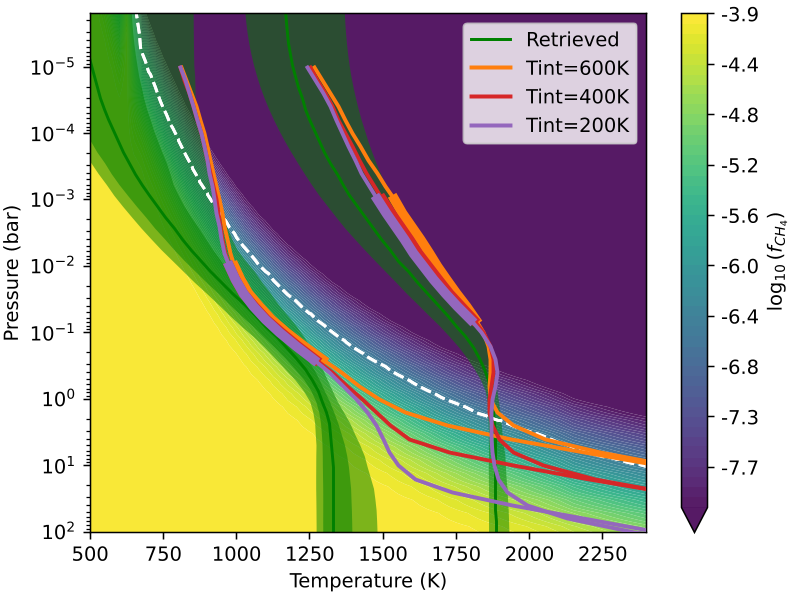 Fig 3: Retreived abundances for the major species. The overlap in CO and H2O between Day/Night emphasizes the global homogenization.
Conclusion: A New Benchmark for Exoplanet Weather
This study marks a milestone in exoplanet characterization. We are moving away from asking "what is in the atmosphere?" to "how does the atmosphere move?"
The fact that NGTS-10A b maintains a dayside-like chemical composition even in its much cooler nightside proves that these worlds are not just static spheres of gas, but highly dynamic engines where weather moves faster than chemistry. This work sets the stage for a new generation of 3D General Circulation Models (GCMs) that must now account for horizontal quenching as a standard feature of hot Jupiter climatology.