
From Mimicry to Mastery: How "Tree-of-Writing" Redefines LLM Evaluation
HoWToBench: Holistic Evaluation for LLM's Capability in Human-level Writing using Tree of Writing
The paper introduces HowToBench, a large-scale Chinese writing benchmark, and Tree-of-Writing (ToW), a hierarchical evaluation framework. ToW uses a tree-structured workflow to aggregate sub-features of writing, achieving a 0.93 Pearson correlation with human judgment and outperforming traditional LLM-as-a-judge methods.
TL;DR
The current "gold standard" for evaluating AI writing is broken. Most benchmarks treat LLMs like parrots—checking if they followed a set of instructions rather than if they actually wrote something good. This paper introduces HowToBench and the Tree-of-Writing (ToW) framework, moving away from simple averaging to a sophisticated, tree-based weighted evaluation that aligns with human expertise at a staggering 0.93 correlation.
The "Negotiation Inconsistency" Problem
When we ask an LLM to "Judge" a piece of writing, we usually give it a rubric. The LLM then tries to "negotiate" between sub-scores like fluency, logic, and creativity. However, the researchers found that this process is opaque and inconsistent. Change a single word in the prompt, and the judge might arbitrarily value "length" over "logic." This is what the authors call Negotiation Inconsistency.
Previous metrics like BLEU or ROUGE focus on word overlap, while modern "LLM-as-a-judge" methods suffer from verbosity bias—the tendency to reward longer, albeit fluffier, content.
Methodology: The Tree of Writing (ToW)
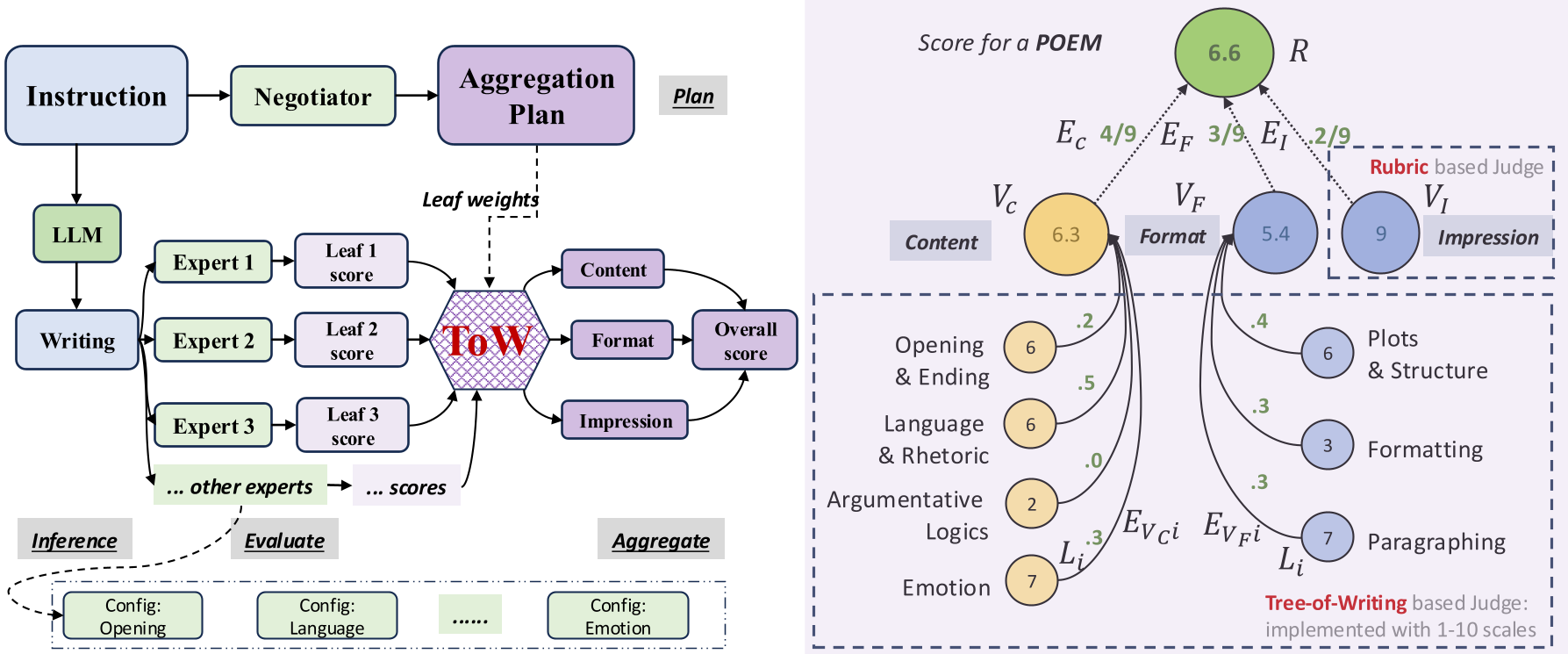
To fix this, the team at Tsinghua University and Z.ai developed Tree-of-Writing. Instead of a flat list, they modeled evaluation as a hierarchical tree.
1. The Architecture
The tree branches into three primary nodes:
- Content (): Coherence, logic, richness, and opening/ending.
- Format (): Plot structure, paragraphing, and technical formatting.
- Impression (): The holistic "soul" of the writing.
2. The Negotiator
Crucially, the framework employs an LLM-negotiator (). For every specific genre (e.g., a Poem vs. a Legal Contract), the negotiator assigns different weights to the edges of the tree. In a legal contract, "Format" might be weighted heavily; in "Fiction," "Emotion" takes the lead. This mimics the human professional decision-making process.
HowToBench: A New Frontier
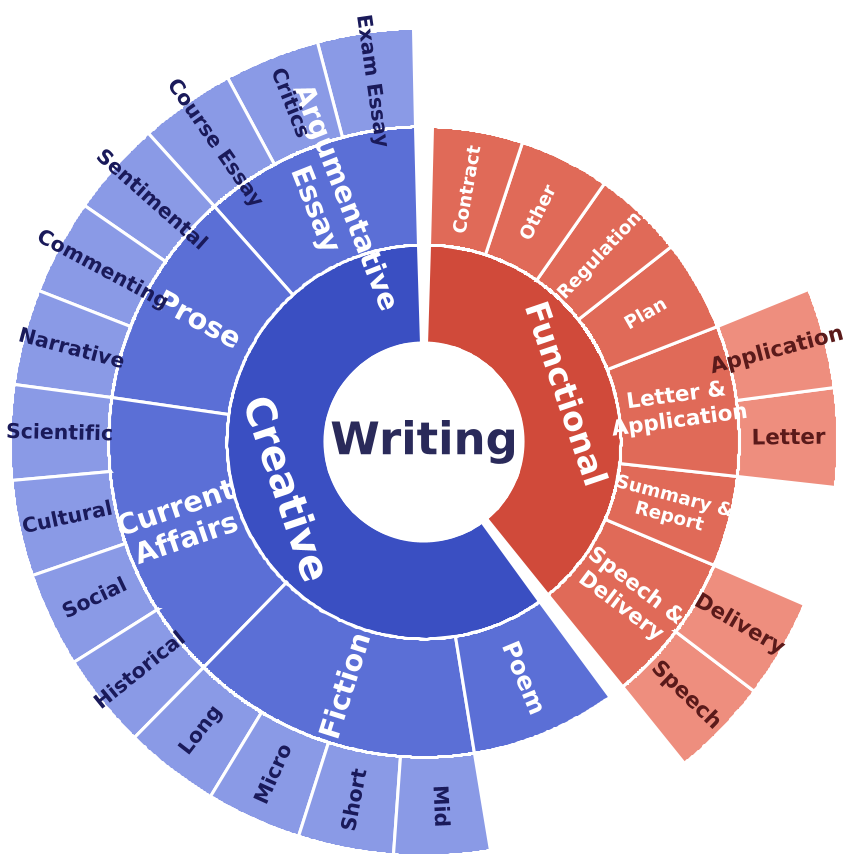
To test ToW, the authors built HowToBench, a massive Chinese benchmark (with English generalizability) featuring 12 genres and 1302 instructions. Unlike previous datasets, these were constructed via "Reverse Construction"—taking high-quality human professional writing and working backward to create instructions.
Surprising Results: Longer is NOT Better
The experiments yielded a counter-intuitive insight that challenges common AI prompt engineering: Input-side information piling does not equal better quality.
In the "Guide" tasks, the researchers found a negative correlation (-0.44) between the amount of input information provided and the final content score. LLMs often struggled to synthesize excessive input, leading to "diluted" quality.
Key Benchmarking Highlights:
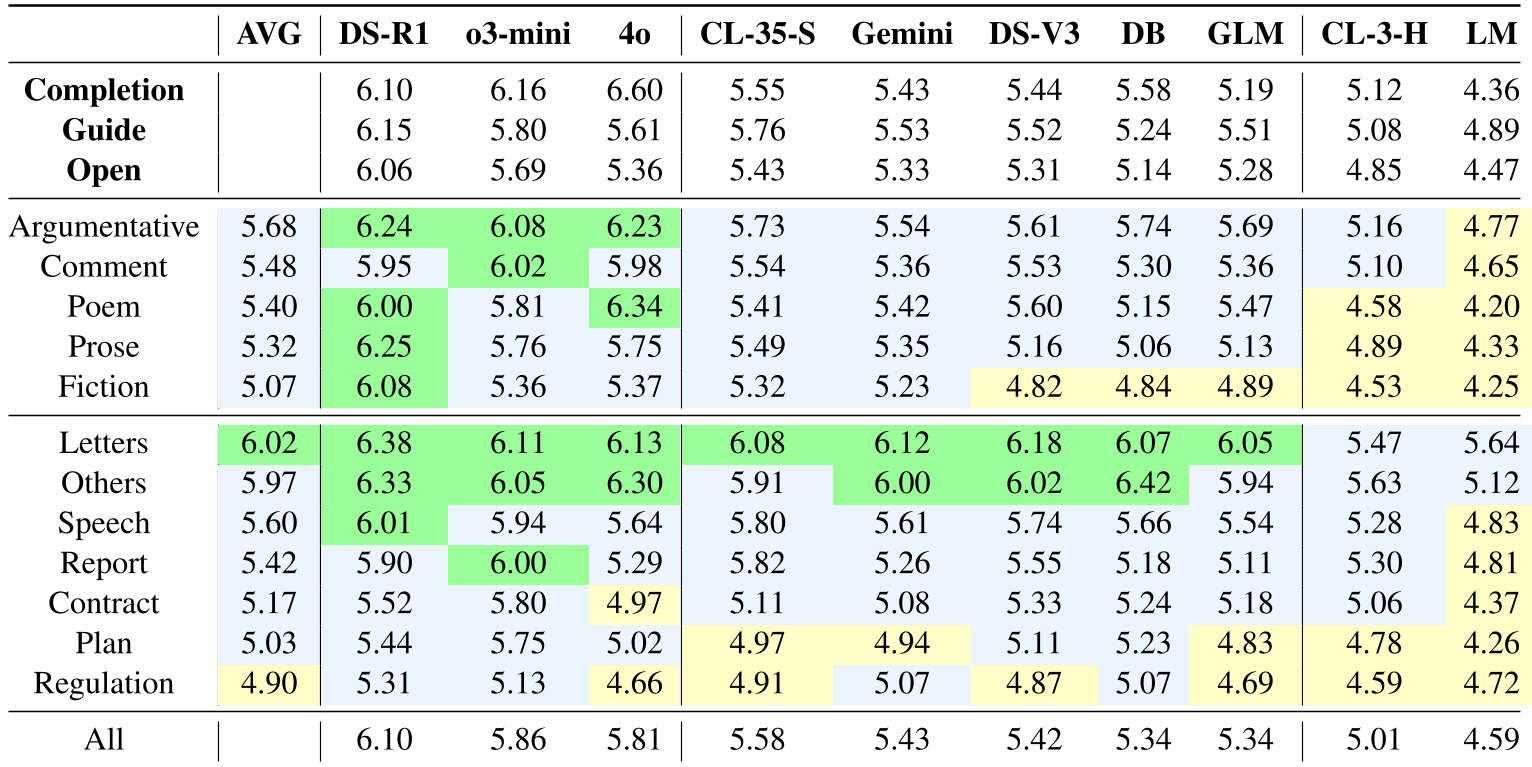
- DeepSeek-R1 and GPT-4o led the pack, but even they showed a sharp 15-18% performance drop when moving from "Completion" tasks to "Open Writing."
- Traditional metrics (BLEU/ROUGE) were found to be highly vulnerable to "Textual Disturbances" like repetition, whereas ToW remained robust.
Critical Insight: The End of the "Mimicry Game"
The industry value of this paper lies in its rejection of the "Mimicry Game." By proving that human-level writing requires independent evaluation of format, content, and subjective impression, the authors provide a roadmap for developing LLMs that can truly write, not just simulate.
Limitations: The current version is primarily focused on Chinese (though English subsets show promise) and focuses on single-round generation rather than the multi-round iterative refinement that defines real-world professional writing.
Future Outlook
The Tree-of-Writing framework sets a new standard for transparency in AI evaluation. As we move toward more "agentic" AI eras, having an "Evaluator" that can explain its weighted reasoning is as important as the model that generates the text itself.