
HumanNet: Is One Million Hours of Human Video the Secret to Robotic General Intelligence?
HumanNet: Scaling Human-centric Video Learning to One Million Hours
HumanNet is a massive, one-million-hour human-centric video corpus designed to bridge the data gap in embodied AI. It integrates first-person and third-person perspectives with rich annotations like 3D poses and SLAM trajectories, enabling a model pretrained on 1,000 hours of its human data to match the performance of models trained on 100 hours of real-robot data.
Executive Summary
HumanNet represents a monumental shift in how we think about "Data for Robotics." Moving away from the slow, expensive process of collecting robot-specific logs, this work introduces a one-million-hour corpus of human-centric video. By treating human behavior as a scalable substrate for physical AI, the researchers from Peking University have demonstrated that a model watching humans for 1,000 hours can learn as much about "action" as a model watching a real robot for 100 hours. This is not just a dataset; it is an infrastructure for Embodied Foundation Models.
The "Data Bottleneck" in Embodied AI
In the world of LLMs, we scale with the internet. In robotics, we scale with the "teleoperator." Learning to manipulate a cup or use a tool currently requires thousands of hours of human-in-the-loop robot demonstrations.
The authors argue that Human-centric video—standard videos of people doing things—is the only source of data massive enough to rival the "Internet scale" of GPT-4. However, the problem with previous attempts at this was "Physical Grounding." A video of someone cooking is useless to a robot if the robot doesn't understand the intent (egocentric view), the contact (hand position), and the kinematics (3D motion).
Methodology: The Anatomy of a Million Hours
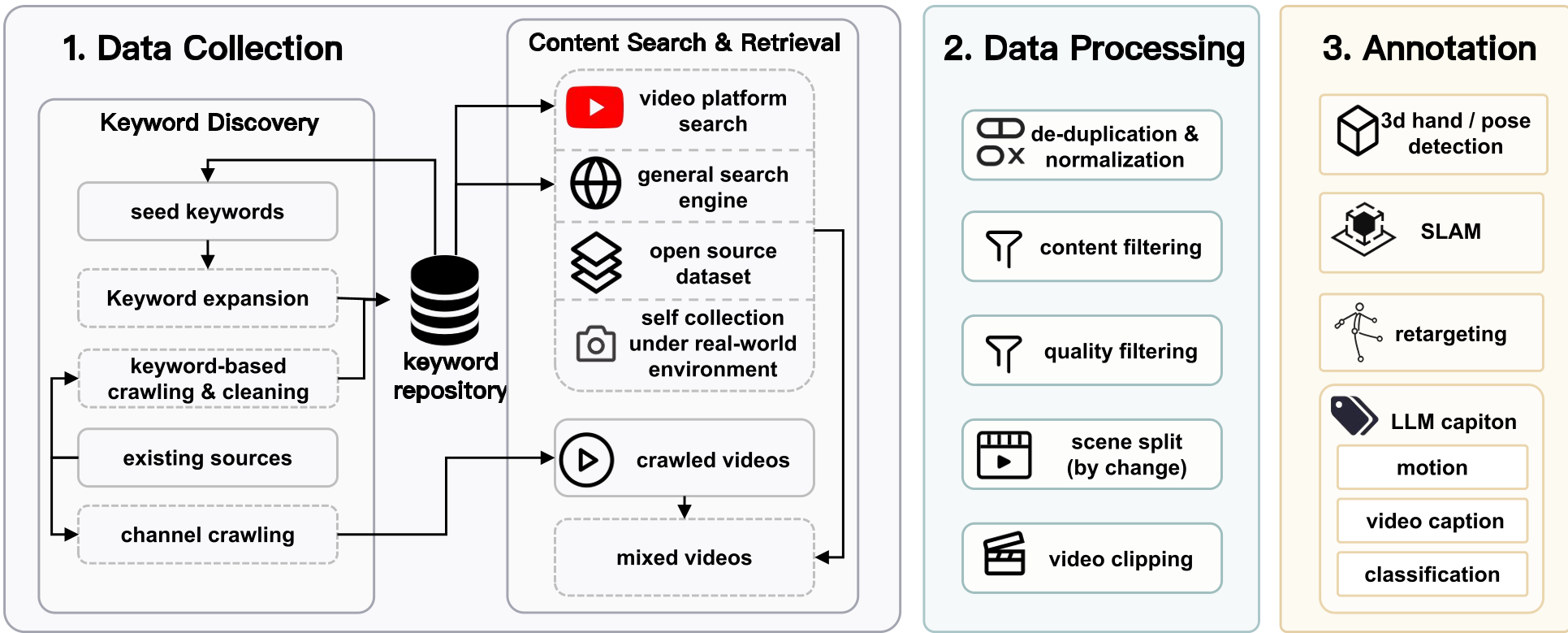
HumanNet isn't just a YouTube scrape; it is a structured taxonomy of human interaction. The core innovation lies in the Curation Pipeline.
1. Viewpoint Diversity
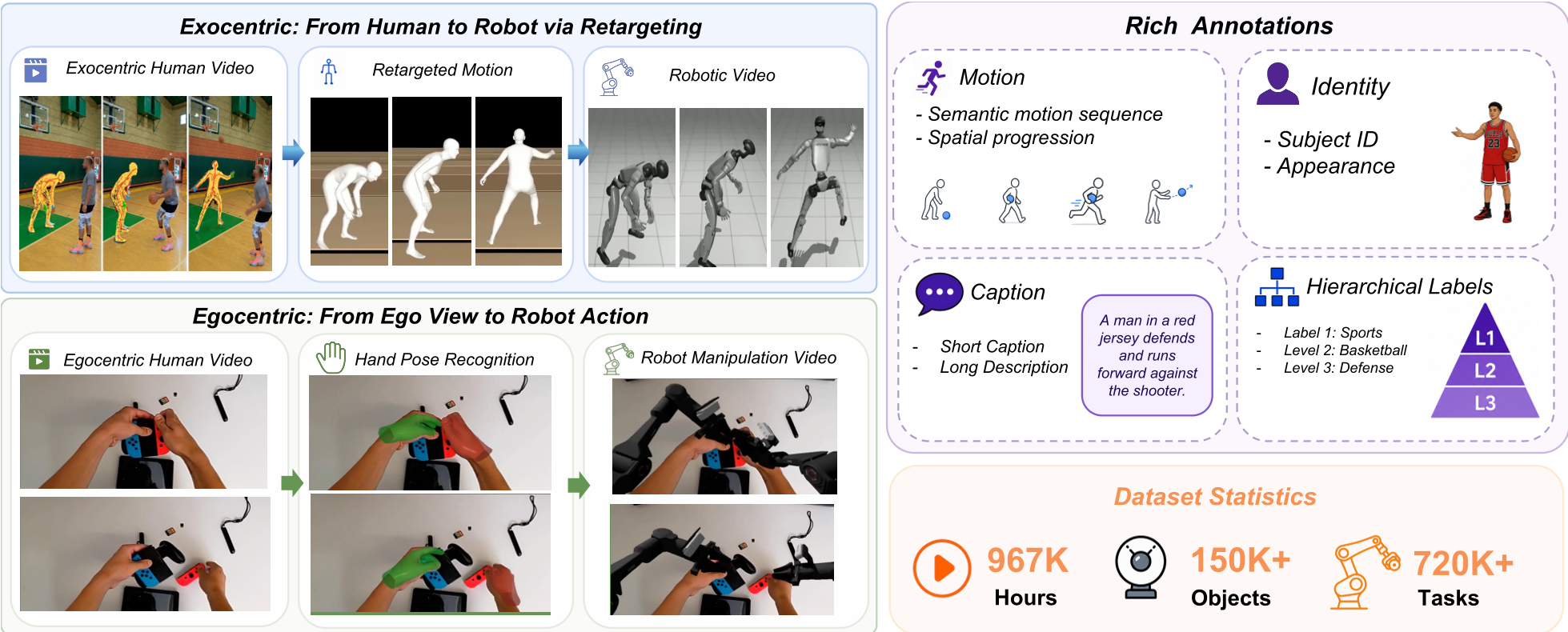
The dataset blends First-Person (Ego) and Third-Person (Exo) views.
- Ego: Captures the visual consequences of motor decisions and hand-object contact.
- Exo: Captures full-body posture, scene context, and multi-person social coordination.
2. Annotation Enrichment
To make these videos "Machine-Actionable," the authors extract:
- 3D Hand & Body Signals: Turning pixels into skeletal motion.
- Monocular SLAM: Mapping the camera's path to understand spatial navigation.
- LLM-Assisted Captions: Providing high-level semantic reasoning for long-horizon tasks.
Experiments: Validation via VLA
The most striking claim of the paper is the 10:1 Ratio. The authors used a Vision-Language-Action (VLA) architecture (LingBot-VLA) and tested it on held-out robot task groups.
- The Baseline: Standard VLM (Qwen).
- The Competitor: Qwen + 100 hours of Real-Robot (Magic Cobot) data.
- The HumanNet Variant: Qwen + 1,000 hours of HumanNet Egocentric video.
The Result: The HumanNet variant matched or surpassed the 100-hour robot data model. This suggests that while human data has an "embodiment gap" (since humans aren't robots), the sheer scale and diversity of human activities compensate for that gap, providing a much richer "prior" for what physical interaction looks like.
Critical Insights: Beyond Hour Counts
HumanNet succeeds because it treats curation as a first-class design principle. By focusing on Fine-grained physical activities (tool use, appliance operation, assembly) rather than passive observations, the dataset manages to preserve the physical structure required for robotics.
However, the authors remain objective about its Limitations:
- Human hands Robot grippers: The embodiment gap remains the "Final Boss" of transfer learning.
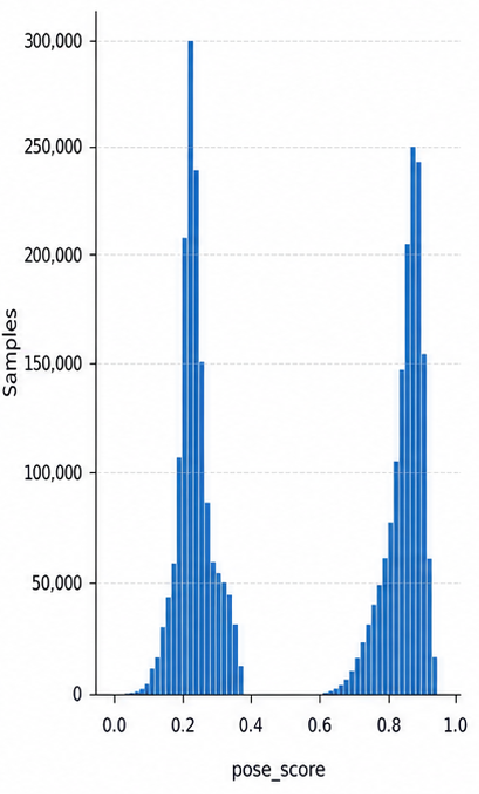
- Noise at Scale: A million hours is impossible to curate perfectly; errors in 3D pose detection are inevitable.
- Privacy Concerns: Capturing 1M hours of human life brings significant ethical challenges regarding bystanders and private spaces.
Conclusion
HumanNet is a compelling argument for Human-to-Robot transfer. It proves that the "internet for robots" doesn't have to be a trillion robot logs—it can be the existing visual record of humanity interacting with the world. As we look toward general-purpose humanoid robots, datasets like HumanNet will likely serve as the foundational "textbook" from which these machines learn the laws of physical interaction.
Final Takeaway: To teach a robot to act, first teach it to see the intent behind every human move.