
HiVLA: Decoupling Reasoning and Action for High-Precision Robotics
HiVLA: A Visual-Grounded-Centric Hierarchical Embodied Manipulation System
HiVLA is a hierarchical Vision-Language-Action (VLA) framework that decouples high-level semantic planning from low-level motor control using a visual-grounding-centric approach. It combines a VLM planner for task decomposition and a Diffusion Transformer (DiT) action expert, achieving state-of-the-art performance in complex robotic manipulation tasks.
TL;DR
HiVLA (Hierarchical Vision-Language-Action) is a new modular robotics framework that solves the "catastrophic forgetting" problem of end-to-end models. By separating high-level planning (what to do and where) from low-level execution (how to move), it achieves a 42.7% success rate boost over state-of-the-art baselines like π0. The core secret? A Cascaded Cross-Attention mechanism that lets the robot see fine details while maintaining a global sense of space.
The Motivation: Why End-to-End VLA is Fragile
The current trend in robotics is to take a massive Vision-Language Model (VLM) and fine-tune it to output robot actions. While this seems "elegant," it has a fatal flaw: catastrophic forgetting. When you teach a model to move a gripper, it often loses the deep reasoning capabilities it gained from web-scale data.
Furthermore, robots face a resolution trade-off. Global images are great for context but terrible for small objects (like clicking a tiny bell); local crops are great for details but lose absolute spatial positioning. HiVLA was designed to bridge this gap.
Methodology: The Hierarchical "Brain & Hands"
HiVLA operates in two distinct stages:
1. The High-Level Planner (The Brain)
Using a VLM (like Qwen3-VL), the system interprets a complex goal (e.g., "Stack the blue block on the green block") and decomposes it into a JSON structured plan. This plan includes:
- Subtask Instruction: Specifically identifying the next step.
- Visual Grounding: A precise bounding box (BBox) of the target object.
2. The DiT Action Expert (The Hands)
This is where the magic happens. The action expert uses a Diffusion Transformer (DiT) with a novel Cascaded Cross-Attention mechanism. Instead of dumping all data into the model at once, it processes information sequentially:
- Level 1: Global Context: Sees the whole table and workspace.
- Level 2: High-Res Local Crops: Zooms in on the target object (preserving 1080p details) and adds Absolute Positional Encodings so the robot knows exactly where that local patch is in the 3D world.
- Level 3: Skill Semantics: Internalizes the specific motion (e.g., "Pick" vs. "Place").
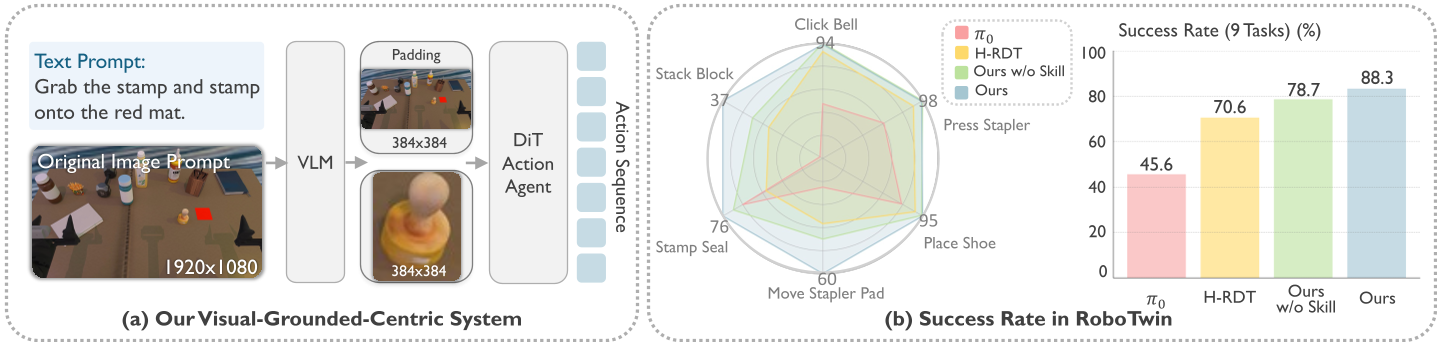 Figure 1: The HiVLA system architecture showing the decoupling of the VLM Planner and the DiT Action Expert.
Experimental Results: Slaying the Baselines
The researchers tested HiVLA in the RoboTwin 2.0 simulation and real-world environments. The performance jump was massive:
- Total Success Rate: 83.3% for HiVLA vs. 45.6% for π0.
- Hard Tasks: In tasks requiring long-horizon reasoning (like clicking three specific bells in a row), HiVLA outperformed the nearest strong baseline (H-RDT) by nearly 20%.
Robustness to "Planner Mistakes"
Interestingly, the action expert is incredibly resilient. Even if the VLM planner provides a slightly shifted bounding box, the action expert can often "self-correct" using its global visual context. However, the system is strictly compliant with language: if you tell it the wrong subtask, it will execute that wrong subtask perfectly.
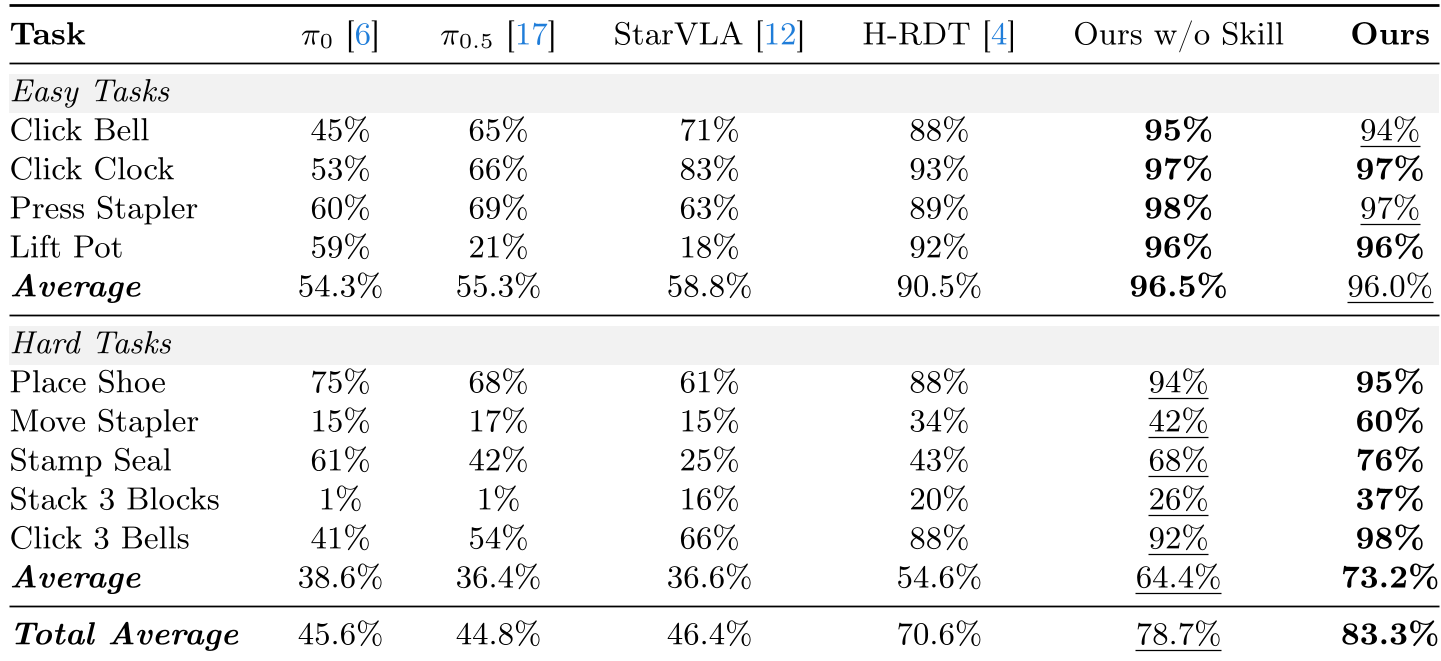 Table 1: Comparative success rates across easy and hard tasks in simulation.
Critical Insights & Future Outlook
The success of HiVLA proves that modularity is not a step backward. By decoupling reasoning from action:
- Independent Scaling: You can update the VLM "Planner" to an 8B, 32B, or 70B model without retraining the "Hands."
- Interpretability: You can see exactly what the robot intends to do (via the JSON plan) before it moves.
- Efficiency: The slow VLM runs at a lower frequency to plan, while the fast DiT runs at a high frequency (8Hz) for smooth control.
Limitations: While the system handles spatial noise well, it is still dependent on the semantic correctness of the VLM. If the VLM hallucinating a subtask, the robot follows. Future work may involve stronger "closed-loop" semantic feedback to detect and correct these hallucinations mid-action.
Conclusion
HiVLA sets a new standard for bimanual manipulation by treating visual grounding as the fundamental bridge between high-level thought and low-level movement. It is a powerful reminder that in the age of monolithic models, a well-structured hierarchy still wins the day for complex, high-precision physical tasks.