
Quasars as Sculptors: The Hydrodynamical Response of Cold CGM Clouds
The hydrodynamical response of cold circumgalactic clouds to quasar radiation
This paper introduces an analytical and numerical framework to describe the hydrodynamical response of cold ( K) circumgalactic medium (CGM) clouds to intense Extreme-Ultraviolet (EUV) radiation from quasars. Using RAMSES-RT simulations, it identifies three distinct evolutionary regimes—Optically Thin, Rocket-Effect, and Radiation-Shielded—revealing that quasar illumination significantly reshapes CGM morphology and enhances Lyman-alpha emission properties.
TL;DR
When we observe the gas surrounding distant galaxies (the CGM), we often use quasars as cosmic flashlights. However, this study reveals that the "flashlight" doesn't just illuminate the gas—it physically reshapes it. By defining three distinct regimes—Optically Thin, Rocket-Effect, and Radiation-Shielded—the authors demonstrate why the brightness of the illuminating quasar fundamentally changes our interpretation of galactic gas density and kinematics.
Motivation: Beyond Static Illumination
In the quest to understand galaxy evolution, the cold ( K) gas in the circumgalactic medium is a critical piece of the puzzle. While researchers have long accounted for photo-ionization, they have largely ignored the hydrodynamical response: how the pressure of heated, ionized gas pushes and compresses the remaining neutral gas. This paper asks: Does the radiation simply turn the gas "off" (ionize it), or does it create new, dense structures that enhance the very emission we are trying to measure?
Methodology: The Strömgren Number Reimagined
The authors define the cloud's fate using the Strömgren number (), which compares the recombination rate to the ionizing photon flux. Crucially, they introduce the density contrast (the ratio of neutral to ionized gas density) to refine the boundaries of cloud evolution.
The Three Evolutionary Paths:
- Optically Thin (): Radiation floods the cloud instantly. The gas heats uniformly and expands.
- Rocket-Effect (): An ionization front moves through the cloud. One side is ionized and expands, while the "back-reaction" compresses the neutral core on the other side. This core is then accelerated—much like a rocket—forming a "cometary globule."
- Radiation-Shielded (): The cloud is so dense that even the ionized layer can't penetrate it. The core remains largely untouched.
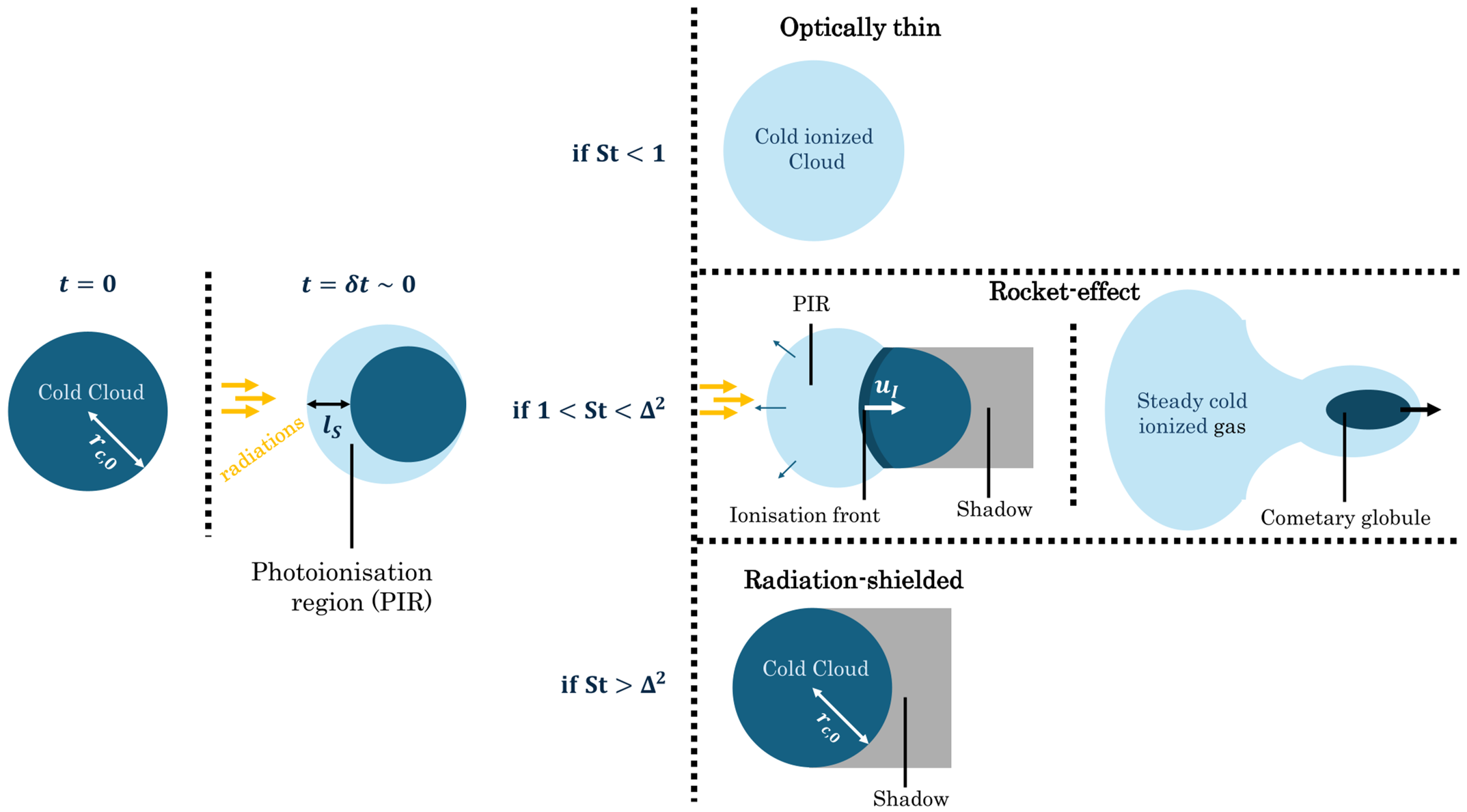 Figure 1: Conceptual illustration showing the transition from uniform expansion to the highly asymmetric rocket-effect.
Simulation Results: Morphological Metamorphosis
Using RAMSES-RT simulations, the team confirmed these regimes. In the Rocket-Effect regime, they observed the formation of finger-like instabilities and dense "heads" of neutral gas.
From an observational standpoint, the most striking finding is the Lyman-alpha () enhancement. In the rocket-effect regime, the luminosity can be 10 times higher than in the optically thin case. Why? Because the compression creates high-density regions where recombination and collisional excitation happen much more efficiently.
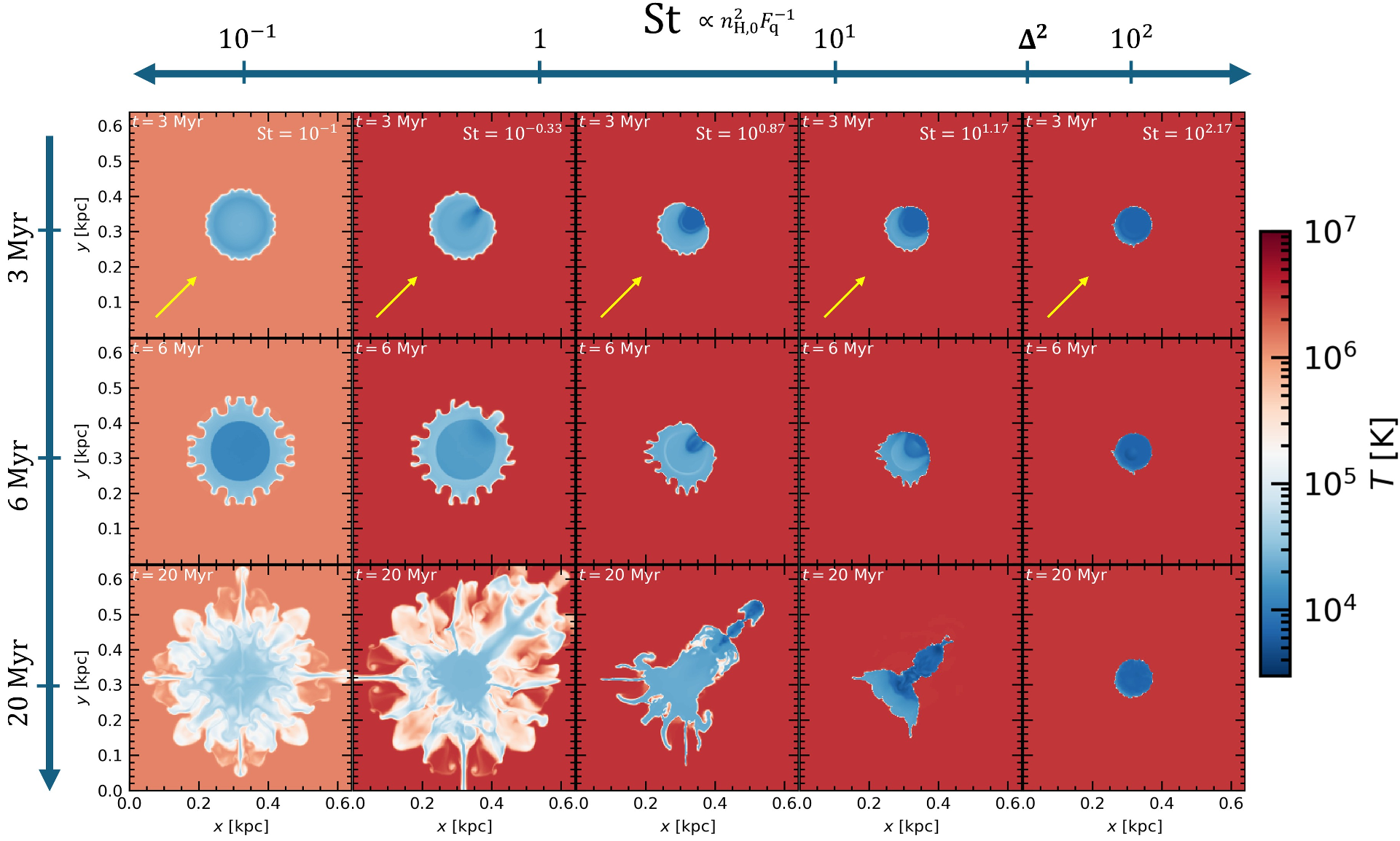 Figure 3: Temperature slices over 20 Myr. Note how intermediate values (middle rows) lead to the distinct cometary shape and the "rocket" propulsion of the cold clump.
Global Implications for Quasar Observations
Applying this single-cloud model to a whole halo, the study finds a significant dichotomy:
- Bright Quasars: They likely fully ionize their surrounding CGM. What we see is the "Optically Thin" regime.
- Faint Quasars: These are the "Sculptors." Their radiation is weak enough that many CGM clouds enter the Rocket-Effect regime.
This means that if we don't account for these hydrodynamical effects when looking at faint quasars, we might overestimate the mass of cold gas or misinterpret its velocity as being driven solely by gravity when it's actually being "pushed" by radiation.
Critical Analysis & Conclusion
This work provides a necessary bridge between small-scale cloud physics and large-scale galaxy surveys.
Takeaway: The "rocket effect" is a double-edged sword for observers. It makes cold gas easier to see (by boosting brightness) but harder to interpret (by physically moving and compressing the gas).
Limitations: The model currently ignores magnetic fields and self-gravity, which could further stabilize or cause the collapse of these "cometary" clumps. Future work moving towards subgrid prescriptions for cosmological simulations will be essential for the next generation of MUSE and KCWI observations.
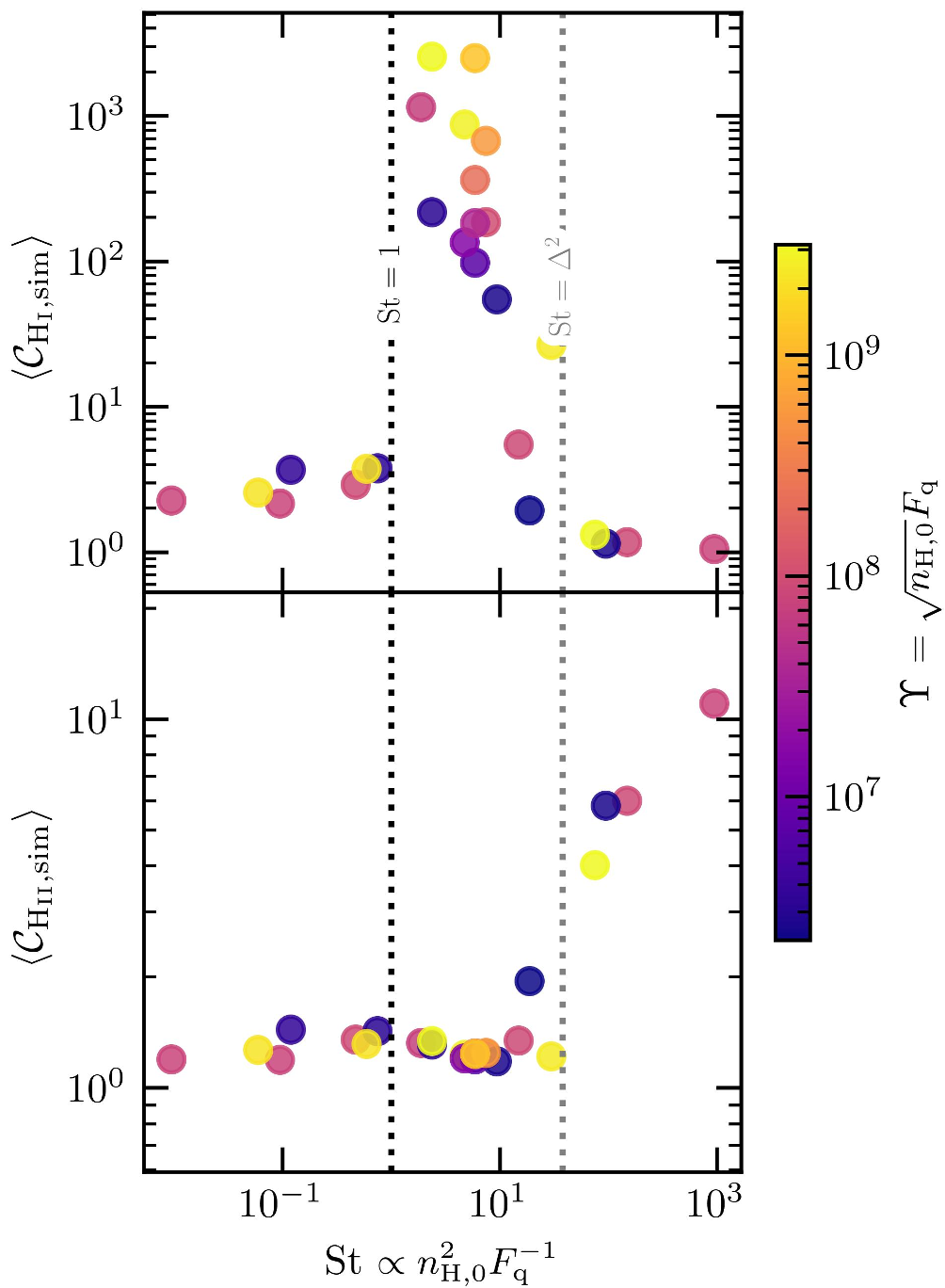 Figure 8: Quantitative analysis showing how the clumping factor—a proxy for internal structure—spikes in the rocket-effect regime.