
HyperEyes: "Search Wider, Not Longer" — Rethinking Multimodal Agent Efficiency
HyperEyes: Dual-Grained Efficiency-Aware Reinforcement Learning for Parallel Multimodal Search Agents
HyperEyes is a parallel multimodal search agent designed to handle complex, multi-entity queries by fusing visual grounding and retrieval into a single "Unified Grounded Search" atomic action. Optimized through a Dual-Grained Efficiency-Aware Reinforcement Learning framework, HyperEyes-30B achieves state-of-the-art results, surpassing comparable open-source agents by 9.9% in accuracy while reducing tool-call rounds by 5.3x.
TL;DR
HyperEyes is a breakthrough in multimodal search agents, shifting the paradigm from slow, sequential processing to high-speed parallelized retrieval. By introducing Unified Grounded Search (UGS) and a curriculum-based RL framework called TRACE, HyperEyes achieves a 5.3x reduction in tool-call rounds while simultaneously boosting accuracy by nearly 10% on open-source benchmarks.
Problem & Motivation: The Sequential Bottleneck
Modern Multimodal Large Language Models (MLLMs) are often used as "search agents" to bypass knowledge cutoffs. However, current agents (like DeepEyes-V2 or MMSearch) are inherently "serial." If you ask a question about four different people in an image, a typical agent will:
- Crop person A -> Search person A.
- Crop person B -> Search person B.
- ...and so on.
This "crop-then-search" loop is brittle. A single mistake in localization at step 1 ruins the whole chain. Moreover, it is incredibly slow and expensive. The authors of HyperEyes identified that existing models are optimized for accuracy alone, giving them no incentive to be concise. This leads to "over-searching," where the model spams tool calls, accumulating noisy web snippets that eventually confuse the final answer.
Methodology: The Architecture of Efficiency
HyperEyes re-engineers the agent workflow through three pillars:
1. Unified Grounded Search (UGS)
Instead of separating "where to look" from "what to search," UGS merges them. The model outputs bounding boxes and retrieval queries simultaneously. This allows the agent to dispatch parallel search queries for every entity in the image within a single interaction round.
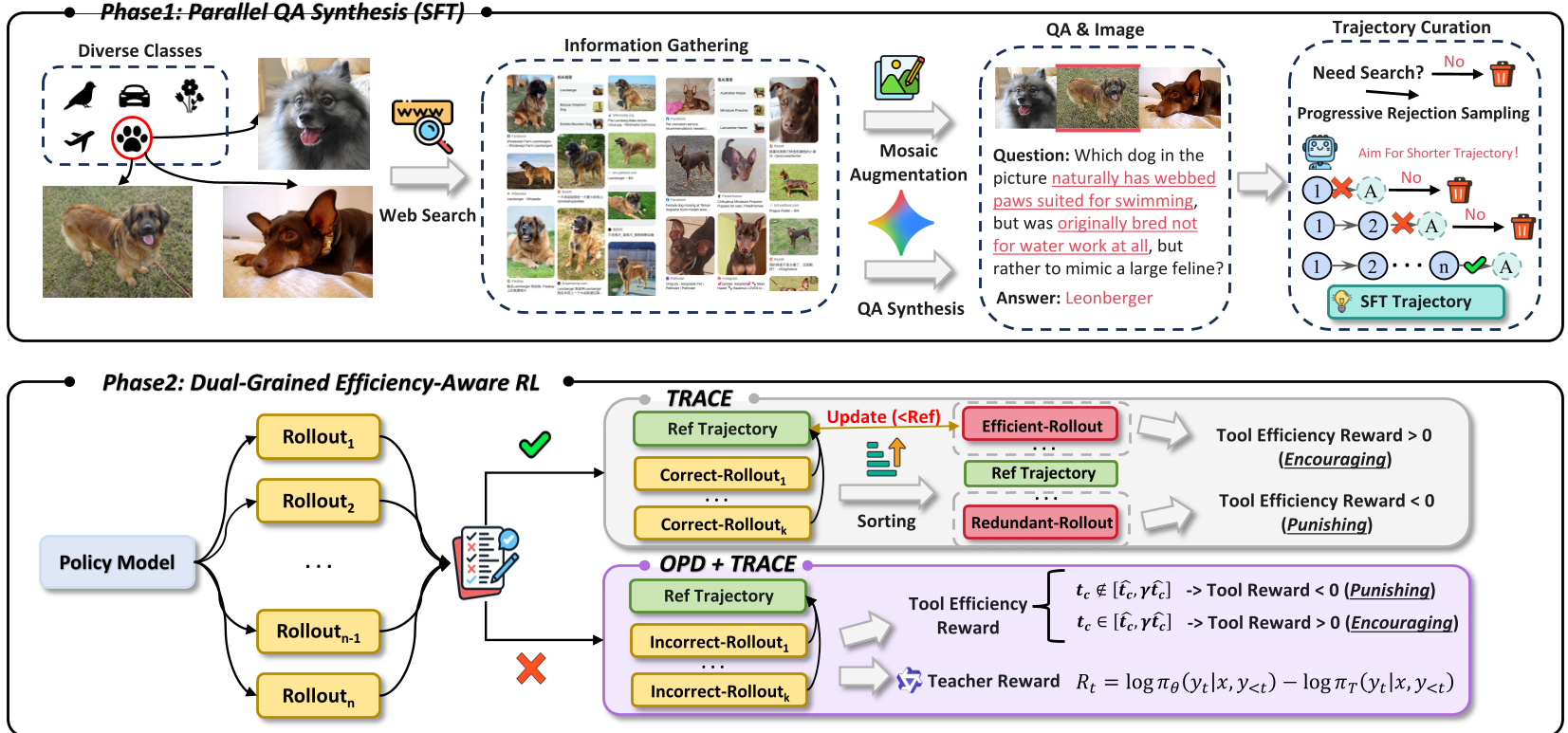 Figure: The HyperEyes training framework, featuring Parallel Data Synthesis and Dual-Grained RL.
2. TRACE: Adaptive Reward Strategy
The most innovative part of HyperEyes is TRACE (Tool-use Reference-Adaptive Cost Efficiency). A common problem in RL for agents is defining what an "efficient" path looks like.
- The Solution: TRACE maintains a dynamic reference threshold that "tightens" as the model improves. If a model finds a way to solve a query in 2 rounds instead of 3, the reward boundary shifts, forcing the model to constantly seek the most compressed path to the truth.
3. On-Policy Distillation (OPD)
Sparse rewards (Success=1, Failure=0) are notoriously bad for credits assignment. HyperEyes uses OPD to inject dense, token-level signals. When a student model (30B) fails, it looks at a "teacher" model (235B) to see which reasoning tokens it should have generated, effectively learning the reasoning patterns of a larger model without its massive compute cost.
Experiments & Results: Pareto Dominance
The authors evaluated HyperEyes across six major benchmarks, including a new human-curated benchmark: IMEB (Image Multi-Entity Benchmark).
 Table: HyperEyes establishes a new SOTA for open-source agents, nearly matching proprietary titans like Gemini-3.1-Pro.
Key Findings:
- Efficiency: HyperEyes-30B requires only 2.2 rounds on average, compared to 11.6 rounds for competing models like VDR.
- Accuracy: Despite fewer search steps, it is 9.9% more accurate.
- Robustness: Analysis showed that HyperEyes is significantly more resistant to "distractor evidence" (fake or irrelevant search results) because its training emphasizes precise, one-shot retrieval over repetitive, noisy cycles.
Case Study: Serial vs. Parallel
In a direct comparison with DeepEyes-V2, HyperEyes solved a complex historical question about six architects in 3 rounds. DeepEyes-V2 took 12 rounds and still got the answer wrong. Why? Because the sequential agent got lost in the weeds of person-by-person searching, while HyperEyes looked at the whole group, identified everyone at once, and focused its remaining "mental energy" on a single, decisive search.
 Figure: Comparison between serial DeepEyes-V2 and parallel HyperEyes on a multi-person reasoning task.
Critical Analysis & Conclusion
Takeaway
HyperEyes proves that for multimodal agents, breadth is more important than length. By grounding multiple entities in parallel, we reduce the chance of cascading errors and keep the context window clean of irrelevant noise.
Limitations
- Teacher Dependency: The OPD stage requires a much larger teacher model from the same family, which might limit its use for researchers who don't have access to 235B+ parameter models.
- Static Modalities: Currently, it focuses on images and text. Extending this parallel logic to video (where temporal grounding is needed) remains a future challenge.
Final Thought: HyperEyes marks a shift toward system-level efficiency in AI agents. It’s no longer enough to just "be smart"; the next generation of agents must be fast, precise, and computationally frugal.